West Nile Virus Confirmed in Mobile County: Sentinel Chicken Tests Positive Near Chickasabogue Park
Sentinel chickens have now tested positive for West Nile virus in the 36605, 36613 and 36575 ZIP code areas of Mobile County, with an additional positive reported in the 36587 area, prompting expanded spraying and testing by Vector Services.
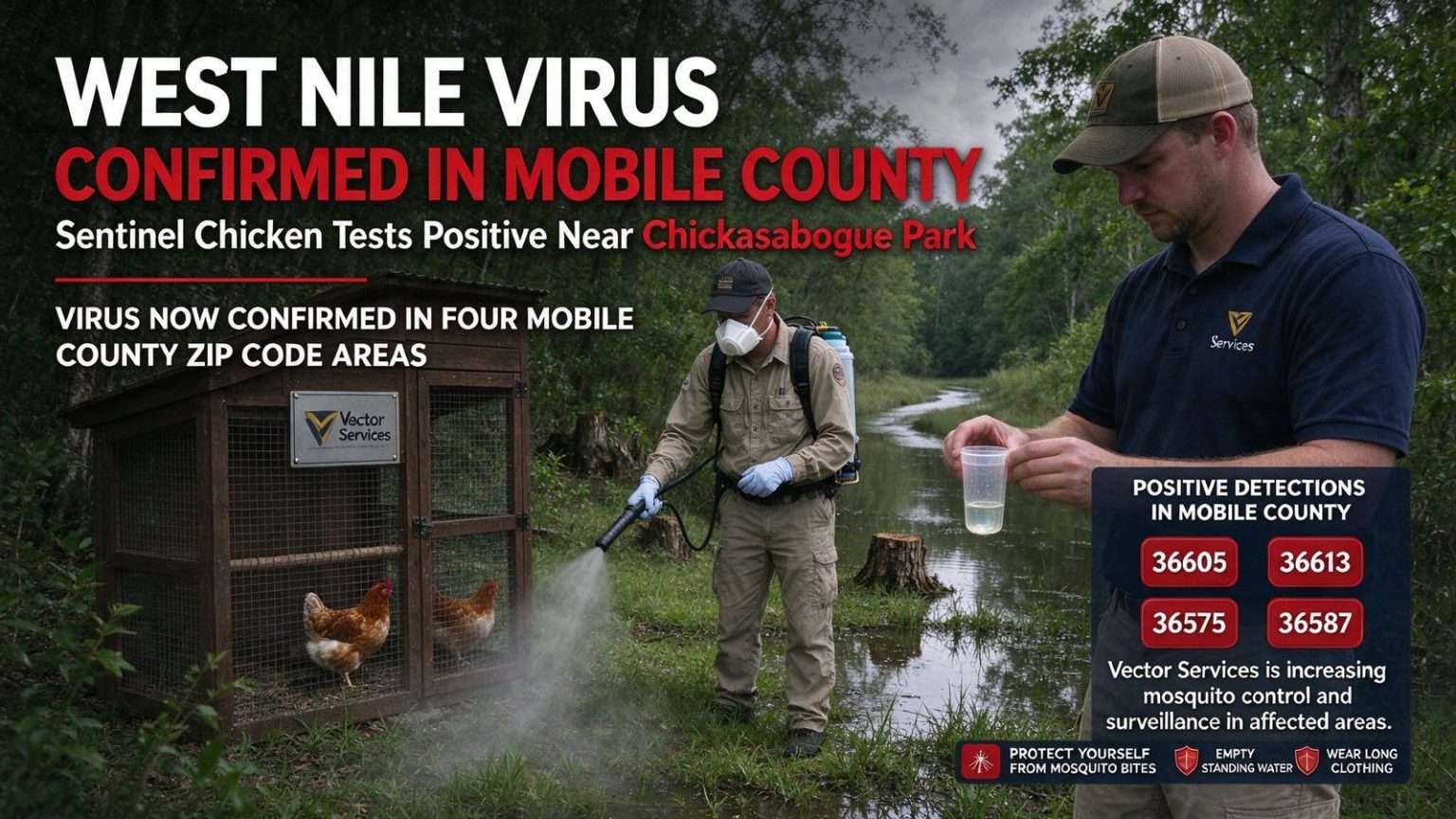
Virus Now Confirmed in Four Mobile County ZIP Code Areas
West Nile virus is circulating in more than one part of Mobile County. Sentinel chickens monitored by the Mobile County Health Department’s Vector Services program have tested positive for the virus in coops located in the 36605, 36613 and 36575 ZIP code areas, and the department has since reported an additional positive test in the 36587 ZIP code area.
The results have been confirmed by laboratory testing, according to Dr. Kevin Michaels, Health Officer for Mobile County.
The first of those detections — the county’s first positive sentinel chicken of the year — came in the 36613 area, which includes Chickasabogue Park. The account below begins with that detection and continues through the additional positives reported since.
The First Detection in Mobile County This Year
West Nile virus is circulating in Mobile County. A sentinel chicken monitored by the Mobile County Health Department’s Vector Services program has tested positive for the virus — the county’s first positive sentinel chicken case this year — in the 36613 ZIP code area, which includes Chickasabogue Park.
“West Nile virus is present in our county, and this detection is an important reminder for residents to protect themselves from mosquito bites,” said Dr. Kevin Michaels, Health Officer for Mobile County. “Vector Services will increase mosquito-control activity in and around the 36613 area, continue monitoring our sentinel chicken flocks, and work to identify mosquito populations that may be carrying the virus.”
The 36613 ZIP code covers a broad swath of northwestern Mobile, including Chickasabogue Park, a heavily used Mobile County recreation area along the Chickasaw Bogue tributary of the Mobile River. The park’s wooded trails, open fields and proximity to tidal creeks make it a popular spot for hiking, horseback riding, picnicking and youth league games — and an environment where mosquitoes can thrive.
What Happens Next in the 36613 Area
The 36613 area falls within three mosquito-spraying routes and has already been treated 19 times this season. Vector Services will conduct additional spraying, door-to-door surveys in nearby neighborhoods, and adult mosquito trapping and testing to track the virus’s spread. The Health Department said crews will work into the early evening hours, when the Culex mosquitoes that carry West Nile virus are most active.
Sentinel chickens serve as an early-warning system: because the virus cycles between birds and mosquitoes, the flocks act as living detectors that confirm where infected mosquitoes are active before human cases appear. Mosquitoes become infected by feeding on infected birds and can then transmit the virus to people, horses and other animals through later bites. When a sentinel chicken tests positive, public health officials know the virus is circulating locally even before any human infections are reported.
Vector Services maintains several sentinel chicken flocks across Mobile County and tests their blood weekly during mosquito season. A positive result triggers stepped-up trapping, spraying and public outreach in the affected zone. Health Department officials said additional test results from nearby coops would be available in the days following the initial confirmation.
Protect Yourself From Mosquito Bites
Residents — especially anyone spending time outdoors — are encouraged to take simple precautions as mosquito activity peaks along the Gulf Coast. Use EPA-registered insect repellent when outside, particularly at dawn and dusk when mosquitoes are most active. Products containing DEET, picaridin, IR3535 or oil of lemon eucalyptus are recommended by the Centers for Disease Control and Prevention.
Empty standing water from buckets, flowerpots, tires, birdbaths, pet bowls, gutters, tarps and outdoor containers — mosquitoes can breed in very small amounts of water. Even a bottle cap full of stagnant water can produce dozens of larvae within a week. Homeowners are urged to walk their yards at least once a week and overturn anything that can hold rainwater.
Keep screens on windows and doors in good repair. Wear long sleeves and pants during peak mosquito hours. For families with young children, infant netting over strollers and cribs offers additional protection during outdoor time, and local pediatricians recommend avoiding scented lotions and bright clothing that can attract mosquitoes.
Symptoms to Watch and When to Seek Care
Most people infected with West Nile virus never develop symptoms. Some experience fever, headache, body aches, nausea, vomiting or rash that may last several days to weeks. Because the early signs can resemble a summer cold or flu, doctors recommend that anyone with sudden fever and neurological symptoms after a mosquito bite contact their health care provider.
In rare cases the virus causes serious neurologic illness — high fever, severe headache, stiff neck, confusion, muscle weakness, tremors, paralysis or seizures — and anyone with severe symptoms should seek medical care promptly. Older adults, people with weakened immune systems and those with chronic medical conditions face a higher risk of developing the more serious neuroinvasive form of the disease. Hospitalization and supportive care are the standard treatments, as there is no specific antiviral medication for West Nile virus.
The virus does not spread person-to-person or from horses to people; horses can be vaccinated, but no human vaccine exists. Pet owners should consult their veterinarians about vaccinating horses and, in some cases, dogs that spend significant time outdoors, since canine cases — while uncommon — have been reported in the South.
Why Late Summer Is the Riskiest Stretch
The risk from mosquito-borne encephalitis viruses is generally greatest from August until the first fall freeze, making late summer the most important stretch for personal protection across coastal Alabama. Warm nights, high humidity and frequent afternoon thunderstorms create ideal breeding conditions for Culex mosquitoes, the primary carriers of West Nile virus in the southeastern United States.
Mobile County’s long mosquito season — typically running from late March through November — means Vector Services remains on alert well after cooler weather arrives farther north. Coastal Alabama residents often see mosquito activity linger into early December in mild years, and public health officials emphasize that personal precautions should continue until sustained cold weather has shut down local mosquito populations.
About Mobile County’s Vector Services Program
The Mobile County Health Department’s Vector Services program has tracked West Nile virus through sentinel chicken flocks for decades, providing one of the earliest and most reliable indicators of virus activity in the region. Program staff collect blood samples weekly from coops placed in strategic locations across the county, then send the samples to a state laboratory for analysis.
When a positive sample appears, Vector Services activates its response plan, which includes targeted adult mosquito spraying using truck-mounted ultra-low-volume equipment, expanded larval control in standing water, and door-to-door canvassing to identify and remove breeding sites near residential areas. The program also accepts service requests from residents who report standing water or unusually heavy mosquito activity.
Residents who want to report standing water, request mosquito spraying or learn more about the program can contact the Mobile County Health Department’s Vector Services office. The Health Department also publishes weekly arboviral activity updates, including positive sentinel chicken results and any human cases, on its website during mosquito season.
Protecting Outdoor Workers and Recreation Hubs
Chickasabogue Park and the surrounding 36613 area attract a steady stream of outdoor enthusiasts, youth league athletes and workers who spend long hours outside. Public health officials urge these groups in particular to make repellent use routine and to check themselves and family members for bites after outdoor activity. Coaches and league organizers are encouraged to build bug-spray breaks into practices and games held near dawn or dusk.
Construction crews, landscapers, public works employees and agricultural workers across Mobile County should also follow workplace mosquito-protection guidelines issued by the Alabama Department of Public Health. These include wearing permethrin-treated clothing where appropriate, keeping break areas clear of standing water, and reporting large numbers of biting mosquitoes to local supervisors and Vector Services.
Reporting Mosquito Problems in Mobile County
Residents who notice large numbers of mosquitoes, abandoned swimming pools, derelict containers or other potential breeding sites can report them to Vector Services through the Mobile County Health Department’s online portal or by phone. Service requests help crews prioritize spraying routes and identify areas where standing water may be producing thousands of adult mosquitoes per day.
Property owners are reminded that under Mobile County ordinances, standing water that poses a public health risk can be addressed through code enforcement if the property owner fails to act. Vector Services staff can coordinate with code officers to gain access to abandoned or neglected properties where breeding is suspected, an important step when positive West Nile samples point to a specific neighborhood.
Staying Updated Throughout the Season
The Health Department will continue releasing updated arboviral surveillance reports as the season progresses. Residents are encouraged to follow the Mobile County Health Department on social media and to check its website for weekly summaries that include any new sentinel chicken positives, mosquito pool results and human cases across the county.
For the latest local information on mosquito-borne illness, residents can also contact their primary care provider, local pharmacies or the Mobile County Health Department directly. Early recognition of symptoms and prompt medical attention remain the most important tools for preventing serious outcomes from West Nile virus infection. Local hospitals, including Mobile’s major health systems, are prepared to test for and treat suspected neuroinvasive cases throughout mosquito season, with reporting requirements that help public health officials track the virus across county lines and neighboring jurisdictions along the Gulf Coast.
Mobile County residents heading to coastal areas in Baldwin County, the Florida Panhandle or Mississippi should remember that mosquito precautions apply wherever they travel along the northern Gulf Coast, where similar species and similar conditions exist. Applying repellent, wearing protective clothing and emptying standing water at vacation rentals and beach houses remain simple steps that protect both visitors and the residents of any community they visit.
Latest: Additional Positive Test Reported in the 36587 Area
The Mobile County Health Department has reported an additional positive sentinel chicken test, this one in the 36587 ZIP code area.
With that detection, sentinel coops monitored by the department’s Vector Services program have now tested positive in the 36605, 36613, 36575 and 36587 ZIP code areas, confirming that West Nile virus is circulating in multiple parts of Mobile County rather than in a single localized pocket.
“West Nile virus is present in our county, and this detection is an important reminder for residents to protect themselves from mosquito bites,” said Dr. Kevin Michaels, Health Officer for Mobile County. “Vector Services will increase mosquito-control activity in and around these areas, continue monitoring our sentinel chicken flocks, and work to identify mosquito populations that may be carrying the virus.”
Vector Services will conduct additional spraying, door-to-door surveys in nearby areas, and adult mosquito trapping and testing in response to the new detection.
What Multiple Positive Areas Indicate
A single positive sentinel bird confirms the virus is present at one monitored site. Positives across several separated ZIP codes indicate broader circulation in the local mosquito population, which is why the department’s response expands geographically rather than concentrating on one neighborhood.
The precautions remain the same throughout the county: use an EPA-registered repellent, wear long sleeves and long pants outdoors around dawn and dusk, stay in places with air conditioning or intact screens, and empty, cover, clean or treat any container holding standing water. Mosquitoes can breed in very small amounts of water — in buckets, flowerpots, tires, birdbaths, pet bowls, gutters and tarps.
Risk from mosquito-borne encephalitis viruses is generally greatest from August until the first fall freeze.