Mobile County Health Department Sets Seven September Rabies Clinics; Shots Are $15, Cash Only
Drive-through clinics run each Saturday in September across Mobile County, from the city animal shelter to Chunchula and Mount Vernon. The department vaccinated 3,261 pets in 2025.
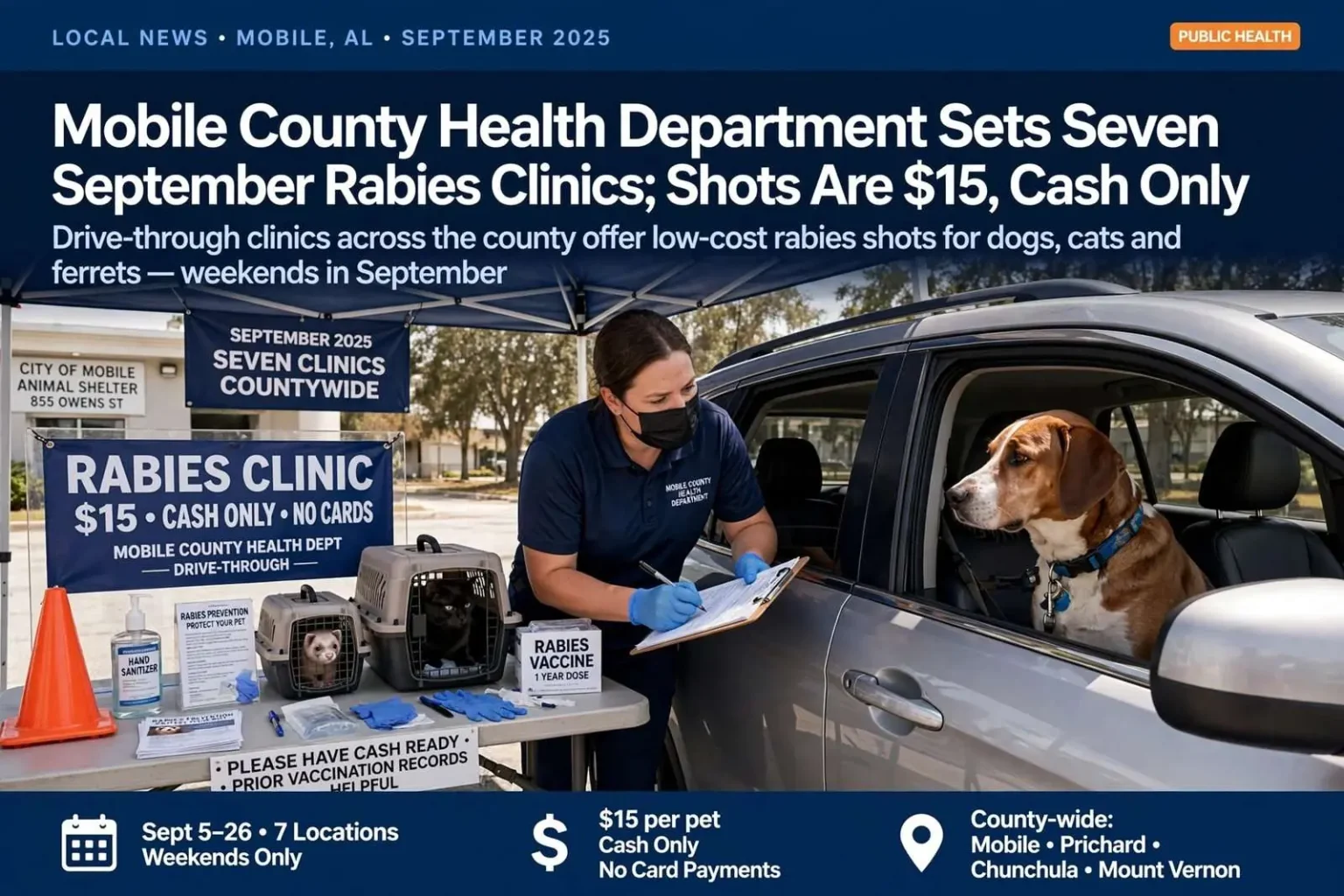
MOBILE, Ala. — The Mobile County Health Department provides low-cost rabies shots for dogs, cats and ferrets — good for one year — during weekend clinics held across the county.
The September Schedule
Saturday, Sept. 5, 10 a.m. to noon — City of Mobile Animal Shelter, 855 Owens Street in Mobile.
Saturday, Sept. 12, 10 a.m. to noon — Mobile County Animal Shelter, 7665 Howells Ferry Road in Mobile.
Saturday, Sept. 12, 1 to 3 p.m. — Pet Supplies Plus, 803 Hillcrest Road in Mobile.
Saturday, Sept. 19, 8 a.m. to noon — Eddie Smith’s Country Store, 14045 Celeste Road in Chunchula.
Saturday, Sept. 19, 1 to 3 p.m. — Mount Vernon Feed & Seed, 19395 Highway 43.
Saturday, Sept. 26, 9 a.m. to noon — Prichard Animal Shelter, 2402 North Rebel Road.
Saturday, Sept. 26, 1 to 3 p.m. — B&B Pet Stop, 5035 Cottage Hill Road in Mobile.
How the Clinics Work
All of these events are drive-through clinics, with one exception: the clinic at B&B Pet Stop, where the owners host the event “on the front porch” of the facility.
The cost of the rabies vaccine is $15 per pet. All rabies shots are payable in cash — a detail worth noting before leaving home, since no card option is offered.
The drive-through format keeps animals in vehicles until their turn, which reduces stress for pets and avoids the crowding that a walk-up line can create when a dozen dogs and cats arrive at once.
Geographic Spread
The September schedule deliberately covers different parts of the county rather than concentrating in the city. Clinics in Chunchula and Mount Vernon serve north Mobile County residents for whom a trip to a Mobile shelter is a substantial drive, while the Prichard, Hillcrest Road and Cottage Hill Road sites cover different quadrants of the metro area.
That distribution reflects the practical reality that a low-cost vaccination program only works if it is genuinely accessible. A $15 vaccine at a location 40 minutes away is not low-cost for a household counting fuel.
Why the County Does This
The state of Alabama tasks local health departments with providing affordable rabies vaccinations to pet owners. Each month, the health department’s Rabies Officer offers low-cost vaccines for pet dogs, cats and ferrets at a variety of locations.
The Rabies Officer provided 264 vaccinations in August — 186 dogs and 78 cats. In 2025, the officer vaccinated 3,261 household pets: 2,585 dogs, 675 cats and one ferret.
Those figures represent thousands of animals that might otherwise go unvaccinated, and each one is a break in the chain between wildlife rabies reservoirs and human exposure.
What Rabies Is
Rabies is a virus that attacks the central nervous system. It is transmitted from infected mammals to humans and is fatal once symptoms appear.
Symptoms include unusual behavior, irritability, headache, fever, inability to eat or drink, balance problems, circling, seizures, coma and, finally, death. All warm-blooded mammals, including humans, are susceptible.
The phrase “fatal once symptoms appear” is the reason the vaccination programs exist. There is effectively no treatment after the onset of symptoms in an unvaccinated animal or person — the entire public health strategy rests on prevention and on post-exposure treatment administered before symptoms develop.
The Quarantine Consequence
Vaccination status also determines what happens after a bite. An unvaccinated pet that bites someone, or that is bitten by a wild animal, faces far more restrictive quarantine requirements than a currently vaccinated animal — a practical consequence that turns a $15 vaccine into meaningful protection for an owner as well as a pet.
A Rabies Quarantine Fact Sheet is available through the Alabama Department of Public Health.
What to Bring
Pet owners should bring cash for the $15 fee, and any prior vaccination records they have, so the certificate issued reflects an accurate history. Dogs should be leashed and cats and ferrets in carriers when the vehicle window comes down.