Alabama Forestry Commission Timber Damage Estimate From Isaias Tops $33.5 Million
A preliminary Alabama Forestry Commission survey estimates Hurricane Isaias damaged more than 2.5 million tons of timber worth over $33.5 million, mostly in Conecuh, Escambia and Monroe counties.
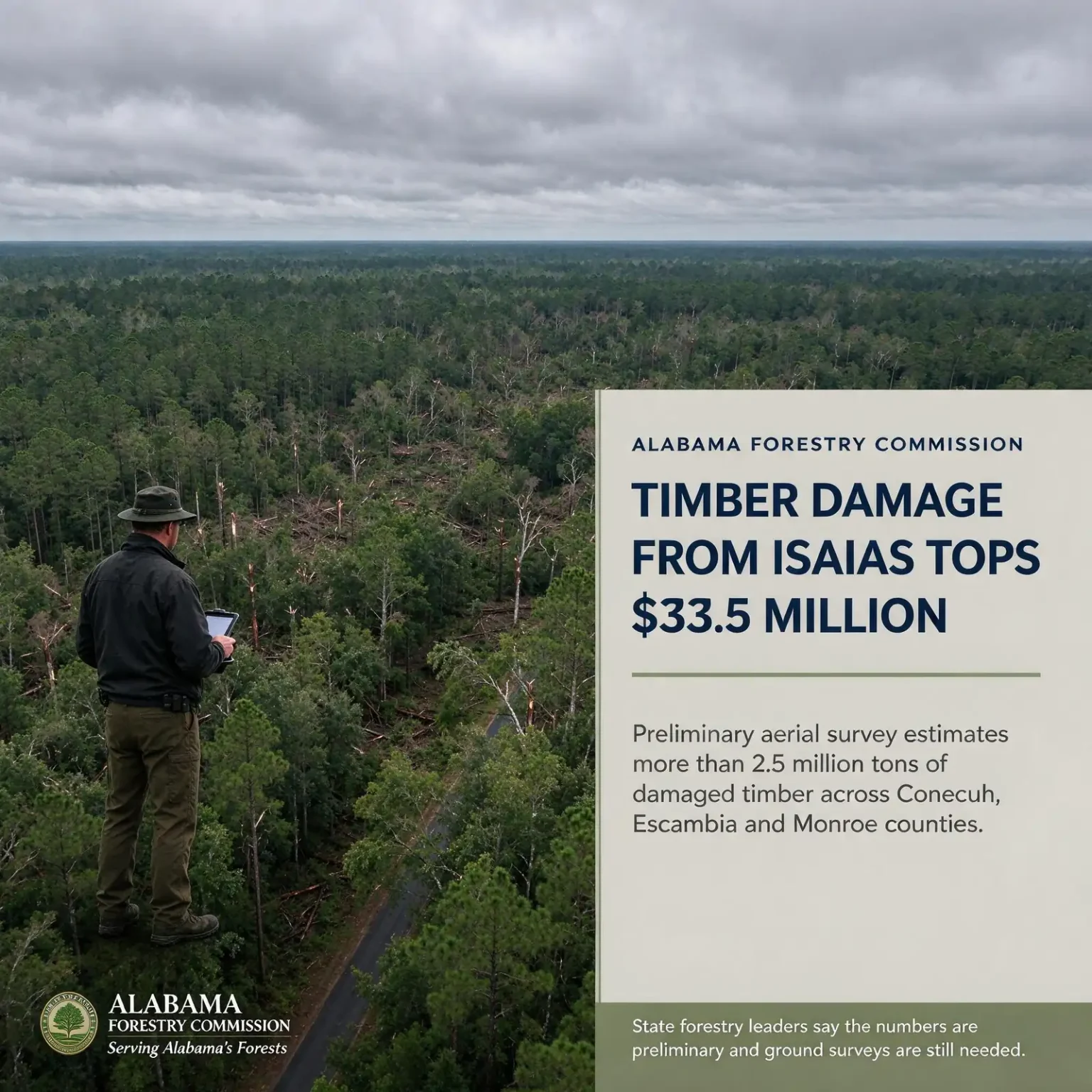
MONTGOMERY, Ala. — Hurricane Isaias damaged more than 2.5 million tons of Alabama timber worth upward of $33.5 million, according to a preliminary Alabama Forestry Commission timber damage estimate released after an aerial survey of the hardest-hit parts of southwest Alabama.
The Alabama Forestry Commission, known as the AFC, shared the figures publicly this week. The early assessment centered on Conecuh, Escambia and Monroe counties, where the storm’s winds cut a long path through private forestland a little more than a week ago.
State forestry leaders stressed that the numbers are a first look, not a final tally. Ground surveys will still be needed to confirm the extent of the losses, but the estimate offers the clearest picture yet of how the storm hit one of the region’s most important economic resources.
A 36-Mile Path Through South Alabama Forests
AFC pilots flew an aerial survey on Tuesday, Oct. 13, four days after the storm made landfall. From the air, they mapped a damaged area roughly 36 miles long and as much as seven miles wide.
Within that footprint, the commission identified 154,783 acres in the impacted area. Of that total, 64,795 acres were classified as forestland, and another 40,805 acres were classified as woody wetlands.
Here is a breakdown of the preliminary figures released by the AFC:
- Timber damaged: More than 2.5 million tons
- Estimated value: More than $33.5 million
- Damage path: About 36 miles long and up to 7 miles wide
- Total acres in the impacted area: 154,783
- Forestland acres: 64,795
- Woody wetland acres: 40,805
- Counties in the initial assessment: Conecuh, Escambia and Monroe
The survey focused on the areas that took the brunt of the storm. Damage outside those three counties was not part of this initial assessment, so the overall figures could change as more information comes in.
The distinction between forestland and woody wetlands matters. Forestland generally includes the upland pine and hardwood stands that landowners manage and harvest for timber, while woody wetlands are low-lying, wooded areas such as swamps and river bottoms. Wind damage in both types of terrain can affect wildlife habitat, water flow and future management decisions, but salvaging timber from wet bottomlands is often more difficult than working on higher ground.
Together, the forestland and woody wetland acreage make up a little more than two-thirds of the land inside the mapped damage path. The remainder of the impacted area falls into other land classifications.
Three Counties at the Center of the Damage
Conecuh, Escambia and Monroe counties sit side by side in southwest and south-central Alabama, and all three are heavily wooded and deeply tied to the timber economy. Conecuh County’s seat is Evergreen, Escambia County’s seat is Brewton and Monroe County’s seat is Monroeville.
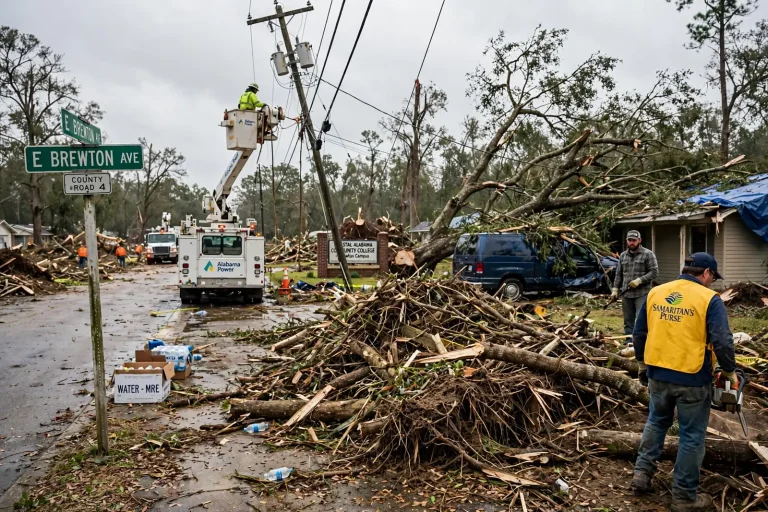
In those communities, the storm’s effects on forests are felt alongside damage to homes, businesses and power lines. In Escambia County, for example, residents spent the week after the storm hauling limbs and trunks to the roadside while crews worked to restore electricity, especially in rural areas.
State Forester: Losses ‘Devastating’ for Landowners
Alabama State Forester Rick Oates said that while the damage could have been worse, the impact on landowners is severe.
“While we are thankful the damage was not as extensive as it could have been, these losses are still devastating for Alabama landowners,” Oates said. “Growing timber is a long-term investment, requiring decades of hard work, careful management and financial commitment. In a matter of hours, a storm can destroy what landowners have spent much of their lives building.”
His point captures why timber losses can be so painful. Unlike an annual crop that can be replanted next season, a stand of pine or hardwood may take decades to reach market size. A family that planted trees as a long-term investment, or as something to pass to the next generation, can see that plan disrupted in a single night.
Forestry is a major part of the economy in southwest Alabama, and the state as a whole has roughly 23 million acres of timberland, according to state forest resource data. In rural counties such as Conecuh, Escambia and Monroe, timber supports landowners, loggers, truckers, mills and the many local businesses that depend on them.
How the Forestry Commission Put a Price on the Damage
To turn aerial observations into dollar figures, the AFC relied on data from the most recent Forest Inventory and Analysis report. The Forest Inventory and Analysis program, run by the U.S. Forest Service in partnership with state agencies, tracks the condition, volume and makeup of the nation’s forests. AFC staff help gather data for that report and compile it each year.
AFC Forest Health Coordinator Drew Metzler said that existing inventory gives the commission a baseline to work from when disaster strikes.
“Forest inventory data gives us a picture of Alabama’s timber resources long before a storm ever develops,” Metzler said. “By combining that information with what we’re seeing from the air, we can begin to understand the extent of the damage and put a dollar value on the losses. It’s one of the reasons maintaining accurate forest inventory data is so important.”
In practice, that means foresters can estimate how much timber typically stands on an acre of a given forest type in a given area, then apply what they observed from the air to the acreage inside the damage path. The result is a reasonable early estimate, though it cannot account for every individual stand.
Aerial surveys have clear advantages after a storm. Pilots and observers can cover a wide area quickly, spot the boundaries of the worst damage and help agencies decide where to send ground crews first. Some details, however, are hard to judge from above, such as whether standing trees have hidden breaks, cracked trunks or root damage that will lower their value.
That is why the commission described its numbers as preliminary. Additional ground surveys will be needed to verify the data, and the final picture could look different once crews inspect damaged stands up close.
Hurricane Isaias’ Track Across Alabama
Hurricane Isaias made landfall near Destin, Fla., on the evening of Friday, Oct. 9, with maximum sustained winds of 105 mph. The storm moved quickly inland after landfall.
By 1 a.m. Saturday, Oct. 10, the center of the fast-moving system was about 55 miles south-southwest of Montgomery, and its maximum sustained winds had dropped to 65 mph. That rapid northward movement carried damaging winds well inland, through the timber-rich counties of southwest and south-central Alabama.
Fast-moving storms can bring strong winds far from the coast before they have time to weaken, which helps explain why counties such as Conecuh, Escambia and Monroe, all well inland from the Gulf, saw such significant forest damage.
Forestry Crews Also Helped With Storm Response
The AFC’s work after Isaias went beyond counting damaged trees. Commission personnel also helped with emergency response efforts in southwest Alabama in the days after the storm.
AFC employees helped deliver water, food and tarps to communities affected by the hurricane. Saw crews from the commission also helped clear nearly 100 miles of roads, opening routes for residents, utility workers and emergency responders.
That road-clearing work is a familiar role for forestry agencies after major storms, since their crews are trained and equipped to handle downed trees safely.
What Timber Landowners Should Know Now
For landowners in Conecuh, Escambia, Monroe and surrounding counties, the days and weeks ahead will involve important decisions about damaged stands. While every property is different, there are several general steps landowners commonly take after a major wind event:
- Put safety first. Downed and leaning trees, hung-up limbs and snapped trunks can be extremely dangerous. Avoid entering heavily damaged stands until it is safe to do so.
- Document the damage. Photographs, maps and notes on the condition of stands can be useful for insurance, tax and management purposes.
- Seek professional advice. A consulting or registered forester can help assess damage, estimate remaining value and plan any salvage harvest. The AFC also offers assistance to landowners through its offices across the state.
- Consider timing. Foresters generally note that storm-damaged timber, especially pine, can lose value as it deteriorates, so landowners often weigh whether and when to salvage.
- Talk to a tax professional. Timber losses from a casualty such as a hurricane may have tax implications, and a qualified advisor can explain the options.
Landowners should be cautious with anyone offering to buy damaged timber without a clear written contract. Working with a trusted forester and understanding the value of a stand before signing an agreement can help protect a significant investment.
What Comes Next
The AFC’s next step is to verify its preliminary findings on the ground. Those surveys will help confirm how much timber was damaged, how much may be salvageable and whether the dollar estimate needs to be revised up or down.
For the communities of southwest Alabama, the timber losses add another layer to a recovery that already includes damaged homes, power outages and roadside debris. The forestry estimate offers a reminder that the storm’s financial toll will continue to be counted for some time, long after the last debris pile is hauled away.
Landowners with questions about storm-damaged timber can contact the Alabama Forestry Commission or a local forestry professional for guidance as assessments continue.