Citronelle-Area ATV Crash Claims Life of 25-Year-Old Mobile County Man
A 25-year-old Mobile County man died at USA Medical Center days after an ATV wreck on West Coy Smith Highway near Citronelle, state troopers report.
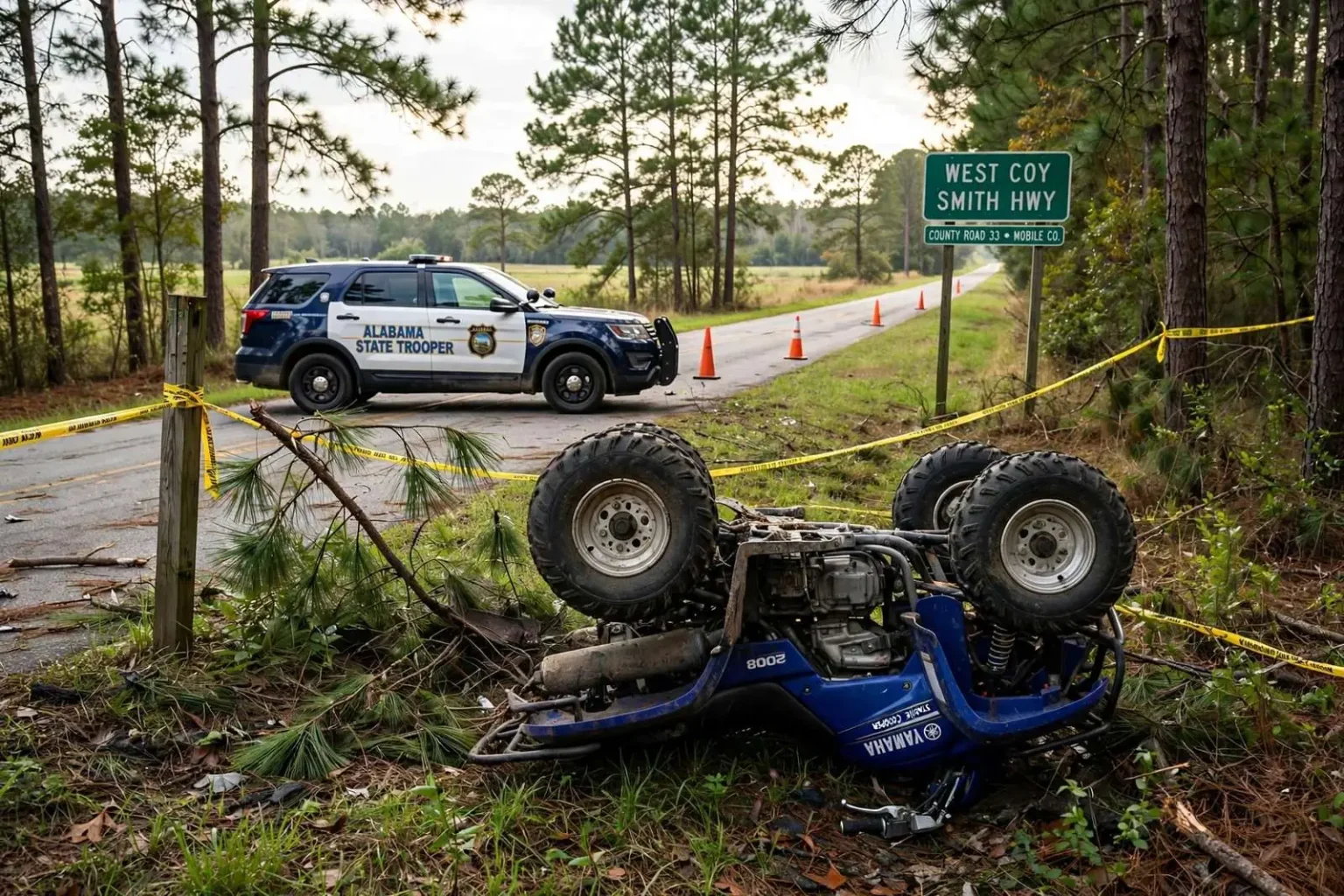
A single-vehicle all-terrain vehicle wreck outside Citronelle has claimed the life of a 25-year-old Mobile County man, according to information released by Alabama State Troopers. The crash added another name to the year’s count of ATV fatalities across south Alabama’s rural counties, where off-road vehicles share a landscape of narrow highways, farm roads and wooded acreage that leaves little margin for error.
What troopers say happened
Authorities identified the victim as Wilbur Weaver of the Citronelle area. Troopers say Weaver was operating a 2008 Yamaha ATV on West Coy Smith Highway, roughly five miles east of Citronelle, when the vehicle crashed shortly after 3 p.m. on a Sunday afternoon in late August. The mid-afternoon hour meant the crash occurred in daylight on a stretch of road that sees regular farm and recreational traffic on weekends.
Weaver was rushed to USA Medical Center in Mobile, where he remained for several days before succumbing to his injuries. The University of South Alabama Medical Center serves as the region’s major trauma facility, and patients injured in serious crashes across Mobile County’s rural northern reaches are routinely transported there — a drive that can take the better part of an hour by ambulance from the Citronelle area under normal conditions.
Troopers noted that Weaver was not wearing a helmet at the time of the crash, a detail investigators often cite when reviewing ATV-related fatalities in rural Mobile County. Head injuries remain the leading cause of death in ATV crashes nationwide, and troopers record helmet use in crash reports not as an accusation but as a data point that recurs with grim consistency in fatal cases.
The road and the terrain
West Coy Smith Highway is a narrow, two-lane rural route that winds through wooded and farm acreage northeast of Citronelle, an area where ATVs are commonly used for recreation, hunting access, and property work. Roads of that type present a particular hazard for all-terrain vehicles, which are designed for off-road use: their low-pressure knobby tires, short wheelbases and handling characteristics make them unstable on pavement at speed, and drivers of standard vehicles do not always expect to encounter an ATV sharing the lane.
As of this report, the Alabama Law Enforcement Agency’s Highway Patrol Division had not released additional findings on what caused the ATV to leave the roadway or overturn. Troopers said the investigation remained open, and no further details were immediately available. Single-vehicle ATV crash investigations typically turn on factors that take time to document — road surface conditions, vehicle condition, speed and whether another vehicle was involved in forcing the ATV off the road.
Citronelle and its off-road landscape
Citronelle, in far northern Mobile County near the Washington County line, sits along a network of rural highways where all-terrain vehicles are frequently driven both on private land and, at times, on public roads and shoulders. The community of roughly four thousand residents anchors the northern edge of the county, an hour’s drive from downtown Mobile through pine forests, creek bottoms and farmland that draw hunters, riders and outdoor families throughout the year.
Local emergency responders in the area, including Citronelle volunteer fire and rescue units, are often the first on scene for ATV and off-road vehicle incidents given the rural terrain and limited highway access in the region. Volunteer departments in north Mobile County cover wide territories with limited staffing, and the minutes between a crash and the arrival of trained responders — followed by the longer transport to a trauma center in Mobile — are a decisive factor in how injuries that begin as survivable end.
A persistent safety problem in rural Alabama
ATV fatalities remain a persistent safety concern across South Alabama’s rural counties. The terrain that makes the region attractive to riders — long seasons, open land, mild winters — also produces a steady toll, particularly among adult riders who grew up around the vehicles and treat helmet use as optional. State and national crash data alike point to the same patterns: riders on paved roads, riders without helmets, and riders operating at speeds the terrain does not forgive account for the overwhelming share of deaths.
Safety advocates and state troopers have repeatedly urged riders to wear helmets and eye protection, avoid paved highways designed for standard vehicle traffic, and never operate ATVs at high speed on unfamiliar terrain. The recommendations sound basic, but they run against decades of habit in communities where children learn to ride before they learn to drive and where an ATV is as often a work tool as a toy. Riders on farms use the machines to check fences, haul feed and reach hunting stands, and the trips are short and familiar — precisely the conditions in which caution erodes.
Alabama does not require helmet use for adult ATV riders on private property, but troopers frequently note in crash reports whether a helmet was worn, given the strong correlation between head injuries and ATV fatalities in cases where riders go without one. The state’s rules for public-road operation are stricter — all-terrain vehicles are generally not legal for on-road travel — yet enforcement on lightly traveled rural highways is difficult, and the practice of riding short distances along road shoulders remains common across the region.
What happens next
No further information about funeral or memorial arrangements was available at the time of this report. Alabama State Troopers said they would release additional details if the ongoing investigation turns up new information about the cause of the crash. Until then, the circumstances that investigators can document — the narrow two-lane road, the Sunday-afternoon hour, the helmetless rider — form a picture familiar to anyone who has tracked ATV fatalities in the rural Gulf South.
For families in Citronelle and the surrounding communities, the crash lands as a local loss with a familiar shape: a young man from the area, injured on a road neighbors drive daily, and treated at the trauma center an hour south before the injuries proved fatal. Rural volunteer responders across north Mobile County will tell you the geography is the hard part — distance, not intent, is what stands between many crash scenes and the care that makes a difference.
A regional pattern
The events described in this report connect to broader patterns across the Gulf Coast region, where rural counties continue to balance an outdoor way of life with the realities of emergency response and road safety. Local institutions, government agencies, and community organizations all play roles in addressing these issues — from troopers documenting helmet use and road type in their reports, to volunteer departments training for remote crash scenes, to families making decisions about helmets and riding habits at home.
The outcomes of these efforts will shape the region’s future development and resilience. Every fatality report that notes a missing helmet and a paved two-lane road is a data point in a conversation rural Alabama has been having for years, and the answers — education, enforcement, and habits changed one household at a time — will determine whether the toll continues.
Understanding ATV risk on rural roads
The engineering mismatch between an ATV and a paved highway explains much of the danger. All-terrain vehicles ride on wide, low-pressure tires designed to grip soft ground; on asphalt, that same tread contacts the road with less grip and makes the machine harder to steer precisely. Add a narrow two-lane road with soft shoulders, ditches close to the pavement edge and curves that limit sight lines, and the margin for a rider’s mistake shrinks to a few feet. When an ATV drops a wheel off the pavement at speed, the rut and the shoulder gradient often do the rest, flipping the machine before a rider can correct.
Injury patterns follow the same logic. ATV crashes frequently produce ejections, and the injuries that kill are disproportionately to the head and chest. That is why trauma physicians and troopers alike keep returning to helmet use: the machines offer no enclosure, no restraint, and no crumple zone, so the protection a rider wears is the only protection there is. Studies of ATV deaths nationally have repeatedly found that a majority of riders killed were not wearing helmets, and rural crash reports across Alabama read the same way.
The Sunday-afternoon timing of this crash is also typical. Recreational riding peaks on weekends, when landowners and visitors take machines out after a week of work, and traffic on rural highways — including the standard vehicles that share them — peaks at the same hours. Response times stretch on weekend afternoons as well, when volunteer departments are drawing from a smaller pool of members who may be scattered across the county rather than gathered at a station.
The response network in north Mobile County
The trip from a crash scene near Citronelle to a hospital bed in Mobile traces one of the longest routine emergency transports in the county. First responders from the volunteer units that serve the area can typically reach a scene quickly by local standards, but stabilizing an injured rider in a field or on a road shoulder is only the first leg; the transport south to USA Medical Center, or a rendezvous with a helicopter ambulance when weather and landing zones allow, consumes the critical minutes that trauma care depends on. Residents of the area know the geography well — it is part of why the community places real value on its volunteer fire and rescue services, whose members train for exactly these scenes.
As the investigation continues, troopers will document the factors that crash reconstructions rely on: skid marks or their absence, the final resting position of the machine, the condition of the roadway edge, and interviews with anyone who saw the ATV before the crash. Those findings will not change the outcome for Wilbur Weaver’s family, but they become part of the record that safety officials in the region draw on — and for the riders of north Mobile County, the report will land as one more account of a familiar machine, on a familiar road, ending in the worst way.