Evening Budget Hearing Set as Mobile Council Weighs Retiree Health, Nonprofit Cuts
Mobile's City Council moved its 2015 budget hearing to evening hours, expecting a large turnout over retiree health and nonprofit funding cuts.
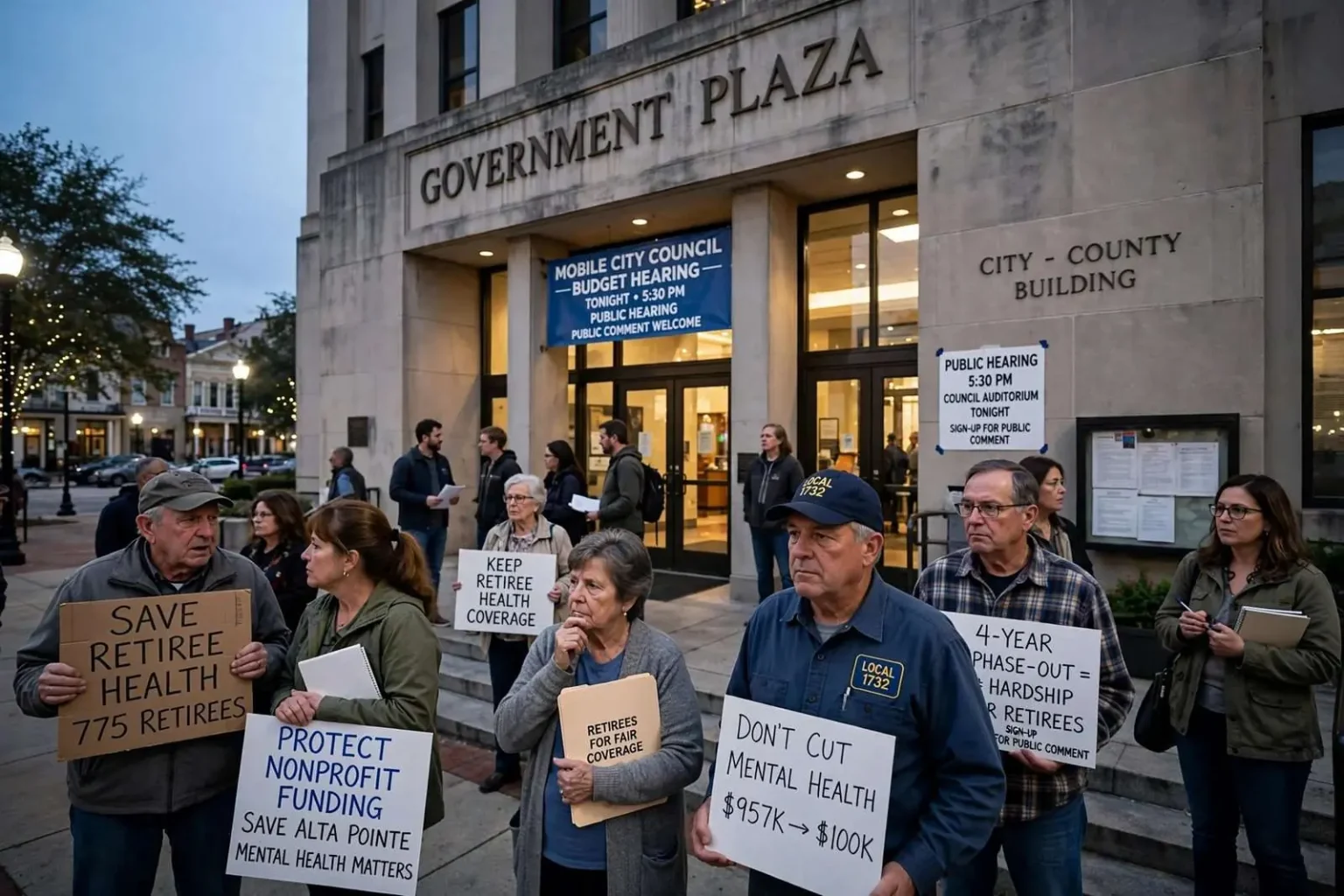
Mobile city officials rearranged their usual Tuesday schedule this week, shifting a required public hearing on the 2015 city budget into the evening in anticipation of a packed house at Government Plaza. Rather than convening during the traditional mid-morning slot, the council’s regular meeting and the budget hearing that followed it were both pushed later in the day, giving working residents a better chance to attend and speak.
Council President Gina Gregory said the hearing would follow the same format as any other public hearing, with the only real change being the timing. The regular council meeting was set to begin in the Government Plaza auditorium at 4 p.m., without the usual morning pre-conference session, followed by the formal budget hearing at 5:30 p.m.
Speakers were expected to be given five minutes each, with organizers pledging to hear from everyone who signed up. The pledge mattered given the volume of interest: two issues were expected to dominate public comment, and both touch thousands of people connected to city government. Proposed cuts to performance contracts awarded to nonprofit organizations ranked first, followed closely by sweeping changes to retiree health insurance.
A schedule built around the public
City council meetings in Mobile traditionally unfold in a mid-morning block, a rhythm that works well for staff, department heads and regular watchers of local government but that can shut out residents who work daytime hours. An annual budget hearing is the single most consequential public comment session on the city’s calendar, since it helps determine taxes, services and payrolls for the coming year, and it has historically drawn some of the largest crowds of any agenda item. Moving it to the evening is an acknowledgment that the people most affected by budget decisions are often the least able to leave a job at mid-morning to speak about them.
Government Plaza, the shared city-county building on Government Street downtown, houses the council auditorium where the session was to take place. The building has hosted years of contentious budget debates, and officials planned for a similar turnout this time. The decision to skip the usual pre-conference session also freed the calendar so the evening could be devoted to the budget rather than routine consent-agenda business.
The timing carries procedural weight beyond convenience. The fiscal year 2015 budget was set to take effect Oct. 1, giving the council a tight window to finalize the numbers after the public hearing. State law requires municipalities to adopt a budget before the fiscal year begins, which leaves little slack for extended debate once public input has been collected. Council members had already worked through departmental requests and revenue projections in earlier work sessions; what remained was to hear directly from residents and adjust the proposal before a final vote.
City officials said updates from the evening session would be shared as the meeting progressed, giving residents who couldn’t attend in person a way to follow the outcome of both the regular meeting and the budget discussion that followed. That running commentary marked a shift toward real-time transparency for a process that has often played out in a single afternoon, recorded only in minutes published days later.
Retiree health insurance takes center stage
On the retiree side, the city’s proposed budget would phase out coverage for Medicare-eligible retirees over four years, replacing it with a $175 monthly subsidy intended to help roughly 775 eligible retirees purchase supplemental coverage on their own. Instead of remaining on the city’s group health plan after turning 65, those retirees would take the subsidy and shop for their own Medicare supplement or Medicare Advantage policy on the private market.
City officials have framed changes like this as a way to rein in long-term liabilities that grow as health costs climb faster than tax revenue. Group coverage for Medicare-eligible members is expensive to maintain because the pool shrinks each year while claims costs continue to rise. A fixed subsidy caps the city’s exposure, since the payment is the same regardless of medical inflation, but it transfers the risk of future premium increases to the retiree.
For the roughly 775 retirees affected, the math will vary widely. A basic Medicare supplement can be obtained for less than the subsidy covers in some cases, particularly for younger, healthier beneficiaries who shop lower-cost plans. Older retirees with significant medical needs, or those who prefer the broadest supplemental coverage, may find that a $175 monthly payment does not stretch as far as the city plan’s benefits did. Supplemental policies are priced by age, geography and plan design, and premiums generally rise over time — a dynamic the four-year phase-out is designed to cushion but not eliminate.
Retirees not yet eligible for Medicare, about 381 people, would see their monthly premiums rise, with single coverage increasing from $54 to $103 and family coverage climbing from $140 to $210. That group faces a different problem: they are too young for Medicare but no longer tied to an employer’s workforce plan, so they must remain on the city plan until they turn 65. Nearly doubling the family premium hits that population hardest, particularly retirees living on fixed pensions.
The pre-Medicare population is often the most expensive segment of a retiree pool to insure, since claims experience for people in their late 50s and early 60s typically exceeds that of younger workers. Cities across Alabama and the nation have wrestled with the same structural issue — generous retiree health promises made in eras of cheaper health care colliding with actuarial reality — and Mobile’s proposal follows a pattern of cost-shifting that has played out in municipal budgets across the Gulf Coast.
Speakers at the hearing were expected to include retirees themselves, some of whom had organized ahead of the session to ask the council to slow the phase-out, raise the subsidy or protect current retirees from the changes. Because the new rates take effect with the Oct. 1 start of the fiscal year, the council’s final budget vote is the last practical point at which the numbers can be altered without a mid-year amendment.
Nonprofit performance contracts in the spotlight
On the nonprofit side, the council was pressing for more detail on how roughly $2.4 million in performance-contract funding would be divided among community organizations under the proposed budget. Performance contracts differ from simple grants: organizations are paid against measurable outcomes, with funding tied to documented service delivery rather than simply handed over as an annual allocation. The structure is meant to ensure accountability, but it also requires detailed reporting, and council members said they wanted a clearer accounting of who receives what before signing off on a final spending plan.
Groups that rely heavily on that funding, including AltaPointe Health Systems, were expected to make their case directly to the council. AltaPointe, which coordinates mental health, substance abuse and developmental disability services across Mobile and Washington counties, faced a proposed reduction from roughly $957,000 the previous year down to $100,000 — a cut of nearly nine-tenths of the city’s contribution.
The scale of that reduction illustrates why the nonprofit line item drew such intense scrutiny. AltaPointe serves as the region’s behavioral health safety net, providing crisis response, outpatient care and case management for residents who often have no other pathway to treatment. Community providers typically braid together funding from the state, county commissions, municipalities and private reimbursement, and a municipal contribution is rarely replaceable once it is cut — city dollars often serve as the match that unlocks other funding or covers services that cannot be billed to insurance at all.
Advocates for the funded organizations argue that municipal support for nonprofits is a small fraction of the city budget with an outsized return: untreated mental illness and substance abuse generate costs in emergency rooms, jails and law enforcement responses that far exceed the cost of community-based care. Council members weighing the reduction must balance that argument against competing demands for public safety, infrastructure and the retiree health changes already straining the budget.
The evening format gave nonprofit leaders and clients alike their best opportunity to address the full council at once rather than lobbying members individually. With five minutes per speaker and a commitment to hear everyone who signed up, the hearing was designed to surface the cumulative effect of the proposed cuts in a single public record — testimony that becomes part of the official proceedings as the council moves toward a final vote.
Once the hearing concludes, the council is expected to make final adjustments and adopt the budget before the Oct. 1 start of the fiscal year. City officials said updates from the evening session would be shared as the meeting progressed, giving residents who couldn’t attend in person a way to follow the outcome of both the regular meeting and the budget discussion that followed.