Mobile Mayor Stimpson Weighs Partial Veto Over Council’s Budget Shift
Mobile Mayor Sandy Stimpson says he may veto part of the City Council's budget after it shifted $2.5 million meant for police and fire equipment purchases.
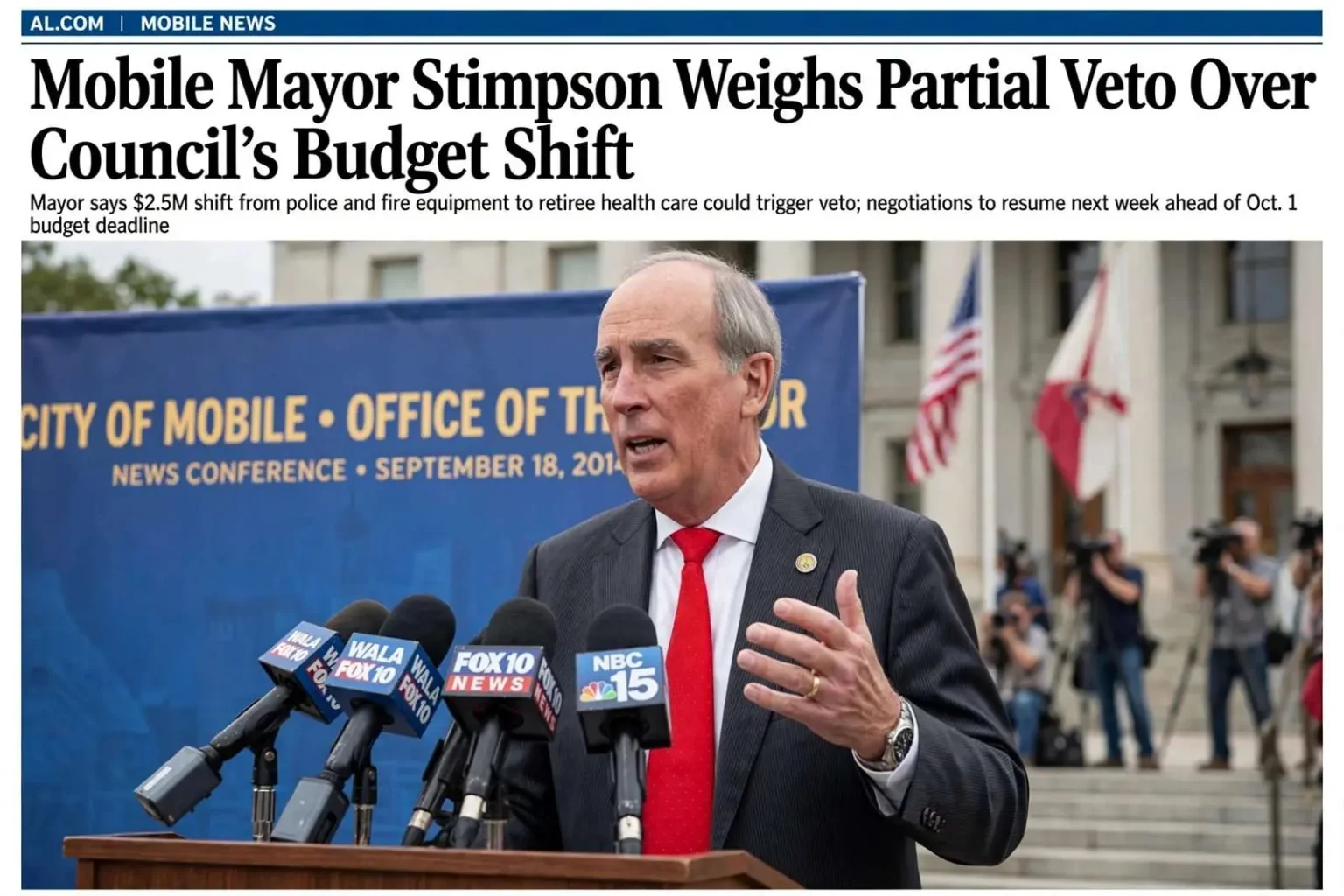
Mobile Mayor Sandy Stimpson signaled this week that he could veto at least part of the city’s newly amended fiscal year 2015 budget, taking issue with a City Council decision to redirect $2.5 million originally earmarked for police and fire equipment toward retiree health care costs. The dispute sets up a tense final stretch before the city’s fiscal year begins Oct. 1, the deadline by which Mobile’s new spending plan must be settled and in place for the year ahead.
Speaking at a news conference on the budget, Stimpson stopped short of threatening a sweeping rejection of the council’s amendments, which passed while he was out of town in Washington, D.C. Instead, he said he plans to resume negotiations with council members early next week, hoping to settle remaining disagreements before his veto window closes at the end of the following week. Under Mobile’s mayor-council form of government, the mayor proposes an annual budget and the council amends and adopts it, after which the mayor has a defined period to accept the document or reject portions of it. A veto would send the disputed items back to the council, making the coming days of negotiation the most consequential stretch of the budget calendar.
“We’re down to having differences on a small amount of money,” Stimpson told reporters, adding that both sides had made “tremendous progress” since budget talks began. The tone was notably softer than an outright confrontation, and it reflected the reality that the mayor and the council have already agreed on the broad shape of a spending plan while remaining apart on a handful of specific transfers and policy choices.
Much of the disagreement centers on how the city pays for capital needs versus retiree benefits, a tension familiar to municipalities across Alabama and the Gulf Coast, where the cost of honoring promises made to retired workers has grown faster than the revenues available to cover it. Retiree health care is one of the most difficult obligations for a city to manage. Unlike a debt payment or a construction contract, it cannot be postponed without directly affecting people who spent their careers in public service, and unlike a fleet purchase it generates no visible asset on the street. That imbalance is precisely what pushed the question into the center of Mobile’s budget fight this fall.
Capital Plans Versus Retiree Costs
Stimpson’s original proposal set aside roughly $3.2 million for 100 new police cruisers, $2 million for fire-rescue vehicles, and $750,000 for public works vehicles. Those line items form the backbone of the city’s annual effort to keep aging fleets operational. Patrol cars in a department Mobile’s size accumulate mileage quickly, and fire apparatus and garbage and street-maintenance trucks are expensive, long-lead-time purchases that cities typically budget for in steady increments rather than one large outlay. Falling behind on replacement schedules, finance officers generally warn, eventually costs more than keeping pace, as repair bills mount and vehicles spend time out of service.
The council’s amendment pulled $2.5 million of city capital funding into the General Fund to help cover rising retiree health care costs, a move Stimpson said caught his administration off guard. The General Fund is the city’s main operating account, the pool of money that pays day-to-day expenses ranging from payroll to utilities. Moving capital dollars into it bolsters the operating side of the ledger, but it does so at the expense of the equipment plans the mayor had laid out for police, fire and public works.
“I don’t think the council was recognizing what was happening there,” Stimpson said, adding that members had not fully understood that the shifted money was coming out of public safety funding. The remark framed the disagreement less as a philosophical clash than as a communication failure, with the mayor contending that the practical consequence of the transfer — fewer cruisers, apparatus and work vehicles bought with city capital dollars — had not registered with council members when they voted.
The Penny Sales Tax Question
The mayor also weighed in on the council’s decision to extend Mobile’s temporary penny sales tax by three years rather than the roughly two-month extension his administration had requested. The one-cent levy has been a recurring flash point in city finances, and the length of its extension became one of the most closely watched items in this year’s budget debate.
Stimpson said he would have preferred the council revisit the tax annually rather than lock in a multiyear extension, arguing that an additional percentage point on the sales tax generates more than $30 million a year for the city and deserves regular public scrutiny. A revenue stream of that size, in his view, should come before taxpayers on a regular basis rather than being committed years in advance, particularly when the original justification for the tax was framed as temporary.
He said he raised that preference directly with council members in private meetings, though several officials, including Council President Gina Gregory and Councilman Fred Richardson, indicated they understood his position differently. The disconnect over what had been agreed to in those conversations underscored how much of the budget process plays out away from the council chamber, in one-on-one meetings and small-group negotiations that leave room for differing recollections once the votes are tallied.
The multiyear extension carries practical consequences for shoppers and businesses across Mobile. A penny on the sales tax touches nearly every retail transaction in the city, from groceries and clothing to restaurant meals and building supplies, and its renewal shapes the planning assumptions of both City Hall and the merchants who collect it. For the city, the added cent represents one of the largest single levers in the budget; for council members, committing to it for three years provides stability that a shorter renewal would not, freeing them from relitigating the issue every twelve months.
Nonprofit Funding Restored
Separately, council members added back funding for local nonprofit agencies whose performance contracts had been cut in the mayor’s original budget, following pushback from groups warning the cuts could cripple their operations. The restorations came after representatives of affected organizations pressed the council to reconsider, describing the city’s annual contracts as a foundation of their budgets rather than a supplement.
Nonprofits set to receive some of that restored funding include community health and social service providers that rely heavily on the city’s annual contracts to continue operating. For organizations of that kind, a city contract often anchors their fundraising, assuring private donors and other grant makers that the work has public support, and a sudden cut can ripple through an entire budget within a single fiscal year.
Stimpson indicated he was unlikely to challenge the council’s roughly $5.2 million allocation for those nonprofit performance contracts, even as he continues to weigh a possible veto on the retiree health care transfer. The distinction suggests the mayor’s veto deliberations are aimed narrowly at the capital-to-General Fund shift rather than at the council’s broader social spending priorities, leaving room for agreement on most of the amended budget even if the central dispute persists.
The nonprofit debate reflects a broader reality of municipal budgeting in Alabama’s port city, where demand for health, housing and family services has outpaced the philanthropic dollars available to meet it. Performance contracts, which tie city funding to specific deliverables, have become the standard mechanism for that support, and the council’s decision to restore the money signaled a reluctance to force abrupt adjustments on organizations that deliver services on the city’s behalf.
What Comes Next Before Oct. 1
City officials said further budget talks were expected in the days ahead as both the mayor’s office and the council work to finalize the spending plan before the new fiscal year begins. The schedule leaves little slack: negotiations resume early next week, the veto window closes at the end of the following week, and the fiscal year turns over on Oct. 1 regardless of whether the two sides have reached agreement on the remaining items.
For residents, the outcome will determine how the city balances two competing demands that have defined recent budget seasons — keeping the police, fire and public works fleets current, and meeting the escalating cost of health benefits promised to the men and women who already served the city. A negotiated compromise could preserve part of the capital program while still shoring up the retiree health care line, while a veto and override fight would leave the funding question unresolved well into the fiscal year.
The dispute also offers a preview of the pressures likely to shape Mobile’s budgets for years to come. Rising retiree health care costs are not unique to Mobile; they are a structural feature of public employment across the region, driven by medical inflation and by benefit commitments made in earlier decades. Cities that confront the cost through annual transfers from capital budgets, as the council proposes, spread the pain across departments. Cities that fund equipment fully must find the retiree money elsewhere, either through new revenue, spending cuts or continued reliance on measures such as the temporary penny sales tax that the council voted to extend.
For now, the mayor has kept both options open. His public posture — firm on the principle that public safety equipment should not fund retiree benefits, but conciliatory on nearly everything else — suggests he sees a negotiated resolution as the likeliest path. The council, having amended the budget while the mayor traveled, now faces the choice of adjusting the transfer or defending it through a veto fight. With the calendar bearing down and both sides describing the outstanding differences as small, the final weeks before Oct. 1 will decide whether Mobile’s fiscal 2015 budget takes effect through compromise or through the city’s veto and override machinery.
What remains clear is that both the administration and the council have framed this year’s process as one of overall progress rather than gridlock. The mayor’s praise for the “tremendous progress” achieved since talks began, paired with the council’s restoration of nonprofit funding that the original budget had cut, points to a working relationship still capable of movement. The unresolved $2.5 million transfer, and the length of the penny tax extension behind it, are the remaining tests of whether that relationship can hold through the fiscal year ahead.