University of South Alabama Gulf Shores
USA to Launch Hospitality and Tourism Courses in Gulf Shores Starting in January
The University of South Alabama and the city of Gulf Shores will offer hospitality and tourism courses at the Gulf Shores Cultural Center beginning in January.
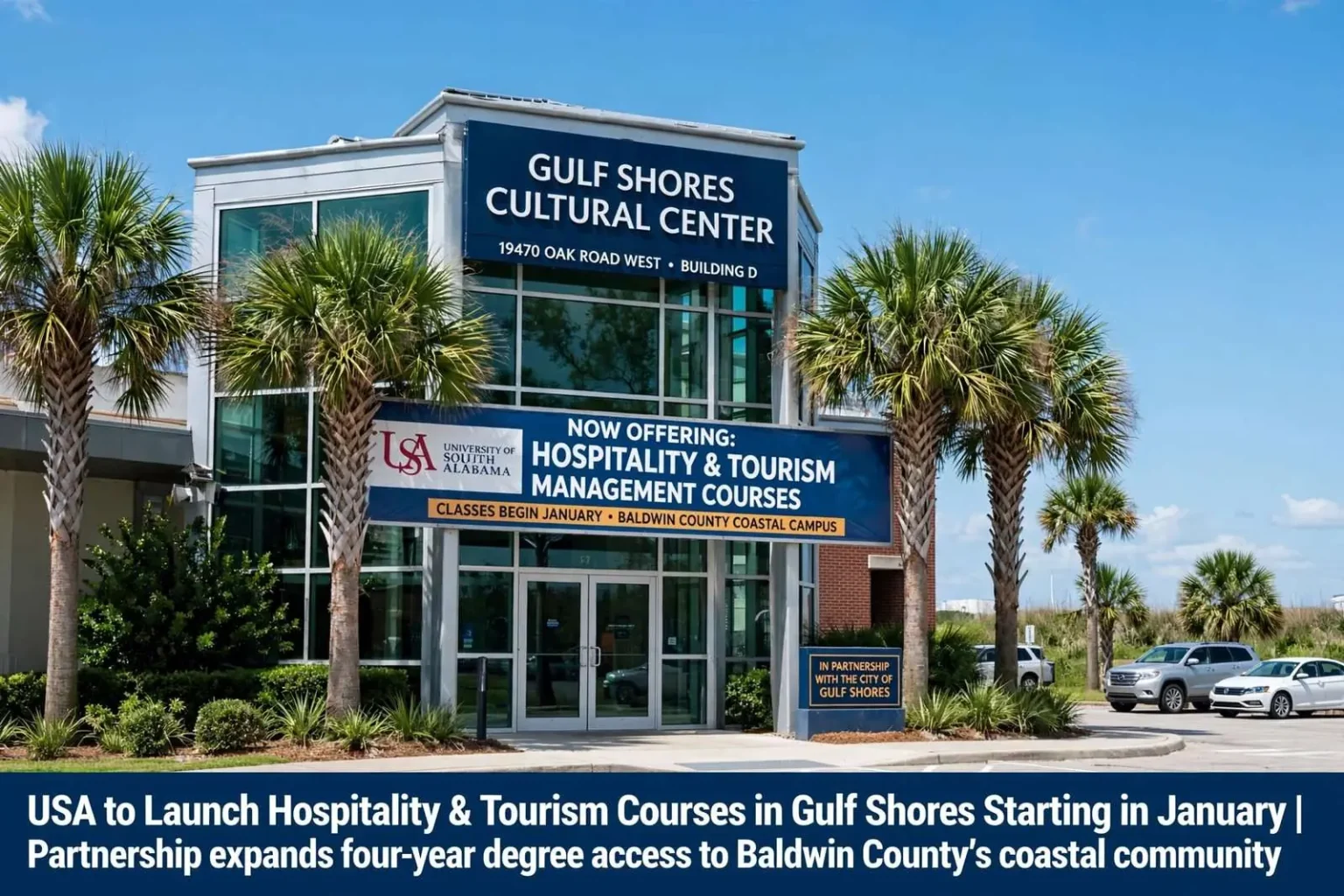
The University of South Alabama and the city of Gulf Shores have reached an agreement to bring university-level hospitality and tourism coursework directly to the coast, with classes set to begin at the Gulf Shores Cultural Center in January. The arrangement marks a deliberate effort to move parts of a four-year degree program out of the university’s main Mobile campus and into the heart of Baldwin County’s tourism economy.
The new offerings will be held at the Gulf Shores Cultural Center, located at 19470 Oak Road West, Building D, giving Baldwin County residents a chance to pursue coursework tied to the region’s dominant tourism economy without traveling to the university’s main campus in Mobile. For residents of Gulf Shores, Orange Beach, Foley, and surrounding communities, the site puts upper-level university instruction within a short drive of home rather than an hour’s commute across Mobile Bay.
University officials announced the Gulf Shores expansion in a release issued Friday, quoting University of South Alabama President Tony Waldrop and Gulf Shores Mayor Robert Craft on the value of the new partnership. Both officials framed the program as a way to create clearer career pathways for Baldwin County residents into the area’s tourism and hospitality industry, which anchors much of the local economy along the Alabama Gulf Coast.
The partnership builds on an existing arrangement between the University of South Alabama and Faulkner State Community College designed to streamline the path from a two-year degree to a four-year one. Under that agreement, students who complete an associate in applied science degree in hospitality management at Faulkner State can transfer directly into the University of South Alabama’s bachelor’s degree program in hospitality and tourism management, carrying their credits forward.
The relationship between the university and the two-year college system in Baldwin County runs deep, and the hospitality agreement is one of several transfer pathways that allow students to begin their education close to home. For older students already working in coastal restaurants or hotels, the coastal course sites also make part-time study realistic in a way that a Mobile commute might not be. The January start gives those students a clean entry point with the spring semester.
Building on an established pathway
That transfer agreement has long been viewed as a model for how two-year and four-year institutions in the region can work together. Students in the hospitality management program at Faulkner State complete technical, hands-on coursework during their associate studies, then move into the bachelor’s program with their credits intact rather than losing ground in the transfer process. The arrangement reduces both the time and the cost of earning a four-year degree, two factors that frequently determine whether students from working families finish college at all.
The hospitality and tourism management program is not entirely new to the region. The University of South Alabama began offering courses in the discipline this fall both at its main Mobile campus and at Faulkner State Community College’s Gulf Shores campus, according to the release. The January launch at the Gulf Shores Cultural Center marks a further expansion of that footprint directly into the coastal community.
Staging the program across multiple sites reflects the geography of the industry it serves. Mobile, the university’s home city, is a working port city with its own hotel, restaurant, and convention business, while the Baldwin County beach communities operate one of the most intense seasonal tourism economies on the Gulf Coast. Offering coursework in both places allows students to learn near the employers who may eventually hire them.
Classes at the Cultural Center
The Gulf Shores Cultural Center, the new home for the coastal coursework, sits on Oak Road West in the western part of the city and has increasingly served as a civic gathering point for Gulf Shores. Hosting university classes in a city-owned building underscores the city’s investment in the partnership, which city officials have positioned as economic development as much as education policy. A workforce trained locally is a workforce more likely to stay locally, filling management positions at the hotels, restaurants, charter operations, attractions, and rental companies that line the coast.
For students, the January start means courses begin with the spring semester. University officials said students interested in enrolling in the hospitality and tourism management program can contact the program directly through the university’s College of Education and Professional Studies for details on course schedules, admission requirements, and how transfer credits from Faulkner State will apply toward the bachelor’s degree.
Advisors with the program are expected to work with transfer students to map out how their Faulkner State coursework counts toward degree requirements, an area where credit loss has historically discouraged community college graduates from continuing on to a bachelor’s degree. Under the existing agreement, the associate in applied science degree in hospitality management feeds directly into the bachelor’s track, and officials have emphasized that students carry their credits forward rather than repeating coursework.
The expansion comes as Baldwin County’s tourism industry continues to grow, with beach communities like Gulf Shores and Orange Beach drawing millions of visitors each year and generating steady demand for trained hospitality management professionals. The industry’s rhythm is intensely seasonal, with the summer months bringing the heaviest visitation and the shoulder seasons of spring and fall increasingly filling in as the area markets itself for events, sports tournaments, and conferences beyond the traditional beach season.
A workforce pipeline for the coast
Local officials have said building a homegrown pipeline of graduates familiar with the area’s tourism sector could help area employers fill management-track positions with residents already rooted in the community. Hotels, restaurants, and attractions along the coast have historically had to recruit managers from outside the area, and turnover in those positions carries real costs for employers. A degree program based in Gulf Shores gives local students — and local employers — a reason to believe those careers can be built at home.
Hospitality and tourism management as a discipline covers far more than front-desk operations. Students in programs of this kind typically move through coursework in resort and lodging management, food and beverage operations, event planning, tourism marketing, and the financial and personnel management skills that separate supervisors from managers. In a coastal market like the Alabama Gulf Coast, those skills apply across a broad range of employers, from beachfront hotels and condominium associations to restaurants, sport fishing and charter businesses, and the venues that host the area’s busy calendar of festivals and events.
The University of South Alabama, a public university based in Mobile, has expanded its coastal presence in recent years as part of a broader effort to serve the fast-growing populations of Baldwin County. With the hospitality and tourism management program now operating at three sites — the Mobile campus, Faulkner State’s Gulf Shores campus, and the Gulf Shores Cultural Center — the university is effectively following its students toward the jobs they intend to hold.
Mayor Robert Craft’s administration has made quality-of-life and workforce investments a recurring theme in Gulf Shores city government, and the cultural center itself has been part of that pattern, hosting civic programming alongside its new academic role. The city’s decision to dedicate space in the facility to university coursework signals how directly municipal officials view education and economic development as linked.
What comes next
For the spring semester, the practical questions are straightforward: which courses will be offered at the Oak Road West site, how often students will need to travel to Mobile for classes not offered on the coast, and how many students the initial coastal sections can accommodate. University officials have directed interested students to the College of Education and Professional Studies for those specifics as schedules are finalized.
For Baldwin County more broadly, the launch represents another step in the gradual build-out of higher education options on the eastern side of Mobile Bay. A county that not long ago required residents to cross the bay for most university coursework now hosts university-level classes in its largest beach city, in a field of study matched to the county’s largest industry. Whether the program grows into a full four-year coastal presence will depend on enrollment, but the January start gives it a foundation.
Educators and industry representatives alike note that hospitality management careers on the coast are no longer limited to seasonal work. Condominium associations, resort management companies, and year-round event operations now offer salaried positions with benefits, and the growth of sports tourism and festival programming has extended the busy season deeper into the fall and spring. Graduates who combine classroom training with the local knowledge that comes from living in the community they serve are positioned for exactly those roles.
Students who complete the bachelor’s degree in hospitality and tourism management will graduate into a labor market that spans the entire Gulf Coast, from the beaches of Baldwin County to the casinos, hotels, and convention centers of the wider region. The agreement announced this week ensures that the first step of that journey can now begin in Gulf Shores itself.