Citronelle and Saraland High Schools Grieved Together After a Weekend That Claimed Three Students
Two weekend car wrecks left Citronelle and Saraland high schools grieving as students, teachers and coaches gathered for prayer, counseling and remembrance in late September 2014.
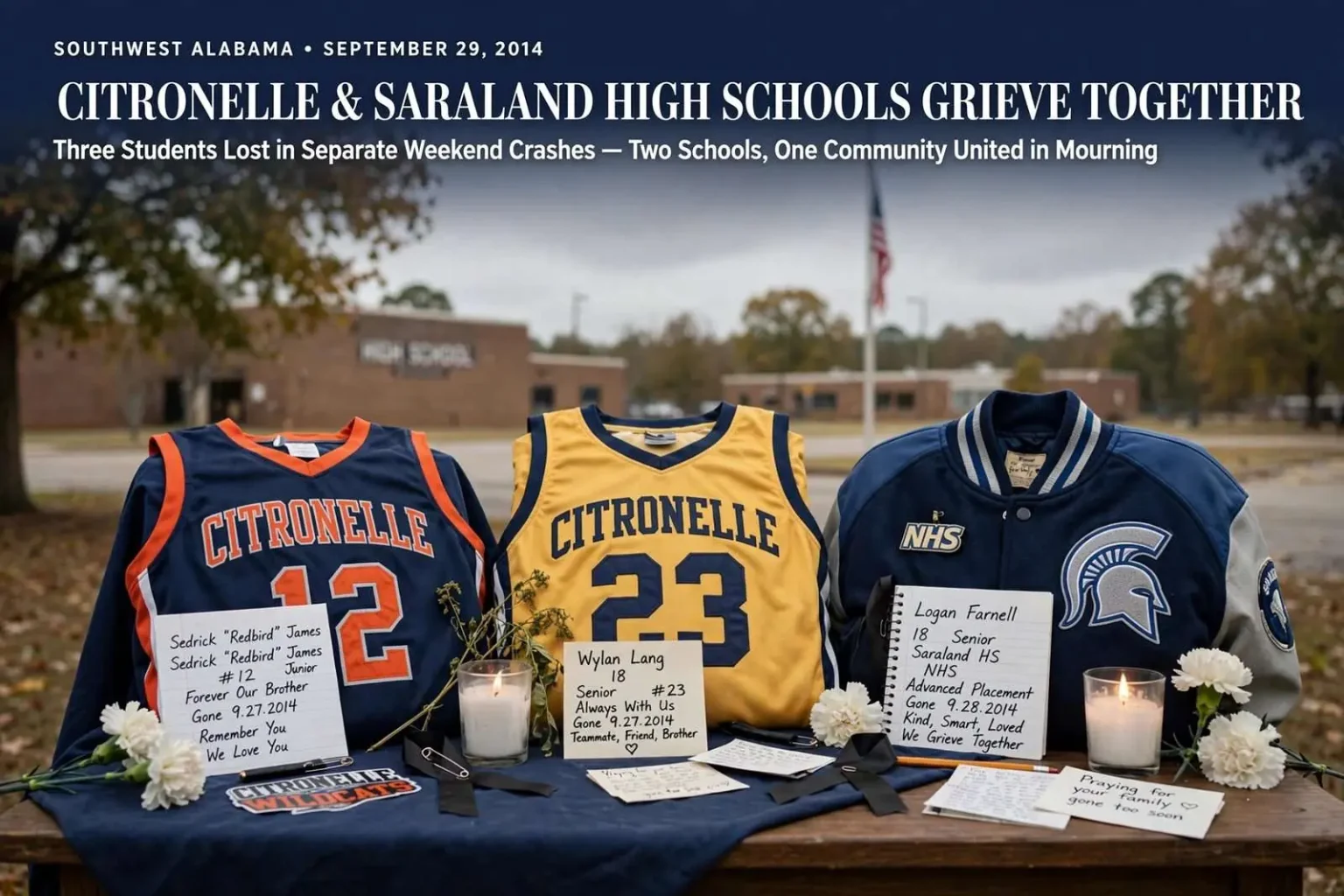
A pair of weekend car wrecks cast a long shadow over two southwest Alabama high schools in late September 2014, turning what should have been an ordinary Monday into a day of grief at both Citronelle and Saraland. The two campuses sit more than thirty miles apart on opposite sides of the Mobile County map, linked that week only by loss — three students dead within a day of each other, and two school communities confronting it at the same time.
Citronelle students Sedrick “Redbird” James, a junior, and Wylan Lang, a senior, were killed in a single-vehicle accident late on a Saturday night along Coy Smith Road, roughly two miles west of Mount Vernon. Both were members of the Citronelle High School basketball program. The two-lane roads that wind through northern Mobile County between Citronelle and Mount Vernon are the kind of dark, straight-then-curved stretches familiar to anyone who has grown up in rural Alabama, the roads teenagers travel between friends’ houses and ballparks every weekend of the year. News of the wreck began reaching players and coaches before most of Citronelle woke up Sunday.
A day later, on Sunday afternoon, Saraland High School senior Logan Farnell — a member of the National Honor Society and an advanced-placement student — died in a separate accident. Details of that wreck were not immediately released. The two events were unconnected — different roads, different young men, no common thread beyond the calendar — but their arrival within hours of each other left two towns comparing notes on how to tell children their friends were gone.
A somber Monday at both schools
By the time classes began Monday, the loss had settled over both campuses. At Saraland, students arrived early to grieve together. “We had a large group of students arrive at the school prior to 7 a.m.,” Saraland City Schools Superintendent Dr. Aaron Milner said. “Logan was a popular young man. They had prayer as a group, and I think even broke off into smaller groups to pray in that manner. Our teachers were there and supported the students and just demonstrated the love they have for all of them.”
Milner described Farnell as a high academic performer and said the school system’s focus for the week would be on supporting students and helping the family “in any way we can.” Saraland’s school system, one of the newest city systems in Mobile County after its split from the county district, has built its reputation on close community involvement, and the days after the wreck showed what that involvement looks like in practice — teachers standing in hallways before the first bell, ministers and counselors drifting through the cafeteria, administrators deciding lesson by lesson what normal could wait.
Grief counselors were made available at both schools. The deployments drew on a practice now standard across Alabama districts: bring in additional counselors from neighboring schools and central office staff, quiet the regular schedule enough to let students gather where they need to, and watch the students who grieve in silence as closely as those who grieve out loud.
At Citronelle, athletic director Barry Gibson described a building full of quiet sorrow. “It’s always tough when young people lose their lives,” he said. “It’s been a very somber day here. There have been a lot of hugs — teachers and students alike trying to console one another and comfort each other. It’s just a very bad situation.”
A basketball brotherhood in mourning
Citronelle boys basketball coach Ty Townsend, who had joined the school only weeks earlier in August after five years at Dale County, received a text message about 2:30 a.m. Sunday telling him his players had been in a wreck. He rushed to the hospital, where he learned that James and Lang had died. A coach’s first season at a new school is measured in installments — installing a system, learning names, earning trust — and Townsend had barely reached the end of the first one when the worst news a coach can receive found him in the dark.
The two were among four people in the vehicle, three of them basketball players; the other two occupants survived. The arithmetic of the crash — who lived, who did not — became its own burden for the survivors and their classmates, a common feature of small-school grief where nearly everyone in the junior and senior classes knows everyone in the wreck.
“The first students I saw today were just holding each other and crying,” Townsend said. “It’s a rough time for us. These were two great, great young men who had futures in front of them and had the right head on their shoulders.”
Townsend, in his fifth year of coaching, said it was the first time he had faced the death of a student. He described a team so close it reminded him of his own high-school days. “When you see one, you see them all,” he said. “These kids feel like they are burying two of their brothers and, honestly, they are.” In a school the size of Citronelle’s, a basketball team is a year-round brotherhood — summer leagues, open gyms, weight room sessions — and the two players had been in the middle of it, seniors and near-seniors every underclassman watched.
Both James, a point guard, and Lang, a forward, were expected to be significant contributors, possibly starters, that winter. The coming season had been built around them: a senior forward’s size and a junior point guard’s hand on the offense, the kind of pairing a small-school coach constructs a program around. Practices for the winter had barely begun when the roster lost them, and Townsend’s first order of business as Citronelle’s coach became something no coaching manual covers.
The crash and the response to it drew attention across the county’s school systems, where administrators keep informal networks for exactly these emergencies. Within hours of the Sunday news, neighboring districts were offering counselors, clergy and youth ministers, and the two communities most directly affected — Citronelle in the county’s far north, Saraland in its industrial corridor along U.S. 43 — found themselves trading the same questions: how to tell the students, when to resume practice, how much normal is healthy. The answers varied by school but shared a philosophy: let the students lead, keep adults visible, and make sure no one grieves alone.
Honoring the three
The two football teams were scheduled to meet at Saraland that Friday night, and Gibson said he and Saraland coach Jeff Kelly had already discussed honoring the three students before kickoff. Friday night football, whatever else it is in southwest Alabama, is the one gathering guaranteed to bring an entire community into a single place, and both coaches understood that the game would have to make room for grief — a moment of silence, a recognition, some gesture that tells two towns their schools are holding the same loss together.
A Celebration of Life memorial for James and Lang was set for 6:30 p.m. Tuesday at Bethlehem Baptist Church in Citronelle and was open to the public. The choice of venue traced the geography of the town’s grief: in communities like Citronelle, the church rather than the school gymnasium is often the only building large enough and close enough to hold everyone who wants to come, and the open invitation meant teammates, teachers and rivals from across the county could sit alongside the families.
In the main hallway at Citronelle, a large postcard was set out Monday morning so students could sign messages and goodbyes. “Some kids express themselves verbally and some kids express something in writing better,” Gibson said. The improvised memorial — markers, a banner, a growing crowd of students taking turns — has become one of the standard rituals of American high school mourning, a place to leave a message when there is nothing left to say out loud.
Gibson, who had lost athletes before in his coaching career, said the pain never eases. “I talked to our football team about how you react when life deals you a tough hand, how you honor your friends in times of grief,” he said. “My heart goes out to the families and the friends of these two boys.”
The week ahead asked both schools to do what schools in small Alabama towns have always done after a loss like this one: keep teaching through the tears, fill the gym and the sanctuary and the Friday night stands, and let the routines of the season carry the grieving along. At Citronelle, the basketball season would eventually begin without two of the players it was built for. At Saraland, the classrooms Farnell’s classmates filled would go on meeting without him. The towns are miles apart, but that week the distance did not matter. Both were burying their own, and both were doing it together.