University of South Alabama Gulf Shores
Little Lagoon Preservation Society to Unveil Water Quality Modeling Work at Gulf Shores Meeting
University of South Alabama researchers will present new flow and water quality modeling for Little Lagoon at the preservation society's quarterly public meeting July 16 in Gulf Shores.
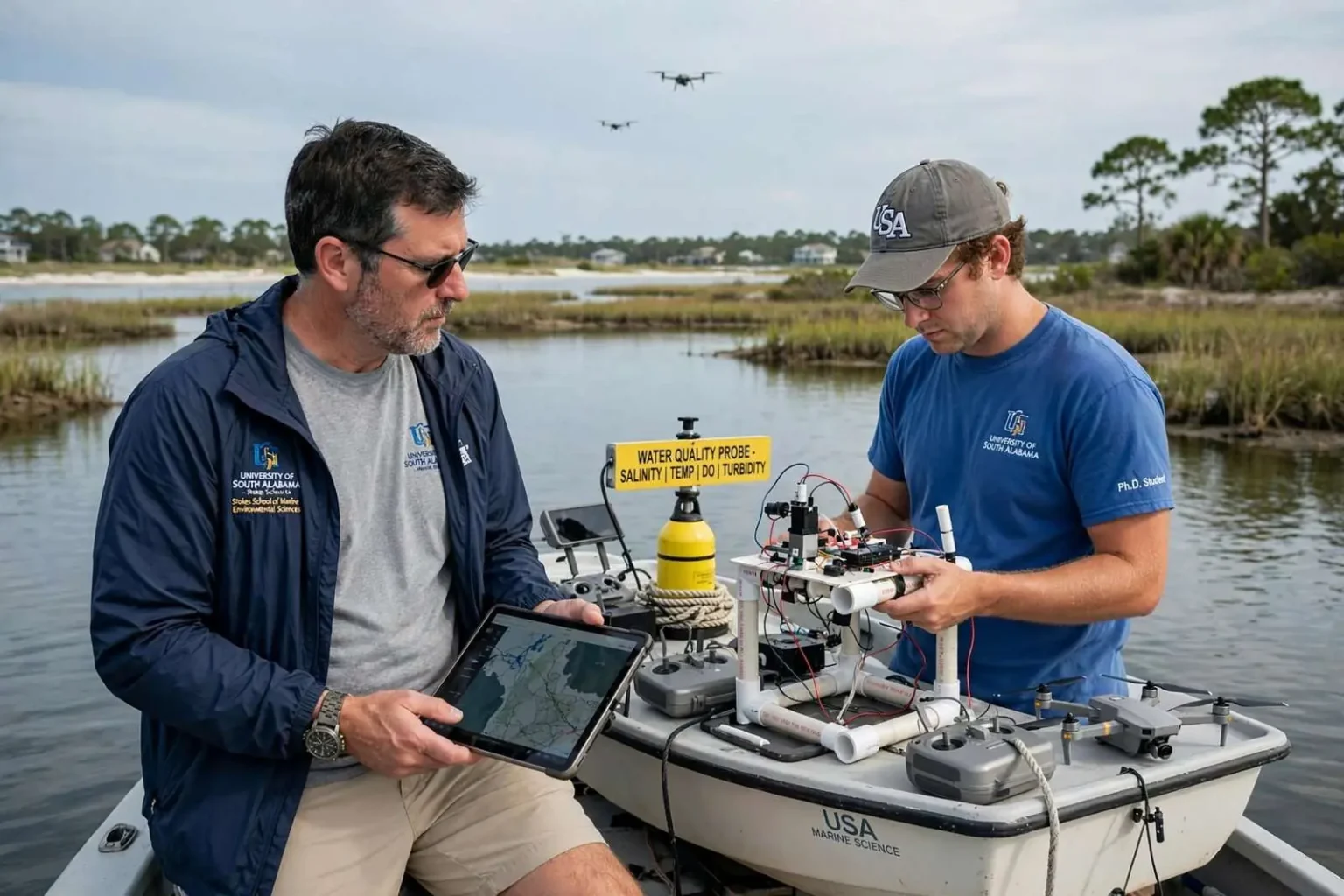
Residents who want to understand what is actually happening in the water behind Gulf Shores will have a chance to hear it directly from the researchers studying it. The Little Lagoon Preservation Society will hold its quarterly public event, titled “Lagoon Models and Measurements,” on Thursday, July 16, featuring Nigel Temple and Ian Adkins of the University of South Alabama.
Event Details
What: “Lagoon Models and Measurements,” a quarterly meeting of the Little Lagoon Preservation Society
When: Thursday, July 16. Activities begin at 5:30 p.m. with light refreshments and conversation; speakers begin at 6 p.m., followed by a question-and-answer session.
Where: Gulf Shores Activity Center, 260 Clubhouse Drive
Cost: Free and open to the public
The Science Behind the Lagoon Monitoring Project
What the Researchers Will Present
Temple and Adkins will discuss their work modeling the flow of water into and out of Little Lagoon, along with efforts to track water quality using self-contained transmitter probes. That combination – a hydrodynamic model paired with continuous, instrument-based measurement – is the modern standard for understanding coastal water bodies, and it addresses a question that has vexed lagoon residents for years: where does the water go, how fast, and what is it carrying?
Self-contained probes are deployed in the water and transmit readings on parameters such as salinity, temperature, dissolved oxygen and turbidity without requiring a researcher to be physically present. Instead of a handful of grab samples collected on a few days each year, this approach produces a near-continuous record. That resolution matters in a system like Little Lagoon, where conditions can swing dramatically after a heavy rain, a tidal exchange or a stretch of hot, still summer weather.
Why Little Lagoon Is Different
Little Lagoon is one of the more unusual water bodies on the Alabama coast. It runs roughly parallel to the Gulf behind the barrier island beaches of Gulf Shores, stretching about 10 miles and connected to the Gulf primarily through Little Lagoon Pass. That single, narrow connection means water exchange is limited compared with more open coastal bays.
Restricted flushing has consequences. Nutrients, stormwater runoff, sediment and bacteria that enter the lagoon tend to stay longer than they would in a system with strong tidal circulation. Over the years, the lagoon has periodically dealt with algal blooms, low dissolved oxygen events and fish kills, and stretches of shoreline have at times been posted with swimming advisories after bacteria counts rose following heavy rain.
Development pressure compounds the picture. Gulf Shores and the surrounding beach communities have grown steadily, and each new roof, driveway and parking lot changes how rainwater reaches the lagoon – less soaking into sandy soil, more running off hard surfaces and into the water carrying whatever it picks up along the way.
The Society’s Role
The Little Lagoon Preservation Society is a volunteer-driven organization that has spent years advocating for the health of the waterway, supporting scientific monitoring, and giving residents a forum to learn what researchers are finding. Its quarterly meetings are open to the public and are one of the few venues where lagoon-specific science is presented in plain language to the people who live on and use the water.
The society has also drawn attention to undeveloped tracts along the lagoon shoreline, including areas such as Laguna Cove, where preserving natural land can help buffer runoff before it reaches the water. Vegetated shoreline and undisturbed wetlands act as a filter, and once they are paved, that function is difficult to replace.
Why Residents Should Care
For homeowners along Little Lagoon, water quality is not an abstraction. It affects property values, the safety of swimming and paddling, the health of the crab and fish populations residents catch, and the odor and appearance of the water outside their windows. For the broader Gulf Shores economy, the health of the back-bay waters is part of the same environmental system that supports tourism on the beach side.
Meetings like this one give residents a chance to hear findings before they become policy debates – and to ask researchers, directly, what the data actually shows. Anyone with an interest in the lagoon, whether or not they own property on it, is welcome to attend on July 16.
Update: Researchers Detail “Smart Lagoon” Sensor Plans at July 16 Meeting
Update: At the July 16 meeting, Temple and Adkins provided new details about how the modeling project will work. Temple said the team’s goal is to use mapping data and water quality sensors to help identify ways to improve the lagoon’s health, and that researchers are currently using drones and a 23-foot skiff to map the lagoon’s depth and geography. “We’ll be using all that information to explore methods to improve flushing and/or improve the water quality,” Temple said.
Update: New Sensor Technology Unveiled at the Meeting
While the project relies on high-end commercial equipment, USA Ph.D. student Ian Adkins also unveiled a prototype for a low-cost, open-source water quality sensor built from PVC pipe and hardware-store parts. The device measures pH, temperature, turbidity and dissolved oxygen, and costs about $1,500 to build, compared with roughly $30,000 for each individual commercial unit currently deployed in the lagoon. Adkins said the lower cost would allow the society to afford more sensors and gather higher-resolution data across the waterway.
The sensors use long-range radio technology known as LoRaWAN to transmit data to land-based gateways connected to the internet, allowing residents to check a real-time dashboard of lagoon conditions from their phones. Adkins asked homeowners near the water to consider allowing small gateways, which he said require about as much power as a nightlight, to be installed on their property to help build out the network. He also proposed an “if you see it, clean it” program that would let recreational users scan QR codes on buoys for instructions on clearing algae growth.
Little Lagoon Preservation Society President Dennis Hatfield said the new data will be folded into the group’s existing water quality database, which dates back to 2007. Hatfield, who said he has waited a long time for this level of technical insight, said the hydrodynamic model should finally help answer some of the society’s most persistent questions about the lagoon. “Is the circulation flushing in the lagoon that we get adequate? What’s the right amount?” Hatfield said. “This model will help us corner the empirical truth about it.” Researchers expect the modeling work to be completed within about two years.
Little Lagoon’s Unique Geography and Regional Context
Little Lagoon stretches roughly ten miles along the back side of the Gulf Shores barrier island, separated from the Gulf of Mexico by a thin ribbon of sand and connected to it primarily through Little Lagoon Pass at the eastern end. The lagoon’s limited connection to the open Gulf makes its water quality sensitive to runoff, tidal exchange and storm events, and the Pass periodically shoals or shifts, affecting how freely Gulf water can flush the system.
The University of South Alabama, based in Mobile, has expanded its coastal and estuarine research portfolio in recent years through programs in the College of Arts and Sciences and the Stokes School of Marine and Environmental Sciences. Researchers there study everything from Gulf sturgeon and oyster reef ecology to the hydrodynamics of shallow lagoons like Little Lagoon, often partnering with local nonprofits and municipal agencies to translate findings into management guidance.
The LoRaWAN low-power radio standard referenced in the open-source sensor design is increasingly common in environmental monitoring networks across the country. Its long range and low power requirements make it well suited to battery-operated sensors deployed in remote or hard-to-reach locations, and the relatively low cost of building compatible gateways has made citizen-science monitoring a viable model for tracking conditions in smaller water bodies like Little Lagoon.
Coastal water quality along the northern Gulf of Mexico has been a focus of sustained federal, state and academic attention since the 2010 Deepwater Horizon oil spill. The Gulf of Mexico Alliance, a partnership of the five Gulf states, coordinates regional priorities including nutrient reduction, habitat restoration and beach water-quality monitoring. Local groups like the Little Lagoon Preservation Society contribute on-the-ground data that informs those larger efforts.
Coastal Alabama’s water-quality challenges are not unique to Little Lagoon. Other estuarine systems along the northern Gulf, including Mobile Bay, Perdido Bay and Weeks Bay, have all faced nutrient loading, stormwater runoff and bacterial contamination issues tied to growth and development. Research in one system frequently produces insights that inform management in the others, which is why partnerships with university researchers are a priority for many coastal advocacy groups.
Long-Term Monitoring and Stormwater Investments
The Little Lagoon Preservation Society’s existing water quality database, which dates back to 2007, has become a valuable long-term record of conditions in the lagoon. Continuous monitoring data, paired with periodic grab samples, gives researchers a baseline against which to measure future changes and to evaluate the effectiveness of any restoration work that may be undertaken based on the modeling results.
The Alabama Gulf Coast has invested heavily in recent years in improved stormwater management, recognizing that runoff from roads, parking lots and developed properties has been one of the largest contributors to water-quality decline in coastal water bodies. Projects to retrofit older neighborhoods with better drainage, bioswales and retention ponds have been funded through a combination of municipal, state and federal grants. The Little Lagoon’s research will likely inform how those projects are designed and where they are prioritized in the future.