Mobile Council Delays Penny Sales Tax Vote in Permanence Debate
Mobile council members postponed a vote on the city's penny sales tax after Councilman Fred Richardson floated making the increase permanent.
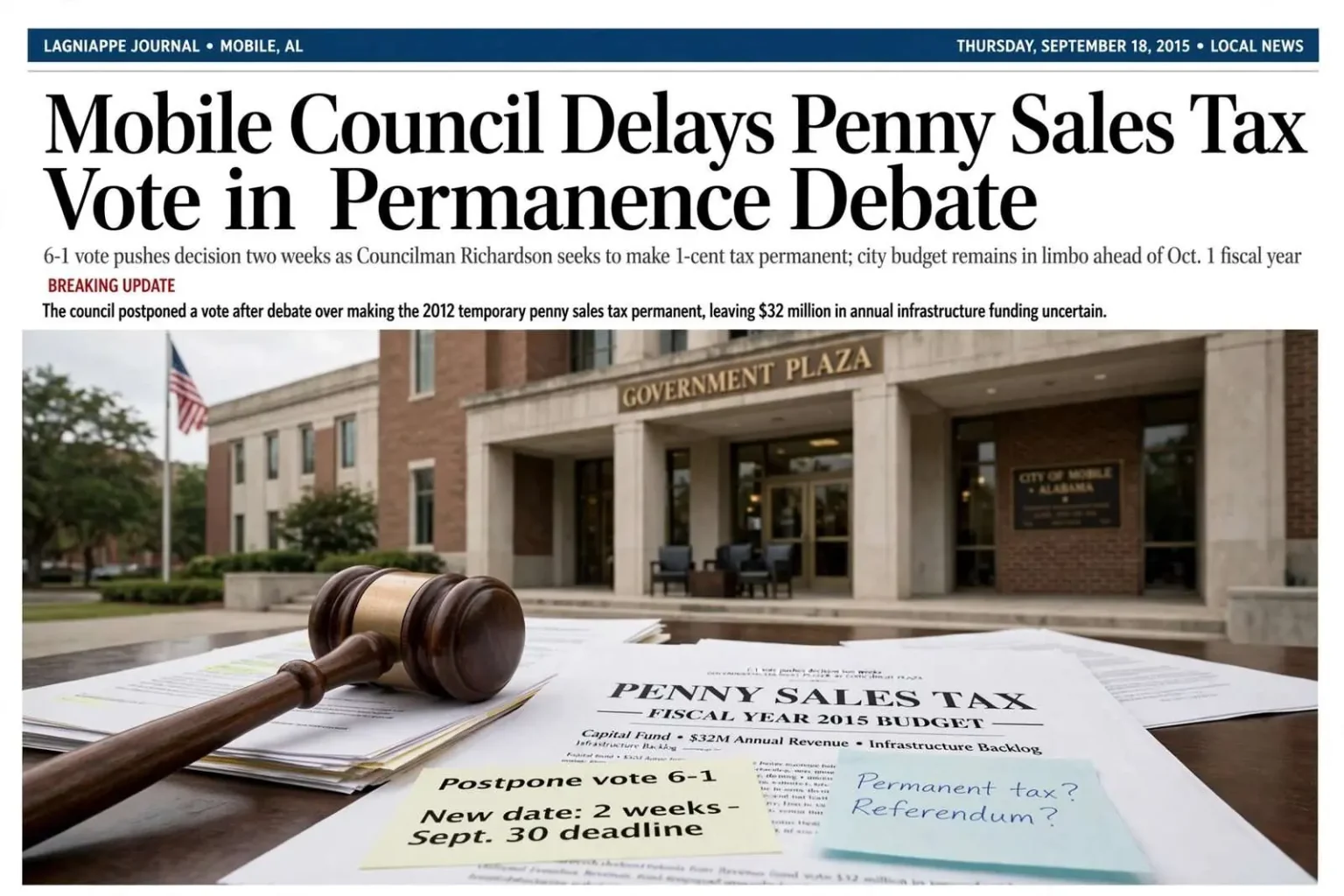
Mobile’s ongoing debate over its temporary penny sales tax hit another delay this week after Councilman Fred Richardson raised the idea of making the increase permanent, prompting council members to push the decision back another two weeks rather than vote immediately. The move means the city’s fiscal decisions — including a budget built on the assumption that the tax’s revenue keeps flowing — stay in limbo a little longer, with the new budget year starting Oct. 1.
Richardson withdrew his motion to permanently lock in the tax after colleagues voted 6-1 to postpone any decision, meaning the city’s entire fiscal year 2015 budget, which depends on extending the tax to generate additional capital revenue, likely won’t come up for a final vote until at least the council’s next meeting later in September. The vote itself was a familiar posture for a council that has revisited the penny question repeatedly since the increase was adopted: no member was ready to kill the tax, and none was ready to entrench it, so the body bought itself two more weeks.
The tax in question traces back to a 2012 temporary increase that raised Mobile’s local sales tax rate from 4 percent to 5 percent, pushing the combined state, county and city rate to 10 percent. Adopted as a stopgap during a lean budget era, the penny was designed to sunset — but the revenue it produced, roughly $32 million a year, proved addictive to a city with an enormous backlog of street repairs, drainage work and public building needs.
Richardson argued the city can’t afford to let the extra revenue disappear given the scale of infrastructure needs facing Mobile. “Other than Semmes, Alabama, there is not a city anywhere that is less than 10 percent,” he said, arguing Mobile’s rate remains in line with peer cities even with the increase in place since November 2012. “Why would we want to give up $32 million when our own engineers said we had hundreds of millions of dollars of infrastructure issues that need to be corrected?” Richardson said. “I say let the penny alone.”
His framing cast the choice as one between honest accounting and political convenience: keep a revenue stream the city demonstrably needs, or preserve a campaign talking point about resisting tax increases while streets deteriorate. Making the tax permanent, in his view, was the fiscally responsible position — and he wanted the council to own it now rather than revisit it annually.
The Case for Letting Voters Decide
Councilwoman Bess Rich cast the lone vote against delaying the decision, arguing instead that Mobile voters should have the final say on whether the tax becomes permanent through a public referendum. Rich, the council’s most consistent voice on budget scrutiny, has long argued that a tax adopted as temporary should not be extended indefinitely by the same body that adopted it without a direct mandate from the people who pay it.
Council President Gina Gregory has also floated the idea of letting residents vote directly on the tax’s long-term fate rather than leaving the decision solely to the council. A referendum would take the politically charged question off the council’s agenda and hand it to the electorate, where supporters of permanence would have to make the case that $32 million a year for streets and capital projects is worth a penny — while opponents would finally have their chance to retire a tax they never expected to become a fixture.
The referendum path carries its own complications, however. Special elections cost money and take months to arrange, and the timing would almost certainly miss the Oct. 1 start of the fiscal year the council is trying to budget for. In the interim, the city would need to extend the tax administratively simply to keep revenue flowing — which is, in miniature, the same extend-it-again pattern the referendum was meant to break.
The Budget Clock Keeps Ticking
The delay carries direct consequences for Mayor Sandy Stimpson’s proposed budget, which counts on extending the tax by two additional months, through Sept. 30, 2015, to generate roughly $5 million earmarked for the city’s Capital Fund. That two-month extension is what allows the administration to balance a budget built around infrastructure spending without assuming the tax’s permanent continuation — a carefully calibrated middle position that the council’s new delay now jeopardizes.
The Stimpson administration had not yet taken a position on whether the tax should be extended beyond that point, maintaining what has been its consistent stance since the mayor took office: the penny was the council’s creation, and its long-term fate is the council’s decision. That posture leaves the mayor’s office free to spend the revenue while avoiding ownership of the question of whether it should continue.
Richardson made clear he wants any renewal to be the last word on the matter. “Don’t come back eight months later and say we need the penny,” he said. “This is it for the penny.” His demand is aimed at the annual ritual the council has performed since 2012 — extending the tax in short increments while insisting the end is near — and at the political risk that comes with voting for permanence. A permanent tax, once adopted, cannot be used as a bargaining chip in future budget negotiations.
Rather than voting immediately, the council opted to schedule a dedicated committee meeting to continue hashing out the tax question, alongside a broader public hearing on the overall city budget held the same week at Government Plaza. The committee format gives the penny debate a focused airing separate from the press of regular council business, and the budget hearing gives residents a formal chance to weigh in on a fiscal plan that quietly assumes the tax continues.
With the fiscal year beginning Oct. 1, the extended back-and-forth over the tax’s future left both the revenue question and the city’s capital spending plans in limbo heading into the final weeks before the new budget year. Every week of delay compresses the timeline for adoption of a budget that must, by law, be in place when the year begins — and every scenario the council is weighing, from permanence to referendum to another short extension, produces a different Capital Fund ledger.
What the Penny Pays For
The stakes behind the parliamentary maneuvering are the most visible promises in city government: streets. Mobile’s engineers have documented a backlog of road, drainage and facility needs running to hundreds of millions of dollars, and the penny’s roughly $32 million in annual revenue has been the city’s principal new funding stream for attacking it. Without the tax, the Capital Fund reverts to its pre-2012 scale, and the pace of repaving and repair slows accordingly.
That arithmetic is why the debate has outlasted every prediction of its resolution. The council members who vote against permanence still vote to extend the tax; the administration that declines to champion it still budgets the revenue. Mobile’s infrastructure needs have made the penny politically indispensable even as it remains politically radioactive — and until either the voters or the council render a final verdict, the city will keep doing what it did this week: putting off the decision, two weeks at a time.
How Mobile Compares
Richardson’s claim about sales tax rates pointed to the argument that has kept the penny alive: Mobile’s combined rate, even with the increase, sits where comparable cities already were. Sales tax in Alabama stacks three layers — the state’s rate, the county’s and the municipality’s — and the total varies dramatically from city to city across the state. Mobile’s climb to 10 percent in 2012 put it at the top end for large Alabama cities, but neighboring municipalities in Mobile County and cities elsewhere in the state were already collecting at or near that level, which is why defenders of the increase describe it as catching up rather than reaching ahead.
The comparison is also where the politics live. A 10 percent rate is a liability in any conversation with shoppers and businesses, and every council member knows it. That is the tension the permanent-tax proposal forces into the open: if the rate is defensible — as Richardson argues, because peer cities charge it and the money addresses documented needs — then the council should defend it on the record, not year after year on a technicality.
The referendum alternative carries its own risks for tax supporters. Statewide and local polling has repeatedly found skepticism toward sales taxes, which fall hardest on lower-income households, and a campaign to make the penny permanent would hand opponents a clean rallying cry: the council promised this was temporary. Advocates for permanence would counter with the only argument that has ever sustained the tax — streets, drainage and a backlog that grows more expensive every year it goes unaddressed.
For now, the sequence is set: a committee meeting devoted to the tax, a public budget hearing at Government Plaza, and then a council meeting where the question returns. The choices on the table — permanence, referendum, or another extension — will determine whether Mobile’s Capital Fund keeps its $32 million a year, whether voters get the final say, and whether the city’s infrastructure push survives contact with the calendar it keeps slipping past.