Repair Contract Awarded for Damaged I-10 Causeway Ramp
The state awarded a contract to repair the I-10 Causeway ramp damaged by a fiery July crash, as new roadwork rolls out across Mobile and Baldwin counties.
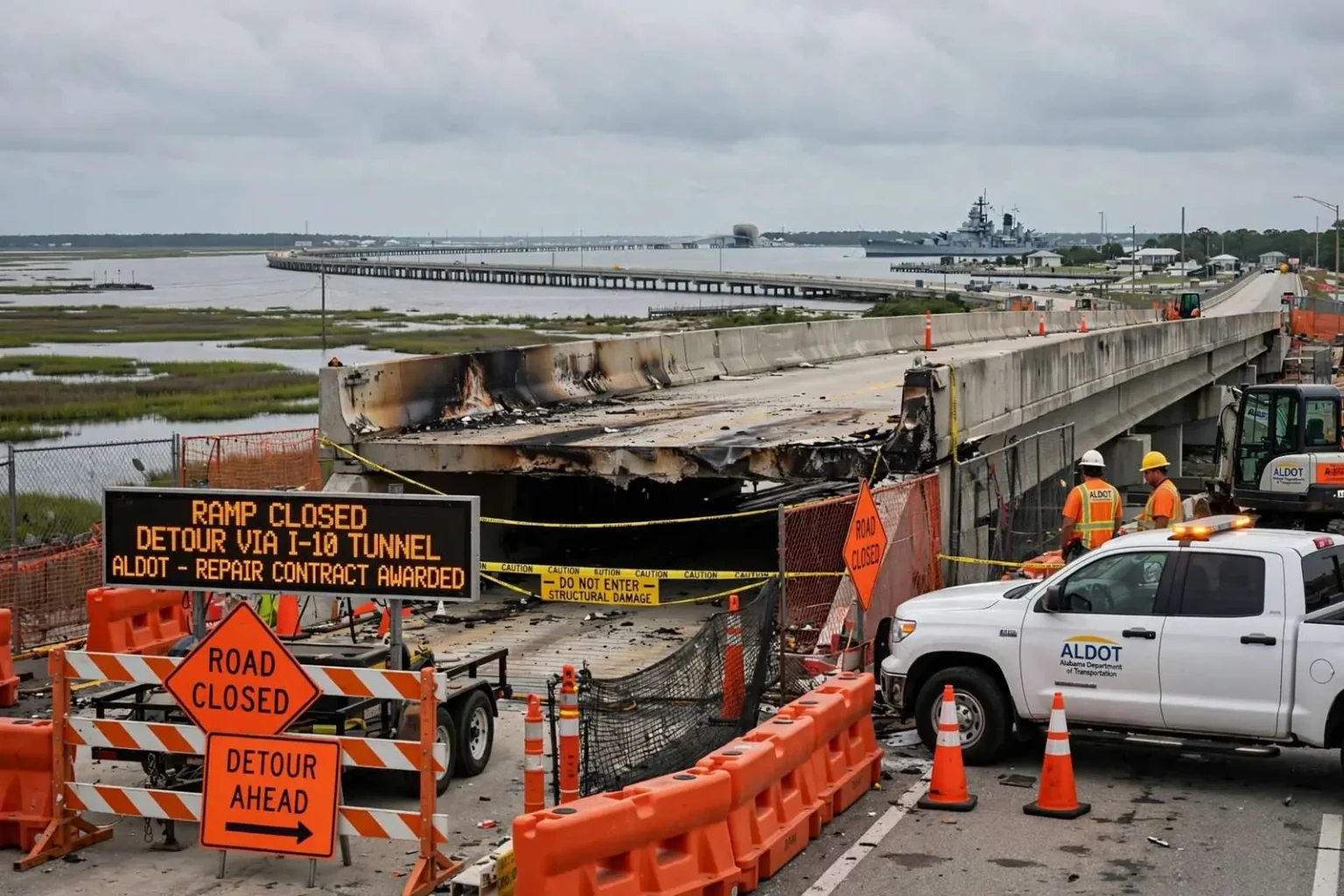
MOBILE, Alabama — The exit ramp connecting Interstate 10 to the Battleship Parkway causeway, closed since a fiery crash in late July, is a step closer to reopening after state transportation officials awarded a contract to repair the damage this week.
Ramp repair contract awarded
A spokeswoman for the Alabama Department of Transportation said the agency awarded the repair contract this week, though more specific details on the timeline were still being finalized. The ramp has remained closed for weeks after the crash badly damaged the structure, forcing drivers headed toward the causeway to find alternate routes.
The closure has been felt well beyond the interchange itself. The Battleship Parkway — the low causeway crossing Mobile Bay that carries U.S. 90 past the USS Alabama Battleship Memorial Park — is one of only a handful of ways to get between Mobile and the Eastern Shore, and losing direct interstate access to it pushed traffic onto the tunnels and onto surface streets in both directions. Commuters who used the ramp for a quick connection between I-10 and the Parkway have instead had to thread through downtown or run the full length of the bay on other crossings.
The crash that damaged the ramp involved fire intense enough to compromise the structure, and repairs to burned or spalled concrete on an elevated ramp are not the kind of work that can be patched overnight. Crews must assess the deck and supporting elements, remove damaged material, and rebuild to standards that will carry interstate loading for years, which is why ALDOT moves carefully even when drivers are impatient.
The closure was one of several traffic headaches around Mobile as the Labor Day holiday weekend brought increased traffic to area roads. Alabama State Troopers also confirmed that one of five deadly Labor Day weekend crashes across the state happened on a Mobile County road, when a driver was killed overnight on Theodore Dawes Road.
Troopers traditionally mount heightened enforcement patrols across south Alabama during holiday weekends, watching for speeding, impaired driving and seat belt violations, and this year’s tally of five deadly crashes statewide was a reminder of what is at stake when summer travel volume peaks. The overnight fatal crash on Theodore Dawes Road, in the western part of the county, underscored the risk on rural and suburban routes as much as on the interstates.
New roundabout construction underway
Elsewhere in Mobile County, construction began without incident this week on the county’s second roundabout, located at the intersection of Three Notch Road, Dawes Lane and Dawes Lane Extension. County officials said electronic message signs were installed ahead of time to warn drivers, and the project is expected to take about two months to complete.
The intersection is a familiar choke point in the fast-growing area around Theodore, where residential development has steadily added traffic to roads originally laid out for far lighter volumes. Roundabouts have become the county’s preferred fix for such intersections because they keep traffic moving at low speeds, eliminate the left-turn crashes that dominate injury statistics at signalized crossings, and cost less to maintain than traffic signals since there are no lights or controllers to power and repair. The project follows the county’s first roundabout, and engineers will be watching how drivers adapt to the second.
Electronic message boards placed in advance of the work are standard practice for the county, giving commuters several days’ notice of lane shifts and flagging operations. Drivers should expect the intersection to remain open for much of the construction period, with alternating closures likely as crews build the new circulatory roadway around the existing pavement.
Downtown, crews are wrapping up emergency sewer repair work on Royal Street between Dauphin and Conti streets that began two weeks earlier. The contractor patched the road temporarily so it could remain open through the holiday weekend.
Emergency sewer repairs are disruptive by nature: the lines beneath downtown Mobile are among the oldest in the system, and when a section fails, crews must excavate in the middle of the roadway, replace the failed segment, and restore the street in stages. The temporary patch on Royal Street allowed restaurants and shops in the Church Street East and Dauphin Street historic districts to keep their street access during one of the busiest visitor weekends of the year, with permanent resurfacing to follow once the repair work is signed off.
A busy season for state road projects
State road crews have several other Mobile County projects moving at once, including resurfacing and safety widening on State Route 163, expected to wrap up in about 35 working days, and resurfacing and bridge work on I-10 between Halls Mill Creek and the George C. Wallace Tunnel that is expected to continue into next summer. Nighttime lane closures with minimal delays are expected on that stretch several nights a week.
The I-10 work is the most visible of the batch, running along the elevated roadway that carries interstate traffic through the city toward the tunnels. Resurfacing a corridor of that volume requires night work by design — closing lanes during daytime hours would gridlock the region — and ALDOT has scheduled the closures for several nights a week to spread the inconvenience while keeping the project on a schedule that runs into next summer because of the bridge elements involved.
Interstate 65 work near Saraland is about 95 percent finished, while resurfacing on U.S. 90 between Halls Mill and Pine Hill Drive is just getting underway and should wrap up by December.
The I-65 project near Saraland has been one of the longer-running state projects in the county, touching a stretch of interstate that carries commuters from north Mobile County and traffic heading between I-65 and U.S. 43. With the work now roughly 95 percent complete, drivers there are mainly seeing finish work — striping, shoulders, and punch-list items — rather than full-scale construction. Farther south, the U.S. 90 resurfacing between Halls Mill and Pine Hill Drive is just starting and will continue into December, refreshing a heavily traveled commercial corridor.
Baldwin County’s parallel projects
In Baldwin County, the connector between County Road 68 and the Baldwin Beach Express is roughly 90 percent complete, with occasional lane closures still possible on County Road 83. Resurfacing on Alabama 181 between U.S. 31 and U.S. 90 is underway at night and should finish by October.
The Beach Express connector is part of the county’s broader effort to build out a network of expressways that moves beach traffic off the two-lane roads that once funneled every summer visitor through Daphne, Fairhope and Spanish Fort. Each completed connector shifts more of that traffic onto purpose-built corridors, and the near-completion of the County Road 68 link marks another step in that long-term plan. The nighttime resurfacing on Alabama 181, meanwhile, addresses a state highway that has been transformed by the county’s growth — what was once a quiet rural route now carries substantial commuter and school traffic between U.S. 31 and U.S. 90.
The Little Lagoon Pass bridge remains under construction as well, at roughly the halfway point, with a temporary detour bridge expected to stay in place through the end of the year.
The Little Lagoon Pass project is one of the most closely watched on the coast, replacing an aging span at the pass that connects Gulf Shores’ western end to the Fort Morgan peninsula. The temporary detour bridge has kept traffic moving beside the construction site while the new bridge is built, an arrangement that will remain in place through the end of the year as work passes its halfway mark. Residents and visitors on the peninsula have adjusted their routines around the work zone, which is unavoidable for a bridge that serves as the only road link for Fort Morgan communities.
State officials say they will continue to provide updates as the I-10 ramp repair timeline becomes clearer and as the various Mobile and Baldwin county projects progress toward completion.
Taken together, the season’s project list shows how much of the region’s transportation spending is aimed at catching up with growth. Resurfacing jobs on State Route 163, U.S. 90 and Alabama 181 repair corridors that carry far more traffic than they did when last paved. The roundabout at Three Notch and Dawes Lane and the Beach Express connector in Baldwin County each address intersections and routes that development has outgrown. And the ramp repair on I-10 is a reminder that the existing system needs constant maintenance even before any new capacity is added, since a single crash can close a key connection for weeks. For drivers, the practical advice is the same in every case: expect work zones, obey reduced speed limits through them, and plan around the nighttime closures that will remain a fixture of area travel well into next year.