Mobile Council Members Push Soccer Complex Partnership With County
Several Mobile City Council members urged Mayor Sandy Stimpson to partner with the county on a soccer and aquatic complex near I-10 and I-65.
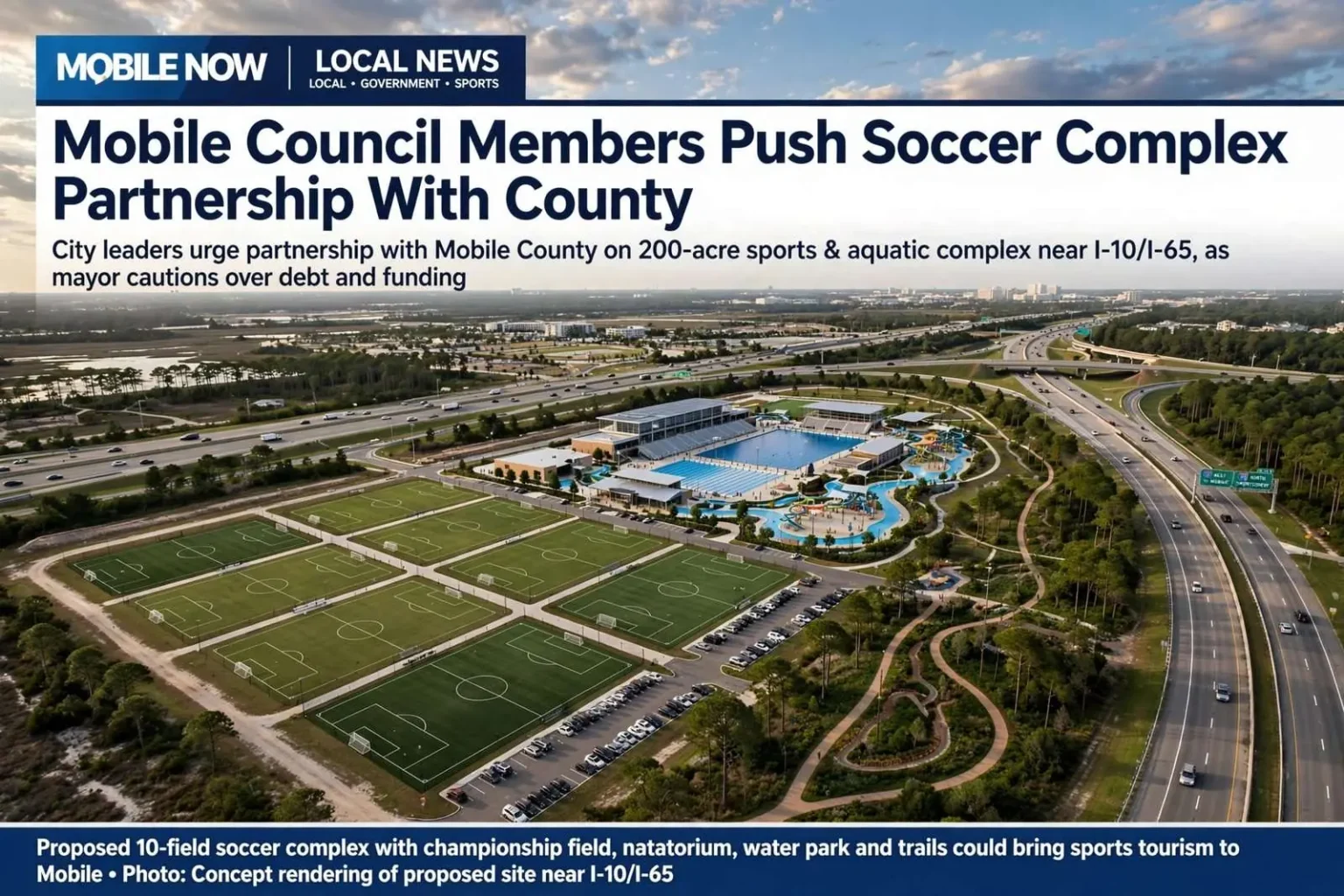
Before the soccer complex debate reached the Mobile City Council floor as a formal budget item, several council members were already pressing Mayor Sandy Stimpson to get behind a partnership with Mobile County on the ambitious sports and aquatic project proposed near Interstates 10 and 65.
The exchange set up a familiar dynamic in Mobile County politics: a county government holding the land, the option and the borrowing power, a city government wary of its own balance sheet, and a council split between fiscal caution and the promise of a facility that could finally put Mobile in the tournament business.
The Mayor’s Caution
Stimpson, appearing on a local radio program, said the city needed to move carefully given its existing debt load compared to the county’s greater borrowing capacity.
“My only concern is we don’t have any borrowing capacity whereas the county does,” Stimpson said. “We have to be very thoughtful about us participating in any future debt until we can get a better grip of what we have.”
The caution reflected the arithmetic of two very different balance sheets. The city had already committed itself to a series of large obligations, and every dollar of future debt service competes with streets, drainage, public safety and the rest of the general fund. A mayor weighing a new partnership had to ask not just whether the complex was a good idea, but whether the city could afford its share without crowding out the services residents notice first.
The Council Pushes
Council members C.J. Small, Bess Rich, and Fred Richardson each voiced support in the days leading up to that interview for the city to join the county on a complex that would include 10 tournament-sized soccer fields, seven grass and three turf, along with a championship field with bleacher seating.
The scale of the plan was the point. Tournament-grade fields with lighting, parking and seating are what allow a venue to book multi-day events that bring hundreds of families into town for a weekend — the visitors who fill hotel rooms, restaurants and gas stations while their children play.
Future phases envisioned for the site include an 80-acre natural habitat with certified cross-country trails, a natatorium with a 50-meter competition pool, a leisure pool, and an outdoor water park featuring a lazy river and splash pads. Taken together, the phases described a sports campus capable of serving swimmers, runners and weekend splashing families as well as soccer players — a multi-sport draw rather than a single-use park.
“This will help the county and city save money and make money at the same time,” Small said, arguing that Mobile has been losing out on soccer tournaments to other markets for lack of a modern facility. His case rested on a simple premise: the demand exists, the teams exist, and the only thing missing is a venue modern enough to host them.
Rich echoed that sentiment, saying she would have liked to see improvements at the Medal of Honor Park soccer fields but ultimately believed partnering on the new county-led site made more financial sense. “The soccer community will be greater served at the new location,” she said. “It is very important that we combine our monetary resources to achieve this goal.”
Rich’s position was notable because it chose a regional project over a neighborhood one. Medal of Honor Park on Cottage Hill Road has long been one of the busiest recreation sites in the city, and its soccer fields have carried heavy use for decades. Upgrading them would have served Mobile players directly; joining the county complex instead meant betting that a bigger regional facility would return more to the city than renovated neighborhood fields ever could.
The County’s Case
Mobile County Commissioner Connie Hudson, in a letter dated Aug. 29, said the county held a legal option to purchase 200 acres for the project and described the complex as a potential driver of sports tourism revenue for the region.
“This complex will be a tremendous asset for the Mobile area in providing long-awaited recreational venues for our citizens,” Hudson wrote, adding it would let the city and county compete more aggressively for tournament business.
The letter framed the project as more than a parks expenditure. Sports tourism has become a competitive industry across the Southeast, with municipalities building ever larger complexes to capture the weekend traffic of traveling teams. The county’s option on the land gave it the one asset that cannot be borrowed: a site big enough, and well enough placed near the Interstate 10 and Interstate 65 junction, to anchor that traffic.
The Proof Across the Bay
Danny Corte, executive director of the Mobile Sports Authority, said developing dedicated soccer fields in Mobile has been a priority dating back to at least 1998.
He pointed to Baldwin County’s success building a soccer tourism economy, noting Orange Beach continues to host the NAIA Women’s Soccer National Championship through the 2015 season and that the Southeastern Conference’s women’s championship is held there each November. For a city of Mobile’s size to watch a smaller neighbor corner two signature events made the argument almost by itself.
Corte also cited the long-running Halloween Blast tournament that draws more than 100 teams to Daphne and Fairhope each fall, along with Fairhope’s own plans to build a 10-field complex near Manley Road. Each fall weekend those tournaments run, Baldwin County’s hotels and restaurants collect revenue that Mobile’s could have — revenue generated by families who book rooms and eat meals between games.
“All you have to do is look around and see the growth in soccer,” Corte said, framing Mobile’s potential complex as a chance to catch up with the sports tourism gains already underway across Baldwin County.
The sport’s growth is national, but it has been especially visible along the Gulf Coast, where youth club soccer has multiplied over two decades and where mild winters let tournaments run nearly year-round. A complex with ten tournament fields could host a full weekend bracket in one place — something no single Mobile facility could offer.
The debate over the complex ultimately turned on the same question that frames most partnerships between the two governments: who pays, who controls, and who collects. What made this round different was the unanimity of ambition on the council side and the county’s head start on land and financing — a combination that turned a parks project into a test of whether Mobile intended to compete for the sports tourism economy at all.
For families who follow youth soccer in the area, the frustration Corte described was familiar. Local leagues have long juggled practice schedules across scattered parks, and hosting a true tournament in Mobile has meant spreading fields across multiple sites — an arrangement that frustrates referees, exhausts volunteers and sends visiting teams to more convenient markets. A single campus with ten tournament fields, seven grass and three turf, would allow an entire age division to play, rest and replay on the same ground.
The turf fields matter in a coastal climate as much as the grass ones. Summer thunderstorms can render a natural pitch unplayable for a day or more, and a championship weekend cannot afford to wait on the weather. Synthetic surfaces drain quickly and recover immediately, which is why tournament operators increasingly insist on them, and why the plan’s three turf fields may end up hosting the most consequential games on the calendar.
The aquatic phases would serve a different but overlapping crowd. A 50-meter competition pool is the standard for major meets, and south Alabama swimmers currently travel long distances to find one; a natatorium on the campus would let the region attract swim championships the same way the fields would attract soccer brackets. The leisure pool, lazy river and splash pads, meanwhile, are the components that keep families on site between games — and give the facility year-round public use when no tournament is in town.
The 80-acre natural habitat with certified cross-country trails rounds out the vision. Cross-country programs across the region have few true championship courses to call home, and certified trails could make the campus a fall destination for high school and collegiate meets. The habitat acreage also preserves green space at a site otherwise destined for parking lots and playing surfaces.
Whether the city joined the county or watched from across the table, the underlying facts were unlikely to change: the land option rested with the county, the borrowing capacity rested with the county, and the tournaments were already driving east across the bay. For Stimpson, the question was how a cash-strapped city buys into that future. For Small, Rich and Richardson, the question was how Mobile could afford not to.