Dredging Begins at Gulf Shores’ Little Lagoon Pass as Bridge Project Continues
State crews begin a two-month dredging project at Little Lagoon Pass in Gulf Shores to restore storm-eroded beach near the ongoing bridge rebuild.
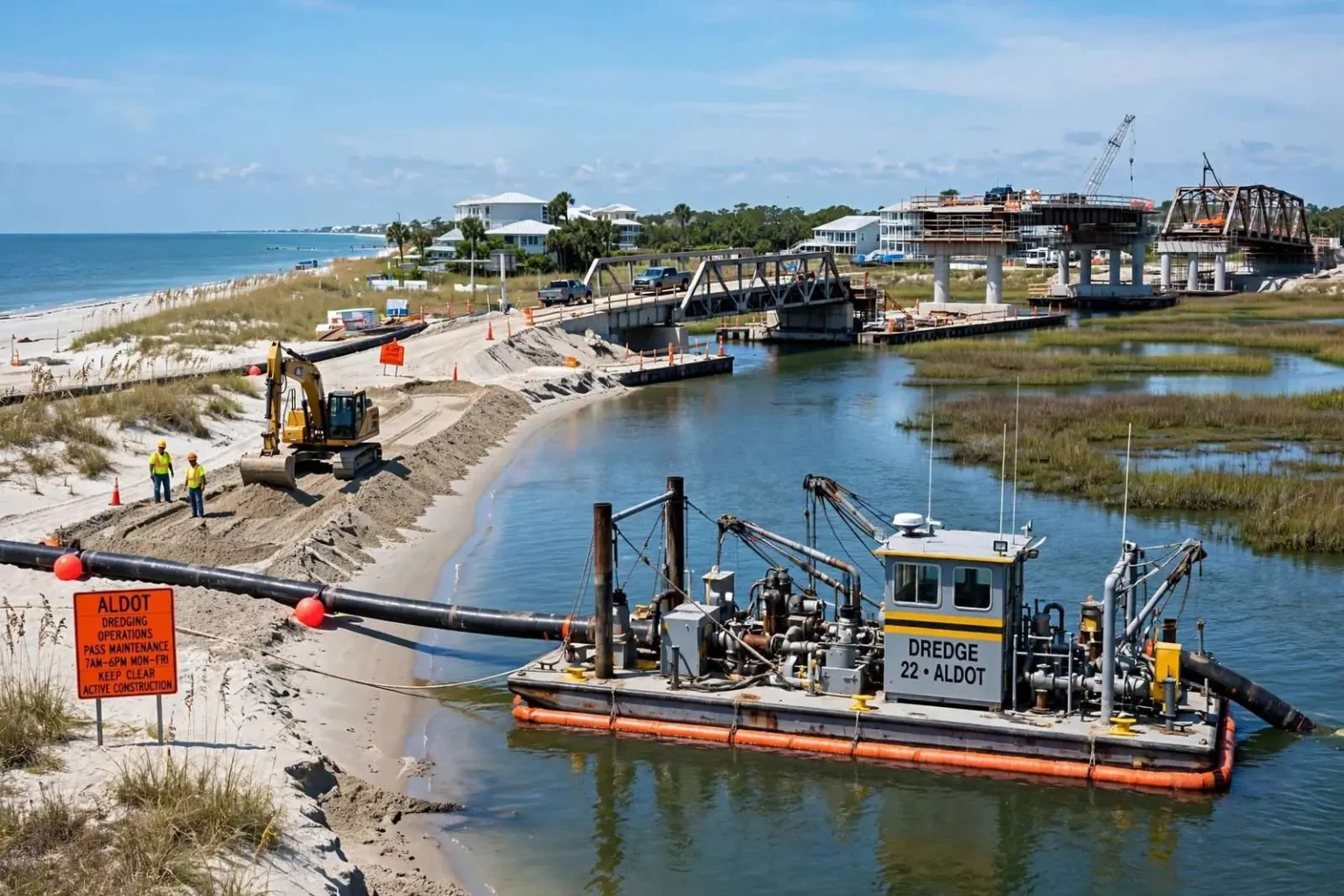
Heavy equipment is set to move into Little Lagoon Pass this week as the Alabama Department of Transportation begins a maintenance dredging operation tied to an ongoing bridge replacement project along West Beach Boulevard in Gulf Shores. The work marks the latest phase in a long-running effort to rebuild one of the island’s most important crossings while keeping the pass itself open and functional for the boaters, anglers, and swimmers who depend on it.
The work, scheduled to start Monday, will run roughly two months, with crews operating Monday through Friday between 7 a.m. and 6 p.m. The dredging will pump sand along the shoreline west of the pass, aiming to restore beach that eroded during winter storms earlier in the year. State officials say the project is a routine but necessary step to keep the pass functioning properly while the larger bridge project continues nearby.
Little Lagoon Pass is the narrow channel that connects Little Lagoon, one of the largest freshwater-to-brackish bodies of water on Alabama’s coast, to the Gulf of Mexico. That connection is what makes the pass valuable: tides move through it twice a day, carrying in the saltwater and bait fish that make the pass one of the most popular fishing spots in Gulf Shores, and allowing water quality in the lagoon itself to cycle. Channels like this one are perpetually fighting the Gulf, which wants to fill them in with sand, and without periodic dredging the pass narrows and shoals until boats struggle to get through and the exchange of water slows.
A Bridge Project Years in the Making
That larger project, a roughly $12 million effort to replace the Lee Callaway Bridge on West Beach Boulevard, has been underway for months. Crews have already demolished the old bridge and are working to rebuild a new, wider span in its place. A temporary bridge has kept traffic moving across the pass in the meantime, a critical detail for a coastal town where West Beach Boulevard is the spine of the beachside neighborhoods and every detour ripples through the summer traffic pattern.
Once complete, the new structure will be a two-lane bridge, and the pass itself will nearly double in width, growing from its current narrow opening to about 80 feet across. The widening matters beyond convenience for drivers. A broader pass improves tidal exchange between the lagoon and the Gulf, which benefits water quality and the marine life that gathers at the channel, and it makes navigation safer for the small boats that run between the lagoon and the Gulf throughout the fishing seasons.
Officials expect the full bridge project to wrap up by the end of the year, though the dredging currently underway is a separate, shorter-term phase focused specifically on shoreline restoration rather than the bridge structure itself. The two phases work in concert: while heavy civil crews build the new crossing, marine crews move the sand that winter storms stripped from the beaches west of the pass, using the material dredged from the channel to rebuild what the weather took away.
Protecting the West Beach Corridor
Local officials have described the work as part of a broader effort to protect West Beach infrastructure, an area that has seen repeated erosion and storm damage challenges in recent years. The West Beach corridor sits on some of the most exposed real estate in Gulf Shores, fronting the open Gulf and absorbing the brunt of every winter nor’easter and hurricane season alike. Keeping the road, the pass, and the beaches in front of them maintained is a constant municipal and state undertaking, and the current projects represent one of the larger investments in that effort in recent memory.
Residents and visitors near the pass should expect ongoing construction activity and equipment presence throughout the dredging window, though the project is not expected to close public access to the beach or roadway during daytime work hours. Dredging operations of this kind typically involve a barge-mounted dredge in the channel, pipeline running to the beach west of the pass, and heavy equipment shaping the deposited sand — a working scene that beachgoers will be able to watch but are asked to give a wide berth.
The sand being pumped onto the shoreline comes from the pass itself, which makes the operation doubly useful: material that would otherwise be an obstruction to navigation becomes the raw material for beach restoration. Coastal engineers call this a borrow-and-beneficial-use approach, and it has become standard practice on developed barrier islands where the alternative — hauling in sand from upland or offshore sources — is far more expensive. Along West Beach, where storm waves regularly chew away at the beach face, every cubic yard of sand placed back on the shoreline buys some protection for the road and the development behind it.
For a stretch of coastline that depends heavily on tourism and recreational fishing, keeping Little Lagoon Pass properly maintained carries real economic significance. The pass draws anglers from across the region for its seasonal runs of fish moving between the lagoon and the Gulf, and the beaches on either side are part of the strand that supports Gulf Shores’ tourism economy, the industry on which the city’s budget and thousands of jobs rest. A shoaled pass and an eroded beach are not just inconveniences; they are slow leaks in the local economy that only get costlier the longer they go unaddressed.
What Boaters and Anglers Should Know
Boaters who use the pass should pay close attention to construction notices while the dredge is operating. Working equipment in a channel that is already narrow means reduced maneuvering room, and mariners are typically asked to pass at slow speed, honor any safety zones around the dredge, and watch for pipeline markers near the shoreline. The channel’s marked route can also shift as dredging progresses, so local fishing guides and bait shop owners will be the best source of current intelligence until the work concludes.
Anglers, meanwhile, can expect the disruption to be temporary. Dredged passes historically fish well once the equipment leaves, because the deeper channel concentrates moving water and the fish that follow it. The widened pass created by the new bridge project should only improve that dynamic, giving the tide more room to flush through and creating a larger zone of current where bait and game fish gather.
Completion of both projects before the end of the year would close out a chapter that has kept the western end of Gulf Shores under construction through the tourism seasons. When the temporary bridge comes out and the new Lee Callaway Bridge opens, drivers on West Beach Boulevard will cross a wider, higher structure over a wider pass, and the beach to the west will be standing on fresh sand. It is maintenance work in the most literal sense — the unglamorous, repetitive business of keeping a barrier island’s infrastructure a step ahead of the Gulf — and it is the kind of work that determines what West Beach looks like for the next generation of residents and visitors.
ALDOT’s role in the project reflects how the state categorizes its coastal infrastructure. West Beach Boulevard is a state route, which places the Lee Callaway Bridge squarely within the department’s maintenance and replacement responsibility, alongside the causeway crossings and beach highways that stitch together Alabama’s coastal communities. The agency’s coastal section deals with challenges that most of its district offices never see — salt-laden air that corrodes bridge components, tides and storm surge that reshape channels, and a tourism economy that demands work be scheduled around peak seasons rather than through them.
Winter storms, the ones blamed for the erosion the dredging will repair, are a chronic force along West Beach. Every cold-season front that pushes strong northeasterly winds across the open Gulf drives water and waves directly at the west-facing shorelines of the island, and a season of repeated events can strip away a beach face that took years to accrete. Unlike a hurricane, which arrives as a single dramatic event, winter erosion is cumulative, which is why the repair schedule looks less like disaster response and more like routine maintenance conducted on a multi-year rhythm.
The two-lane configuration of the new bridge is a deliberate choice rather than a compromise. West Beach Boulevard serves a mix of local residents, rental guests, and beach traffic, and planners have generally favored modest two-lane crossings with widened shoulders and improved safety features over sprawling multi-lane structures that would consume more of the narrow island and invite higher speeds through residential blocks. The replacement gives the corridor a modern structure built to current standards — stronger piling protection, better railings, improved visibility — without changing the character of the road that defines the west end.
For now, the sequence of work at the pass will look like this: the dredge and its pipeline operate on weekdays through the two-month window, the temporary bridge continues carrying traffic in the mornings and evenings, and the new bridge rises in stages between them. Gulf Shores officials have asked for patience from the neighborhoods around the pass, noting that the construction activity, noise, and equipment presence are the visible cost of infrastructure that has to be renewed on a barrier island where nothing stays put for long.