Mobile County School Officials to Unveil Design for New Fournier-Chastang K-8
Mobile County school leaders will present renderings of the new Fournier-Chastang K-8 School, a $14 million project rising along Interstate 65.
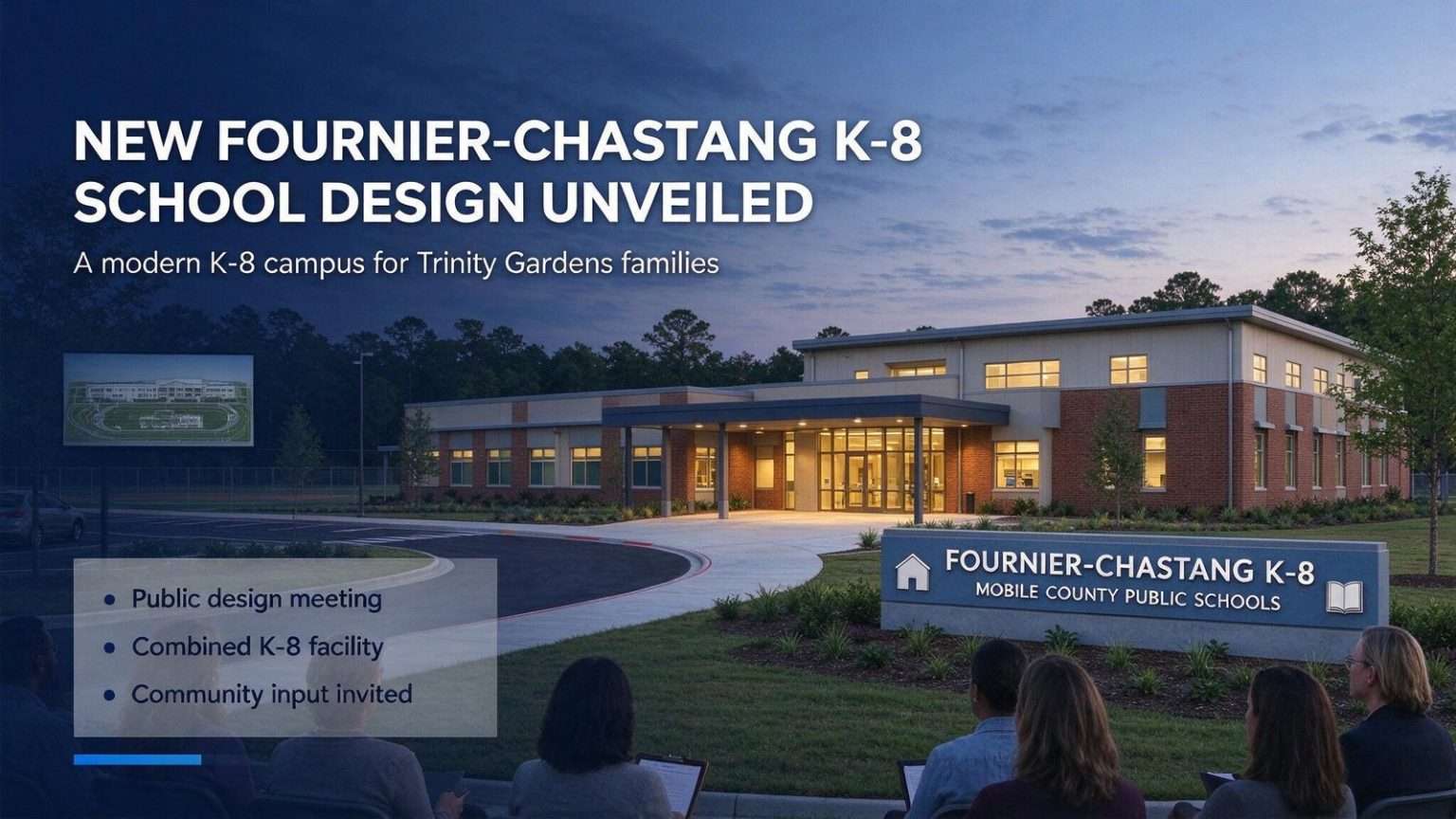
Families in Mobile’s Trinity Gardens neighborhood will get their first real look at what a long-planned replacement school will actually look like when Mobile County school system officials hold a public meeting at Chastang Middle School. The gathering is set for 6 p.m. and will center on architectural renderings and construction details for the new Fournier-Chastang K-8 School, a project that has been in the works for months as part of a broader push to modernize aging campuses across the county.
For parents in the area, the session marks the moment a project that has existed mostly in bond-program paperwork becomes something they can see on a screen — floor plans, elevations, parking layouts and the practical details that determine how a campus will function day to day. School system representatives plan to walk attendees through the proposed layout and design choices while fielding questions from parents, teachers and neighborhood residents who want a say in how the new campus takes shape.
Public input meetings of this kind have become a standard step in large school construction programs, and officials in Mobile County have leaned on them to build community support for projects that reshape long-standing neighborhood institutions. A school is often the most visible public building in a community like Trinity Gardens, and decisions about where it sits, how it looks and who it serves draw attention that few other civic projects attract.
Two schools become one
The new building will replace two schools that have served the Trinity Gardens area for decades. Students currently attending the former Brazier Elementary campus and Chastang Middle School will eventually move into a single combined K-8 facility, a shift school system leaders say will streamline resources and give younger and older students access to updated classrooms and shared facilities under one roof.
The K-8 model has gained traction nationally and across Alabama as districts weigh the costs of operating numerous small campuses against the educational benefits of keeping students in a familiar setting through the middle grades. In a combined school, elementary students can remain in a neighborhood setting they already know, while middle schoolers gain access to facilities — labs, libraries, athletic spaces — that a small standalone middle school often struggles to maintain. The approach also allows one administrative team, one cafeteria operation and one transportation plan to serve the same enrollment that once required two.
The new campus is planned to sit along Interstate 65, giving it a visible presence for a community that has watched the surrounding corridor change over the years. The interstate has shaped development patterns across Mobile for decades, and a campus along the corridor will be among the first things many travelers see as they pass through the northeastern part of the city. School leaders have pointed to the site’s accessibility as a practical advantage for families and buses alike.
The roughly $14 million project carries a name that reflects the district’s own history. Earlier in the year, the Mobile County school board voted to attach the Fournier name to the new building, honoring Hazel Fournier, a longtime board member and school system employee whose career was closely tied to local education efforts. Pairing her name with the existing Chastang identity was meant to preserve continuity for a community that has known the middle school under that name for years.
Part of a larger building program
This project is not an isolated one. It marks the second entirely new school building to move forward under the school system’s $100 million bond initiative, a financing program aimed at replacing or renovating a handful of the district’s oldest facilities. Bond programs of that scale are uncommon in Alabama school systems, and Mobile County’s effort has required the board to prioritize among dozens of aging campuses — some of them buildings that have served students since the era of segregation and desegregation.
The Mobile County Public School System is the largest school district in Alabama, serving tens of thousands of students across the city of Mobile, the Eastern Shore suburbs and the rural stretches of the county. With that scale comes an aging inventory: elementary and middle school buildings scattered across more than a thousand square miles, many of them decades old and costly to maintain. District officials have argued that replacing the most worn facilities is cheaper over time than continually patching them, and the bond initiative represents the most ambitious attempt in years to act on that argument.
Hoar Program Management, the firm overseeing construction management for the broader bond program, has been coordinating timelines and budgets across the various campus projects included in the initiative. Program management firms of this kind serve as a buffer between school boards and contractors, tracking costs, schedules and change orders so that individual campus projects do not drift away from the overall program budget. For a district managing multiple simultaneous construction efforts, that oversight role is central to keeping promises made to taxpayers when the bond was approved.
According to Tommy Sheffield, the school system’s executive facilities manager, the Fournier-Chastang project is expected to go out to bid in November, opening the door for construction contractors to submit proposals for the work. Bidding is the step where design becomes a contract: local and regional builders will price the drawings, and the district will evaluate submissions before awarding the job. The gap between the public design meeting and the bid opening gives district staff time to incorporate community feedback into final documents.
What families can expect
Once a contractor is selected, officials estimate the build itself will take more than a year to complete, meaning students are not likely to walk the halls of the finished school until sometime after the 2015-2016 school year gets underway. In the meantime, students will continue attending classes in the existing buildings, and district officials have said the transition to the combined campus will be planned so that students, teachers and staff move together as complete school communities rather than being scattered.
For a stretch of Mobile County that has waited years for updated school facilities, the session represents one of the first concrete steps toward seeing the K-8 school move from bond-program paperwork to an actual construction timeline. Parents who attend will see renderings of classrooms and common spaces, hear the construction schedule firsthand, and have the chance to raise questions about everything from traffic patterns at drop-off to how the merger of two school identities will play out in athletics, clubs and school traditions. For the Trinity Gardens community, the meeting is where a decade of planning begins to take on a shape residents can actually picture — and, in time, walk through.
A neighborhood and its schools
Trinity Gardens is one of Mobile’s long-established communities, a residential neighborhood in the city’s northeastern section whose identity has been tied for generations to its churches, its civic groups and its schools. Families there have watched the Interstate 65 corridor grow up around them, bringing new commerce and traffic while the neighborhood’s core remained residential. The condition and future of the local schools have been a recurring concern for residents, who have seen how the quality of school buildings influences everything from enrollment to home values.
Community response to consolidation projects tends to mix optimism with attachment. Many parents welcome modern classrooms, up-to-date technology infrastructure and safer buildings, but they also worry about what happens to school traditions, staff relationships and the identity their children have grown up with. District leaders involved in the Fournier-Chastang project have emphasized that the combined school is intended to carry forward both campuses’ legacies rather than erase them — a intent reflected in the decision to keep the Chastang name alongside the new Fournier honor.
The naming itself carries weight in a district where school names often trace back to educators who shaped the system. Hazel Fournier’s career connected her to local education efforts across decades of service as a board member and school system employee, and supporters of the naming resolution described it as a fitting tribute to that record. For students, the name will be a daily reminder of the people who built the system they now attend, and for older residents it preserves a link between the new facility and the schools that came before it.
Details that residents will want to watch as the project advances include the construction schedule, the traffic plan for the I-65-adjacent site, and how the district phases the move from two operating campuses into one. Questions about bus routes, boundary lines and which teachers and programs make the transition are typical at this stage, and district officials generally use these public sessions to gather that feedback before final decisions are locked in with contractors.
The meeting at Chastang Middle School is open to families and residents of the area, and district officials have encouraged attendance from anyone with a stake in the new campus. For a community that has waited years for updated school facilities, it is the clearest sign yet that the Fournier-Chastang K-8 School is moving from concept to construction — one rendering, one question and one answer at a time.