Mobile Mayor Questions Soccer Complex Push in 2015 City Budget
Mayor Sandy Stimpson urged caution on a proposed Mobile County soccer and aquatic complex, saying the city should focus on fixing existing parks first.
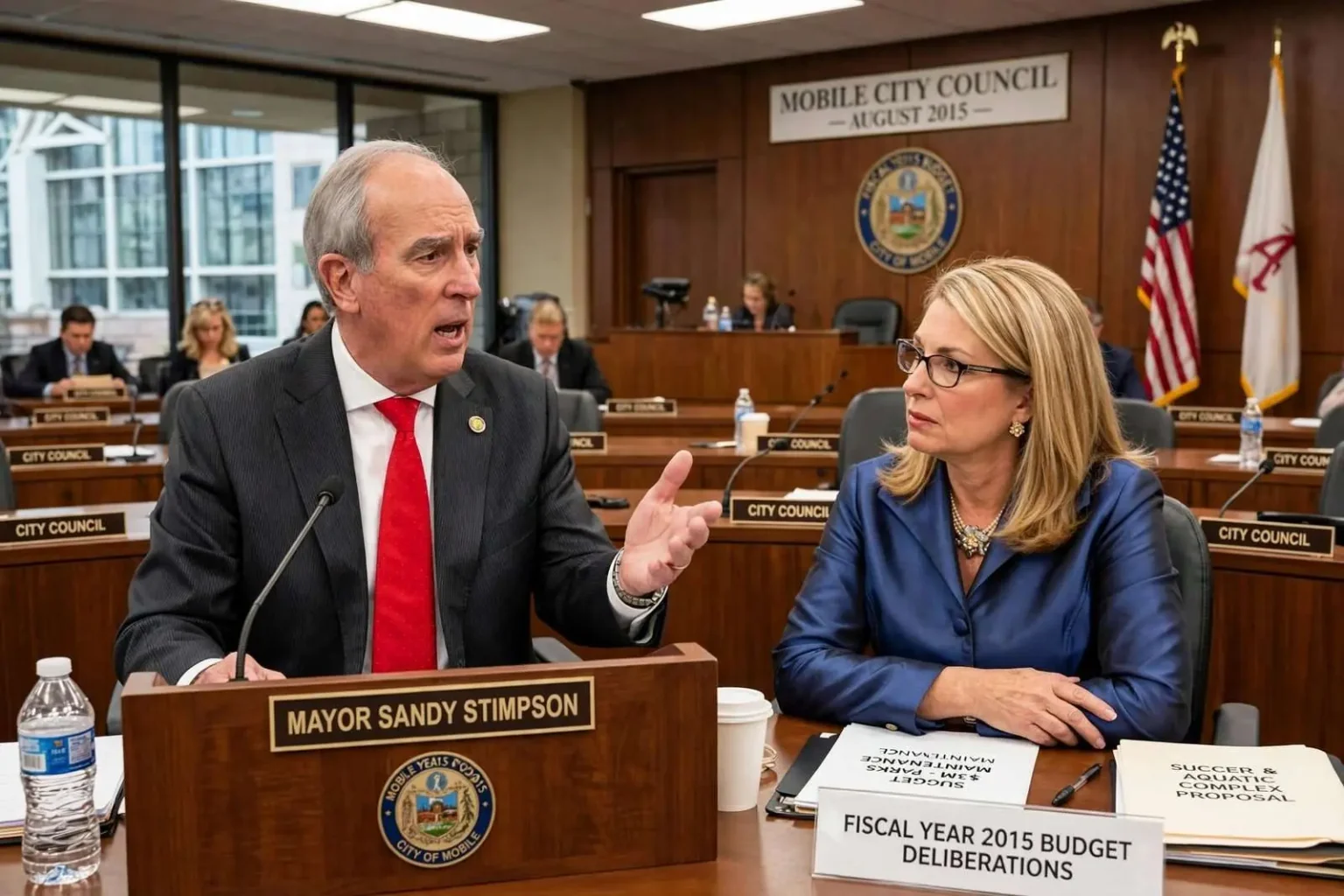
Plans for a large soccer and aquatic complex near Interstate 10 and Interstate 65 became a point of tension at Mobile’s City Council meeting this week, after Mayor Sandy Stimpson questioned whether the project belonged in the city’s fiscal year 2015 budget at all. The exchange, unfolding in the middle of the city’s annual budget deliberations, laid bare a running argument at Government Plaza over how Mobile should spend its money: catching up on the parks and streets it already has, or betting on new amenities that could reshape the region’s sports tourism economy.
A pay-as-you-go park plan versus a new complex
Stimpson told council members the idea “came up quickly” and that he would question whether the council needed to act on it right away. His administration has proposed dedicating roughly $3 million in the coming year’s budget toward fixing up the city’s existing parks rather than committing money to a new complex, describing it as a pay-as-you-go approach to catching up on years of deferred maintenance. The mayor, a first-term executive who made fiscal discipline a centerpiece of his campaign, argued that a city carrying hundreds of millions in debt should think hard before adding new recreational infrastructure to its responsibilities.
The comments came a day after Mobile County Commissioner Connie Hudson asked the council to set aside city funding to help build the proposed complex, which would include 10 soccer fields for tournament play, an aquatic center with a lazy river and splash pads, an indoor competition pool, and roughly 80 acres of natural habitat with certified cross-country trails. The full project would sit on 200 acres, which the county currently holds an option to purchase for around $3.1 million. The site near the junction of Interstates 10 and 65 sits at one of the Gulf Coast’s great crossroads, the point where travelers from Florida, Mississippi, and New Orleans converge, and its accessibility is precisely what makes it attractive for regional tournament play.
“This is an opportunity to provide what the community has been begging for decades,” Hudson told council members, urging the city to partner with the county to make the project happen. She pushed back on the mayor’s characterization of the proposal as a surprise, noting that she had raised the idea with Stimpson’s administration early in his term and that the project had been publicly discussed for some time.
Debt, maintenance, and the question of who pays
Stimpson raised concerns about long-term costs, noting the city already carries close to $280 million in debt and would likely take on an ongoing maintenance obligation even if it isn’t asked to help finance construction directly. “If built, who will maintain it?” he asked. The question goes to the heart of municipal finance: mowing ten soccer fields, staffing and chemically treating an aquatic center, and maintaining trails and pools costs real money every year, long after the ribbon-cutting. Pools in particular are notorious budget items for Southern cities, with high utilities, seasonal staffing, and expensive repairs.
Hudson said the county has no intention of obligating the city to any responsibilities unless the two governments formally agree to specific terms in advance. Her position is that the partnership can be structured so the city knows exactly what it is committing to before it commits — a point she emphasized as she pressed the council not to let the proposal die in the budget process without a full airing.
The dispute is also a chapter in the ongoing division of labor between Mobile’s city and county governments. The county, under its commission, has increasingly taken on regional projects — parks, health facilities, and infrastructure — that serve residents well beyond the city limits, while the city concentrates on its own corporate limits and its balance sheet. Hudson, a former city councilwoman who moved to the county commission, knows both sides of that equation, which is why her advocacy for a city-county partnership carried particular weight in the chamber.
What’s at stake for Mobile
Supporters of the complex point to the experience of other Southeastern cities that built tournament-grade facilities and watched weekend visitors fill hotels, restaurants, and gas stations. Mobile, despite its convention center and downtown revival, has long lagged behind Gulf Shores and other regional competitors in capturing the youth sports travel market, where families arrive by the carload and stay for entire weekends. A complex at the I-10/I-65 junction would put the city directly in that trade.
The mayor’s allies counter that Mobile’s existing parks — from Municipal Park to Medal of Honor Park to neighborhood playgrounds in every district — have waited years for basic repairs, and that promising residents functioning amenities matters more than chasing visitors with new ones. The administration’s $3 million maintenance push is presented not as an alternative to ambition, but as the first claim on a limited budget.
For now, the project’s fate rests with the city council, which must pass a fiscal 2015 budget over the mayor’s stated reservations. Whether the soccer and aquatic complex makes it into that document, or waits for a future budget season, the debate has already clarified the two competing visions of Mobile’s future — one that builds what the city has, and one that builds what the city hopes to become.
The fields themselves
The scale of the proposed complex is worth spelling out. Ten soccer fields built specifically for tournament play would allow a host organization to run age brackets for an entire weekend — say, a boys’ tournament for younger divisions on Saturday and a girls’ showcase on Sunday — without shipping players across town between games. The aquatic center’s mix of a lazy river, splash pads, and an indoor competition pool would serve two audiences at once: families looking for recreation and swim teams needing year-round training space, a facility type that Mobile currently lacks at scale. The 80 acres of preserved habitat with certified cross-country trails would give the city a venue for high school and collegiate distance running events, a sport in which Alabama schools already compete for state titles on courses scattered across the region.
Siting the project near the Interstate 10 and Interstate 65 junction also reflects hard-won lessons in sports facility planning. Tournaments draw their crowds from a two- to three-hour drive radius, and complexes that sit at interstate interchanges capture families passing through as much as those who plan overnight stays. Mobile’s junction is the meeting point of the corridors linking Pensacola, New Orleans, Montgomery, and the beaches, making it arguably the most tournament-accessible ground on the northern Gulf Coast.
The county’s option and the path to construction
The county’s option to purchase the 200-acre site for roughly $3.1 million is the project’s first concrete step, and it gives the commission control of the land while funding partners are lined up. County officials have described the purchase as an investment that only makes sense if the governments that would benefit — the city among them — help carry the construction and operating load. That is why Hudson appeared before the council: the county can secure the dirt, but a project of this size typically needs a portfolio of contributors, from city and county general funds to tourism dollars, grants, and private naming or sponsorship arrangements.
The timing of Hudson’s appeal, one day before the mayor’s budget comments, was no accident. Municipal budgets are drafted by the administration but approved by the council, and advocates for any project know the council chambers in August are the one venue where a proposal can be written into next year’s spending plan over the mayor’s objection. Hudson’s request put the project squarely on that agenda, forcing a public position from a mayor who had been noncommittal.
Debt and deferred maintenance in context
Stimpson’s reference to roughly $280 million in city debt framed his caution in numbers the council could not ignore. Debt service is the part of a municipal budget that cannot be cut without consequence — it competes directly with police, fire, and street funding — and a mayor who inherited a backlog of capital needs is wary of any new obligation, however attractive. The administration’s pay-as-you-go philosophy reflects a broader trend among Sun Belt cities that watched older Northern municipalities buckle under infrastructure debt and resolved not to follow.
At the same time, Hudson’s argument about decades of unmet demand resonates with families who currently drive their children to tournaments in Foley, Gulf Shores, or Pensacola, spending their weekends — and their sales tax dollars — outside the city. The soccer and aquatics debate is, in that sense, a proxy fight over whether Mobile should capture its own residents’ recreational spending or keep improving the basics and let the travel market develop on its own.
What happens next is procedural but consequential. The council will work through the budget line by line in the coming weeks, and any funding for the complex would have to appear there. Whatever the outcome, both sides have staked out their principles in public: the mayor’s standard that new amenities must never crowd out existing obligations, and the commissioner’s conviction that a generation of Mobile families has waited long enough for a first-class regional sports facility.