Dinner and a Movie: Turkey Burgers With Asian Mayo and ‘The Danish Girl’
A lighter turkey burger with a zippy Asian-style mayo shared a Mobile Bay table with The Danish Girl, the award-winning period drama.
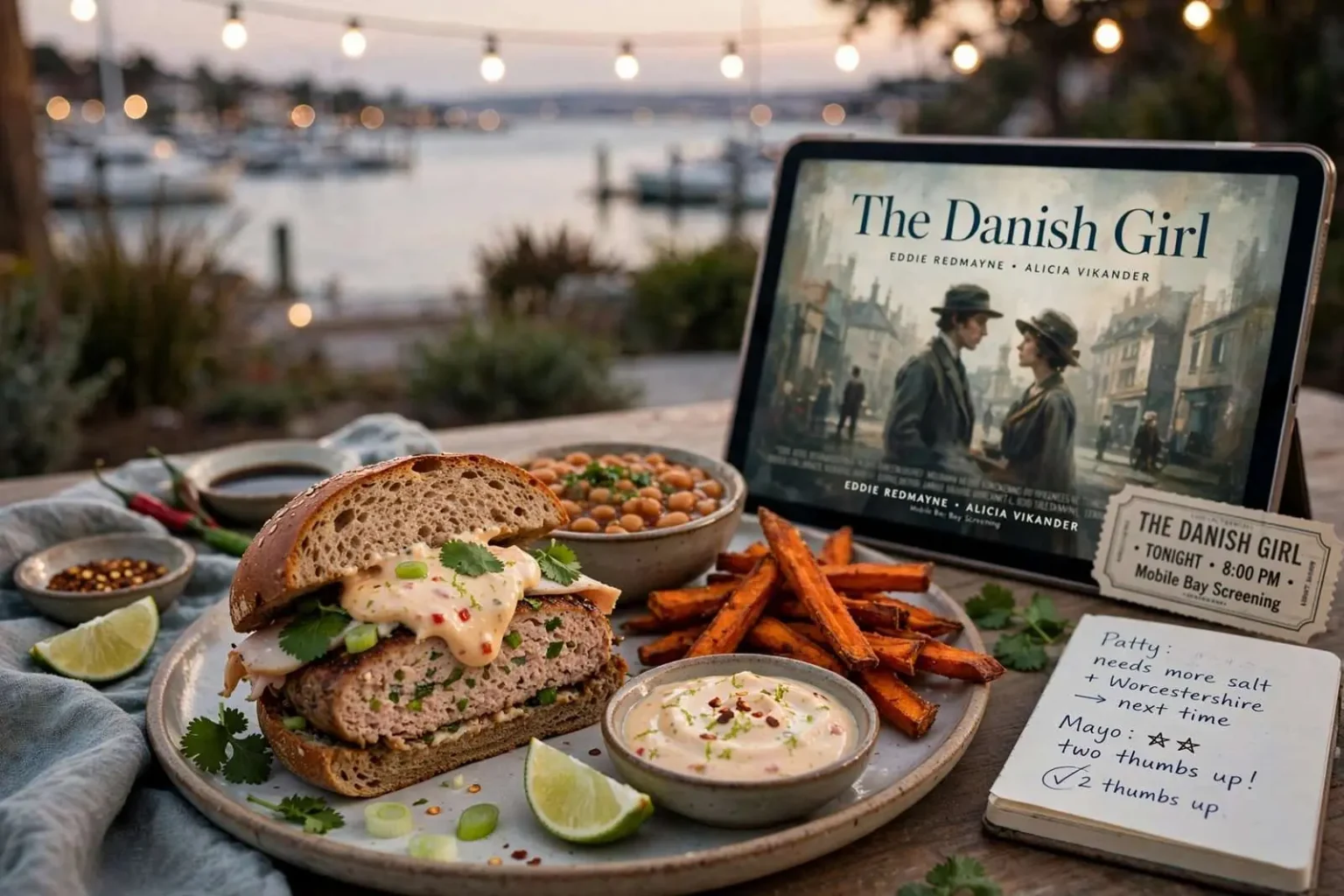
Even a household fond of pork burgers makes room for something lighter now and then. On this Mobile Bay evening, a turkey burger with a bright Asian-style mayo took center stage, followed by the acclaimed period drama The Danish Girl. The pairing made for an easy weeknight rhythm: a grill-and-mix dinner that came together quickly, then a film with enough weight to hold the couch for two hours after the dishes were cleared.
Turkey burgers occupy a particular place in the home-cooking repertoire. They promise the familiar satisfaction of a burger with a fraction of the fat, and they deliver on it — as long as the cook remembers that lean poultry has very little of the fat that makes beef burgers forgiving. A turkey patty cooked the same way as a beef patty tends to turn out dry and, left under-seasoned, bland. The whole game with turkey is what goes into the meat before it ever meets the heat, which is exactly where this recipe focused its effort.
In the kitchen
The burger started with a four-to-six-ounce turkey patty seasoned with green onion, cilantro, ginger, curry powder, ground cumin and soy sauce, then grilled or baked to preference. The seasoning blend leans toward Southeast Asian flavors rather than the standard ketchup-and-mustard direction, and that choice sets up everything else on the plate. Green onion and cilantro bring freshness, ginger and curry powder add warmth, and the soy sauce does double duty — salt and umami in one pour — while helping the lean meat hold onto moisture.
Four to six ounces is the right range for a patty that cooks evenly. Much bigger and the outside finishes long before the middle is safe to eat; much smaller and the burger dries out on a hot grill before it develops any color. Turkey needs to be cooked through completely — no pink middle, unlike a beef burger — so a moderate patty size with moderate heat is the reliable path. Grilling gives a smokier result; baking in the oven is the hands-off option and keeps the kitchen cooler on a Gulf Coast evening, which is no small consideration in summer.
The sauce was the simplest part of the build and, as it turned out, the best. A tablespoon of fat-free whipped dressing was mixed with a splash of lime juice and a small measure of Asian garlic chili sauce to make the mayo. The result is a bright, spicy, low-fat condiment that tastes considerably more indulgent than its ingredient list suggests. The lime keeps it sharp, the chili sauce brings heat with a little sweetness behind it, and the whipped dressing carries it all without the fat load of real mayonnaise. It is the kind of sauce worth mixing in a bigger batch and keeping in the refrigerator for sandwiches all week.
To serve, dieters could keep it lean with just the sauce; everyone else was invited to build it on rye or a bun with cheese, baked beans and chips or sweet potato fries. The rye option is an unusual and worthwhile one — its slight sourness cuts through the ginger-and-chili flavors better than a plain white bun does. Sweet potato fries are the natural sidekick for the Asian-leaning seasoning, their caramelized sweetness playing off the chili mayo, while baked beans round the plate out into a proper dinner rather than a snack.
The cook’s honest assessment: the patty itself ran a little bland and could use salt, Worcestershire and a dash of seasoning next time, earning a single thumb up. The Asian mayo, on the other hand, was the clear winner and took home two thumbs up on its own. That split verdict is instructive for anyone trying the recipe. Turkey burgers live or die on aggressive seasoning, and a soy-sauce-only approach left a gap that a teaspoon of salt and a few shakes of Worcestershire would have filled. Worcestershire works particularly well in ground poultry because its fermented depth mimics what fat normally contributes to a burger’s flavor.
The lesson generalizes: when cooking lean, season harder than instinct suggests, and build a condiment that can carry the plate if the main event underdelivers. This recipe, whatever its patty flaws, got the second half right. A sauce with this much personality can rescue a plain patty, and it costs almost nothing to make. Next time through, the same cook will fix the patty, keep the mayo unchanged, and probably end up with a burger that earns both thumbs.
On the screen
The evening’s feature was The Danish Girl, directed by Tom Hooper, starring Eddie Redmayne and Alicia Vikander alongside Ben Whishaw, Sebastian Koch, Amber Heard and Matthias Schoenaerts. Hooper, whose The King’s Speech took the Academy Award’s top prize a few years earlier, brought the same painterly, detail-forward style to this material, shooting Copenhagen and Paris in a soft, considered light that makes the 1920s settings feel like paintings come to life.
Set in 1920s Europe, the film tells the story of painter Einar Wegener and one of the earliest documented gender-confirmation journeys, and the marriage tested and transformed along the way. The historical heart of the story — the Danish artist Lili Elbe’s transition and the pioneering surgeries that followed — gave the film subject matter unlike anything else in mainstream release that year, and the production treated it with evident care rather than sensation.
Redmayne’s performance is the film’s centerpiece: a careful, physically precise portrayal of a person discovering and claiming an identity long suppressed. Vikander carries an equally demanding role as the painter’s wife, Gerda, whose love, confusion and eventual acceptance form the emotional spine of the picture. The supporting cast gives the story its texture — Whishaw as an artist friend, Schoenaerts and Koch as the men whose paths cross the couple’s world in Paris, Heard in a smaller but memorable part.
What holds the film together is the marriage at its center. The Danish Girl is as much about Gerda as about Lili, and the picture’s most affecting moments come from the couple negotiating a change neither asked for: what remains of a marriage when one partner becomes fully herself, and what kind of love can survive that kind of transformation. The art world settings — galleries, academies, studios — give the story its backdrop, but the real canvas is domestic.
The reviewers admired the acting and direction and admitted they were not sure at first whether the film would win them over. It did. They called it different and affecting, a drama that held their attention through to the end, and awarded it two thumbs up. The hesitation is understandable — a period drama about a subject this delicate could easily have turned stiff or didactic — but the film earns its emotional payoff through performance rather than message, and by the final act the household was fully invested.
It is worth noting what kind of viewing experience this is before queuing it up. The Danish Girl is a slow, deliberate picture, more concerned with glances, silences and small revelations than with plot momentum. Viewers looking for a light romance or a fast-moving biopic should adjust expectations; viewers willing to sit with a quiet, serious film will find two of the finest lead performances of its year doing remarkable work in close-up. The production design and cinematography alone justify the watch, particularly for anyone who enjoys films where the setting behaves like a character.
Why this pairing works
A dinner-and-a-movie night succeeds when the kitchen and the screen match in effort and payoff. This one did: the burger required modest but genuine attention — mixing seasonings into the meat, watching the lean patties carefully so they did not dry out, whisking the three-ingredient mayo — and the film asked the same kind of engagement, rewarding it in kind. Neither element was throwaway; both were quietly better than expected, even if neither was flawless on the first attempt.
There is also a practical case for recipes like this one in a Mobile Bay kitchen. Ground turkey is inexpensive and widely available, the seasonings are pantry staples for most households, and the entire dinner — patties, mayo, sides — comes together in well under an hour with minimal cleanup if the oven does the cooking. That leaves the evening intact for a two-hour film, which is the whole point of the format. A dinner that consumes the night defeats the purpose; a dinner that funds it is the ideal.
The scaled-down mayo deserves a final word, because it is the kind of small technique that changes routine cooking. Whipped fat-free dressing is usually a sad substitute on its own, but treated as a base and built up with acid and chili, it becomes something genuinely good — a reminder that condiments are where home cooks get the most flavor for the least cost. The same formula would work on grilled chicken, fish tacos or a roasted vegetable sandwich, which makes the single tablespoon of effort even more worthwhile.
As for the leftovers and the second viewing: the sauce keeps, the film rewards a rewatch, and the recipe will be back on this table with a properly seasoned patty. Turkey burgers with Asian mayo and The Danish Girl made for an evening that was lighter than the household’s usual pork-burger fare and no less satisfying — one thumb up for the patty until the next attempt, two for the mayo, and two more for a film that turned out to be worth every minute of the attention it asked for.