Commissioner Ludgood Backs Soccer Complex Concept, Wants Cost Details
Mobile County Commissioner Merceria Ludgood says she supports the proposed I-10/I-65 soccer complex in concept but wants firm cost figures first.
A Measured Voice in a Divisive Debate
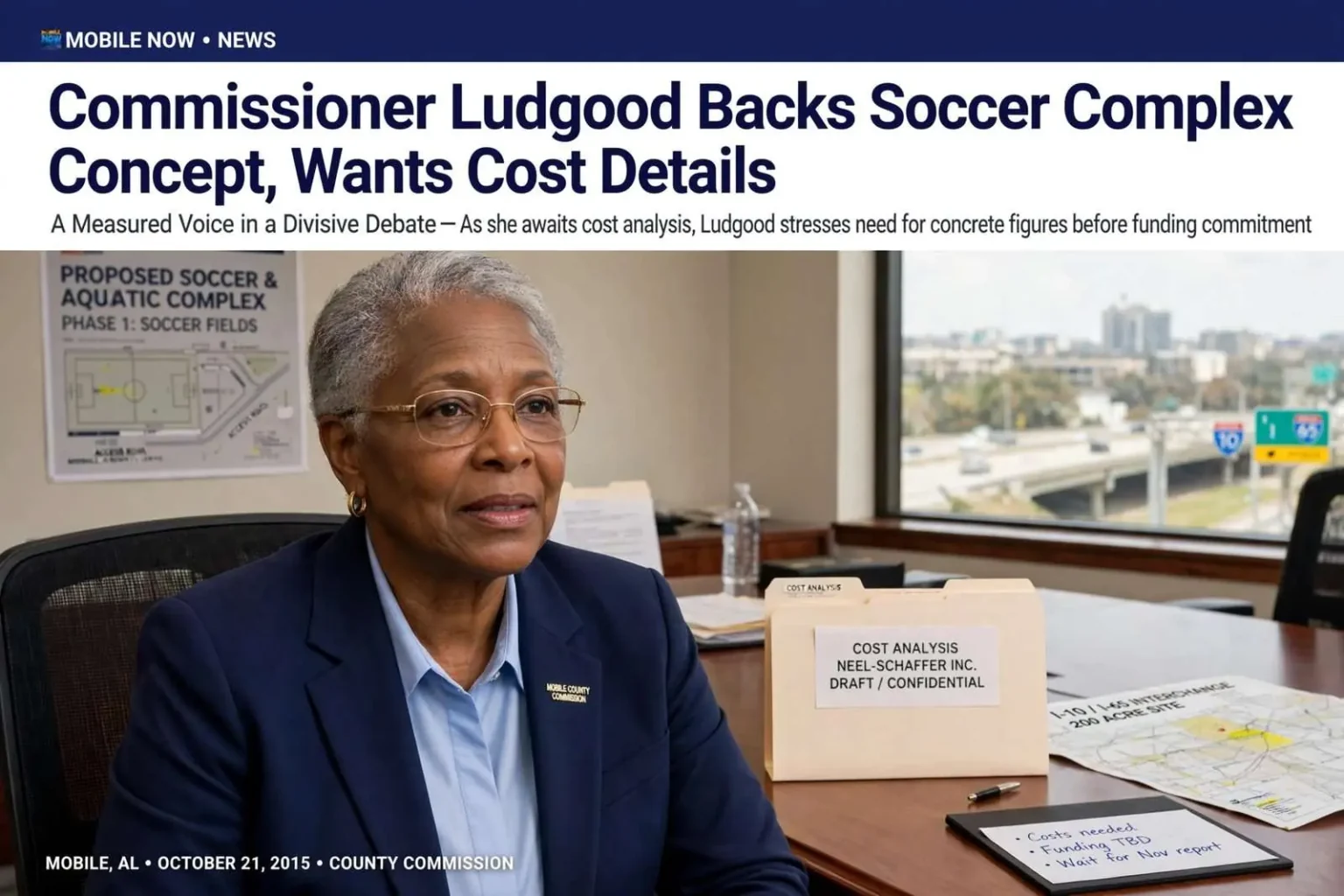
As debate over a proposed soccer and aquatic complex near the Interstates 10 and 65 interchange continued to divide local officials, Mobile County Commissioner Merceria Ludgood offered a more measured position than some of her colleagues, saying she backs the idea “conceptually” but wants concrete cost figures before committing further. Ludgood, one of three votes on the Mobile County Commission, said the biggest unresolved question remains price, and that answer will not be available until the consulting firm Neel-Schaffer Inc. finishes a cost analysis due in November. Until those numbers arrive, she argued, any conversation about how to pay for the project is essentially guesswork.
“The most salient features of this have to be the costs and whether or not we can put together the funding for it,” Ludgood said. “We won’t even know how to start that until we get numbers.”
The commission she sits on is a three-member board that sets policy for county government, including roads, parks and the county budget, so her vote would be essential to any plan that puts county dollars behind the complex. A county-led effort of this scale would also ripple through other agencies, since utilities, road improvements and site preparation around a 200-acre tract would require coordination well beyond the commission chambers. That reality, Ludgood suggested, is exactly why she is unwilling to guess at a price tag before the professionals finish their work.
She declined to weigh in directly on whether the Mobile City Council should set aside city funds in its 2015 budget to help the county cover part of the project, an idea Commissioner Connie Hudson has pushed in recent weeks as she lobbied council members ahead of a scheduled budget vote. Hudson has emerged as the project’s most aggressive advocate on the three-member board, making the case in recent weeks that city participation would be an investment in recreational infrastructure that serves residents of the whole county. Council members, meanwhile, have been sorting through a long list of competing priorities as they work to finalize a spending plan before the fiscal year begins.
The Site and the Stakes
The complex’s first phase would sit on 200 acres the county holds an option to purchase for roughly $3.1 million. The land lies near the point where Interstates 10 and 65 converge on Mobile’s west side, a location chosen for its access to population growth corridors in both Mobile and Baldwin counties and for the visibility an interstate-adjacent site gives visiting teams. Proponents argue that ease of highway access is critical if the county hopes to attract travel ball tournaments and other events that bring overnight visitors.
Youth soccer has grown rapidly across south Alabama in recent years, and league officials have long complained that the area lacks enough quality fields to host large tournaments. Sports tourism has become a competitive industry across the Gulf Coast, with neighboring communities investing in multipurpose athletic facilities to capture the hotel nights, restaurant meals and sales tax revenue that traveling families generate. Whether Mobile County wants to compete in that market, and at what cost, is the question commissioners have been wrestling with as the proposal has moved from concept to contract.
Stimpson and Carl Push Back
Ludgood’s comments came a day after Mayor Sandy Stimpson urged the council not to redirect budgeted funds toward the county-led project, instead pushing for the council to approve $3 million he set aside for repairs to the city’s existing park system. The Stimpson administration has framed that allocation as a promise kept to neighborhood associations across the city, whose parks have accumulated a backlog of deferred maintenance. The mayor’s position puts him at odds with Hudson’s lobbying campaign and has sharpened the friction between City Hall and Government Plaza over who should pay for regional recreation.
Fellow County Commissioner Jerry Carl has gone further, calling the I-10/I-65 site a poor use of taxpayer money and urging officials to explore cheaper alternative locations for a soccer complex instead. Carl has argued that land costs, road work and utility extensions at the interchange site could balloon beyond the county’s projections, and that a less expensive parcel elsewhere could deliver the same fields without the premium price. His objections have given cover to city officials reluctant to send money across Government Plaza, and they have made the commission’s internal split public.
Against that backdrop, Ludgood has tried to keep the discussion grounded in history rather than heated rhetoric. She noted that large recreational projects like this one have historically been joint city-county ventures, though she stopped short of committing city dollars to it. From the city’s earliest public parks to more recent shared facilities, the pattern in Mobile County has been for the two governments to pool resources when a project’s benefits spill across municipal lines.
“Projects of this scope typically have been joint projects with the city and county coming together,” she said. “I know all of that is driven by revenue. I can’t really speak for the city’s budget.”
Her refusal to dictate to the city reflects the practical limits of county authority. The commission can approve an option on land and direct its own funds, but it cannot compel the council to participate, and a project of this size is unlikely to move without some agreement between the two bodies. Ludgood’s stance leaves room for negotiation while declining to pressure council members who are still balancing their own budget books.
Financing Options Still Open
While she awaits the cost study, Ludgood said the county may eventually roll some or all of the project’s cost into a capital improvement bond issue it could consider later in the year. Bond financing would spread payments over decades, matching the life of the facilities themselves, and would allow the county to preserve cash for other needs. She said officials were also exploring whether the project could draw private donations or qualify for RESTORE Act funding tied to the 2010 Deepwater Horizon settlement, which channels penalty money from the oil spill into economic and ecological recovery projects along the Gulf Coast.
RESTORE Act money, however, comes with strings attached. The federal law distributes Clean Water Act penalties from the spill to Gulf Coast states and their communities for restoration, conservation and economic development, and every proposed use must fit the eligible purposes laid out in the statute and in each community’s spending plan. Recreation projects have been funded elsewhere on the Gulf Coast through RESTORE dollars, but any application tied to the soccer complex would face review and competition from other proposed projects across the region.
Private donations are another avenue that could ease the public burden. Youth sports complexes in other Southern cities have attracted corporate sponsorships for field naming, scoreboard packages and tournament infrastructure, and county officials hope similar interest exists locally if the project wins approval. How much such support could realistically cover, though, is unknown until the overall cost is finally established.
Soccer Now, Aquatics Later
On the scope of the project itself, Ludgood said her focus for now is strictly on the soccer fields rather than the more elaborate aquatic center envisioned for later phases, which would include an outdoor water park with a lazy river, splash pads and an indoor competitive pool. The aquatic component would substantially increase the price and operating complexity of the complex, and she made clear that she is not prepared to carry that vision on her own account just yet.
“I’m only dealing with the soccer aspect of it,” she said. “I know Commissioner Hudson has a broader vision for the complex.”
The distinction matters for the county’s financial exposure. Fields and lighting can be built and maintained at a comparatively predictable cost, while a water park and indoor competitive pool carry year-round staffing, chemical treatment and insurance expenses that can burden operating budgets for decades. Phasing the project would let the county prove demand for the soccer component before deciding whether the aquatic center is worth the additional investment.
For young athletes and their families, the debate in Government Plaza is about more than accounting. Local clubs currently travel out of the county, and sometimes out of the state, to reach tournaments on suitable fields, and an in-county venue could keep that spending at home while giving local players more opportunities to compete at a high level without long drives. Coaches and league organizers have followed the commission’s discussions closely for exactly those reasons.
With the council’s budget vote looming and commissioners still split on financing details, the project’s fate remains tied up with the broader city budget negotiations playing out at Government Plaza. The Neel-Schaffer analysis due in November should give both governments the first hard numbers on what the complex would actually cost to build and operate. Until then, Ludgood’s position is likely to define the county’s posture: interested, open to partnership, and unwilling to write checks the county cannot yet count.