Mobile County Commission Narrowly Approves ‘In God We Trust’ Display for Government Plaza
A divided Mobile County Commission voted 2-1 to allow a privately funded 'In God We Trust' plaque inside Government Plaza.
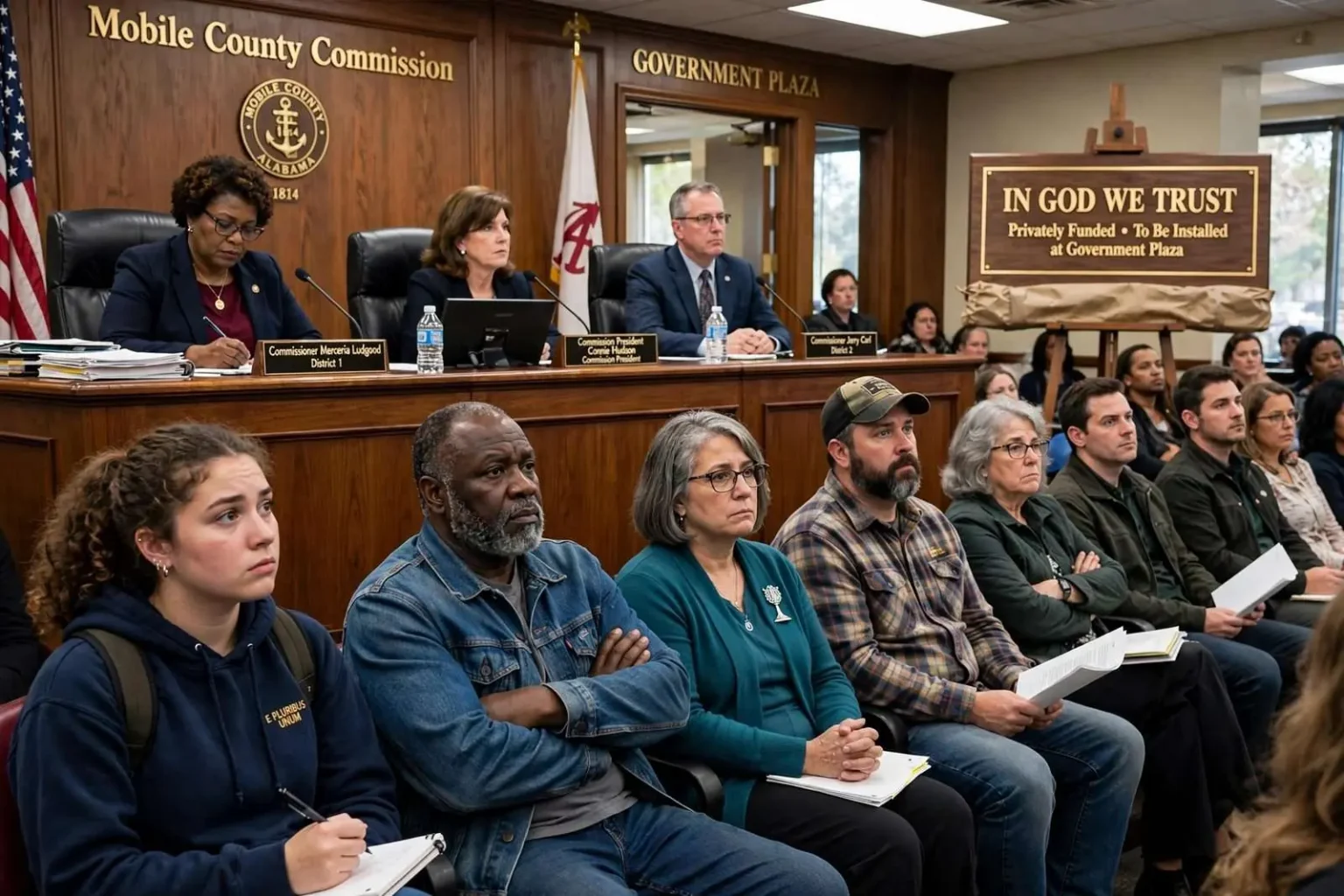
A packed meeting of the Mobile County Commission turned emotional this week as commissioners voted 2-1 to approve a privately funded plaque reading “In God We Trust” for public display inside Government Plaza, capping months of debate over religion’s place in the county’s main government building.
The vote capped a public hearing that laid bare the divide. Nine residents signed up to address the commission before the vote, with eight speaking against the display and one in favor. The crowd that filled the chamber reflected the intensity of an issue that has surfaced in county and city governments across Alabama in recent years, usually with the same fault lines on display.
Opponents argued the phrase would alienate non-Christian and nonreligious residents inside a building meant to serve everyone in the county, regardless of faith. They pointed to the daily traffic through Government Plaza — jurors reporting for duty, taxpayers settling bills, couples applying for marriage licenses — and argued that a religious statement on the wall changes the experience of dealing with county government for those who do not share the sentiment.
One community college student who addressed the commission described herself as an atheist and proposed the Latin motto “E pluribus unum” — out of many, one — as a more unifying alternative. She argued that the older motto, which appears on the nation’s coins and seal, celebrates the country’s pluralism rather than dividing residents along religious lines. Her suggestion drew nods from several in the audience but did not move the commission from its plan.
A local Unitarian Universalist minister argued that the First Amendment was designed to keep government out of religion just as much as religion out of government, warning that entangling the two diminishes both. The minister’s testimony echoed a long line of church-state debates that have played out in courtrooms across the country, and it foreshadowed the legal questions that several speakers said they expected the county to face.
The lone supporter, and the commissioner’s defense
The lone speaker supporting the display, a local real estate agent, invoked historical references to the nation’s founders, arguing that the phrase reflects longstanding American tradition rather than an endorsement of any specific religion. Supporters of such displays nationally have made the same case, pointing to the motto’s adoption by Congress and its presence on federal buildings and currency for generations.
Commissioner Jerry Carl, who supported the plaque, pushed back on concerns that the word “God” specifically referenced the Christian faith, arguing the term could hold different meaning for different people and that the phrase carries historical significance beyond religious doctrine. His framing aligned with the argument most commonly offered by governments defending similar displays — that “In God We Trust” functions as a civic and historic statement rather than a theological one.
The most pointed remarks of the meeting came from Commissioner Merceria Ludgood, who cast the lone dissenting vote. She told the packed room she could not in good conscience support the gesture, arguing that the commission’s role is fundamentally secular and that Government Plaza belongs equally to all county residents. She also raised legal concerns about the display, calling it “legally dubious,” and pushed back on the idea that morality can be legislated through a government building’s décor.
Commission President Connie Hudson, who joined Carl in supporting the measure, formed the second vote that carried the proposal. The 2-1 split left the county’s three-member board publicly divided on an issue that consumes no tax dollars but considerable goodwill, and it guaranteed that the plaque’s installation would be watched closely by residents on both sides of the question.
Privately funded displays like the one approved this week have followed a familiar pattern across Alabama. Local governments from municipalities to county commissions have fielded requests for “In God We Trust” plaques, posters, and monuments, with the costs covered by private donors or civic groups to head off any argument that public money is financing religious expression. The legal fight, when it comes, usually turns not on funding but on whether a reasonable observer would see the display as government endorsement of religion.
Courts have reached different conclusions in different contexts. Federal appeals courts have allowed motto displays that appear among other historical documents, while some displays that stand alone or appear to single out one faith have drawn injunctions. The distinction explains why Ludgood’s “legally dubious” warning mattered to county attorneys, who must now weigh where and how the plaque is installed — and whether accompanying historical displays would strengthen the county’s position if the decision is challenged.
What Government Plaza means to the county
The stakes extend beyond symbolism. Government Plaza, the shared downtown complex housing county and city offices, is where Mobile County residents interact with their government most directly — paying property taxes, obtaining licenses, filing records, and serving as jurors. It is also where the commission holds its public meetings, making the lobby and chambers the most visible civic space in the county. A display on those walls is, by design, seen by more residents than nearly any other statement the county could make.
The debate also reflects Mobile County’s changing demographics. The county is home to a broad mix of religious traditions — longstanding Catholic and Protestant congregations, growing Muslim and Hindu communities drawn by the port and the industries that surround it, and a steadily rising number of residents who claim no religious affiliation at all. Speakers on both sides of the plaque question acknowledged that diversity, though they drew opposite conclusions from it.
County commissions and councils in neighboring states have faced identical votes in recent years, with outcomes splitting both ways. In some jurisdictions, boards have approved motto displays unanimously; in others, similar proposals have died in committee or been tabled after crowded hearings. Mobile County’s split decision puts it in the middle of that spectrum — the plaque approved, but over the objection of a commissioner who articulated the case against it in unusually direct terms.
What happens next depends on whether the display draws a legal challenge. A lawsuit would land in federal court, where judges weigh each display on its context and history, and the county’s installation choices would become part of the record. Absent a challenge, the plaque will take its place in the plaza, and the debate will move to the county’s elections, where the vote is likely to follow each commissioner through the next campaign.
For the residents who packed the chamber, the meeting itself was a reminder of how closely county government touches daily life, and of how a single agenda item can draw more public attention than any budget decision. Nine speakers for a plaque is an unusually heavy public comment load for the commission, which routinely conducts its business before a handful of observers — a measure of how questions of faith in public space continue to grip the Gulf Coast, and of how differently neighbors can read the same two words.
The history of the motto itself has become central to these debates nationally. Congress adopted “In God We Trust” as the official motto of the United States in the 1950s, directing that it appear on American currency, and federal law still requires it there today. Supporters argue that makes the phrase as much an artifact of national law as any other civic emblem, while critics counter that its adoption came during the Cold War as a deliberate statement of religious identity — a distinction that echoes through nearly every public hearing like this week’s in Mobile.
Alabama’s state government has taken its own position on the question. State law acknowledges the motto’s place in public life, and legislative sessions in Montgomery have repeatedly taken up measures related to religious expression in public buildings and schools. For local boards, that state-level support provides political cover, even as federal courts remain the final authority on what individual displays may lawfully do.
Ludgood’s dissent also touched on the practical work of the commission, reminding colleagues that the board’s regular agenda — roads, drainage, health department funding, industrial incentives — fills enough of the county’s attention without a fight over wall décor. Her argument that morality cannot be legislated through décor drew quiet agreement from several opponents in the room, who said after the meeting that they appreciated a commissioner voicing what eight of nine speakers had argued from the podium.
Carl, for his part, told colleagues that the backlash he had heard directly from constituents ran the other way, with more residents contacting his office to urge approval than to object. County commissioners across Alabama have reported the same dynamic in similar debates — organized opposition filling the hearing room while quieter majorities voice support by phone and email — and the imbalance has shaped outcomes in both directions depending on the board.
The county’s decision now joins a public record that residents can weigh as commissioners face future elections. Whatever the plaque’s ultimate reception, the hearing demonstrated the range of conviction the two words can summon: a student offering an older motto as a broader embrace, a minister warning of entanglement, a real estate agent invoking the founders, and three commissioners splitting a two-word question down the middle of a crowded chamber.