Half Shell Oyster House Set to Open First Alabama Location in Mobile
Half Shell Oyster House will open its first Alabama restaurant on Airport Boulevard in Mobile, hiring more than 100 workers.
A popular Gulf Coast seafood chain is bringing its first Alabama restaurant to Mobile. Half Shell Oyster House, based in Gulfport, Mississippi, plans to open its new location on Airport Boulevard on June 30, marking the brand’s first crossing of the state line after years of building a loyal following along the Mississippi Gulf Coast. The opening adds a recognizable name to one of Mobile’s busiest dining corridors and gives Alabama diners their first taste of a menu that has made the chain a staple in its home state.
A French Quarter-Style Restaurant Near I-65
The new restaurant will be located at 3654 Airport Blvd., at the northwest corner of Interstate 65 and Airport Boulevard, a heavily traveled commercial corridor in Mobile. The intersection is one of the city’s key crossroads, linking the Spring Hill and West Mobile neighborhoods with the shopping and office districts that line Airport Boulevard, and it sits minutes from some of the area’s densest residential growth. Thousands of vehicles pass the corner daily, and the site offers the kind of visibility and access that restaurant operators along the Gulf Coast compete for.
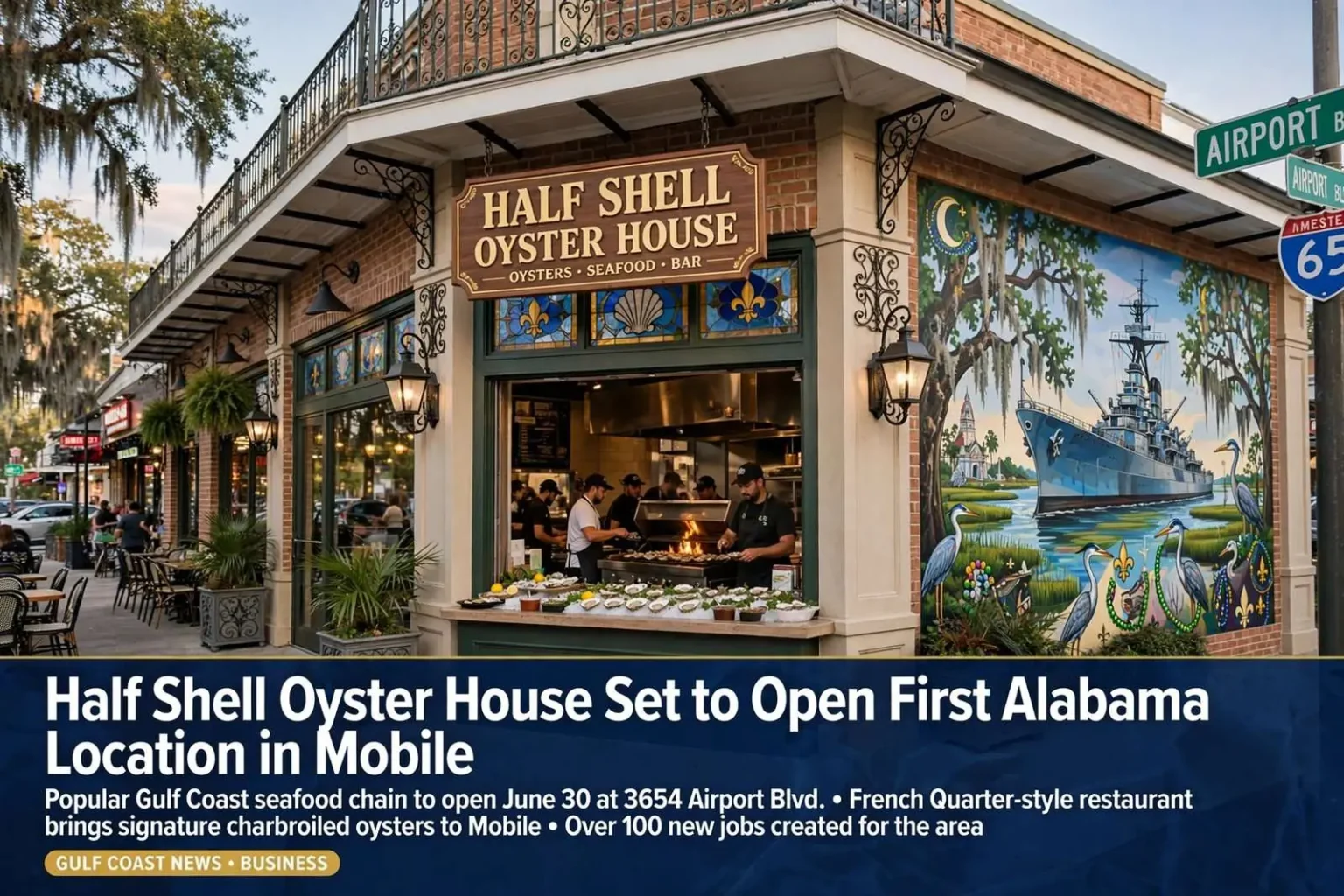
The building is designed with a French Quarter theme, featuring gas lamps, stained glass, wrought-iron railings, murals from local artists and an exhibition-style oyster grilling bar where diners can watch food prepared in the open. The look borrows from the architecture of New Orleans, whose influence runs deep across the northern Gulf Coast, while the murals tie the space specifically to Mobile by showcasing the work of local artists. The open grilling bar is meant to be the centerpiece of the room, turning oyster preparation into part of the evening’s entertainment.
Half Shell Oyster House is known for its wide range of oyster preparations, including its signature Charbroiled Oysters Orleans, and the Mobile location will serve both lunch and dinner. The menu leans heavily on Gulf seafood alongside steaks, pasta and Southern-style entrees, a combination that has allowed the chain to draw both casual family crowds and celebration dinners. Serving lunch and dinner positions the restaurant to capture the office lunch trade from the surrounding corridor as well as the evening crowds that fill West Mobile’s restaurant row.
The chain already operates restaurants in Gulfport, Biloxi and Hattiesburg, Mississippi, along with a location in Sarasota, Florida, giving it a strong reputation along the Gulf Coast before its expansion into Alabama. That footprint spans beachfront tourist towns, a college city and a Florida Gulf Coast market, a mix that has tested the concept against both seasonal visitors and year-round locals. Mobile becomes the brand’s newest market and its first in a state where oysters already hold a beloved place on restaurant menus from the Causeway to Dauphin Street.
Mobile’s dining scene has grown steadily in recent years, with the city blending its own deep culinary traditions — gumbo, oysters, and the legacy of its Mardi Gras-adjacent hospitality culture — with an influx of regional and national chains. Restaurant openings along Airport Boulevard and the surrounding West Mobile corridors routinely draw attention because the area’s population base supports high volumes. A French Quarter-styled concept with an open oyster bar fits neatly into a market where seafood houses remain among the most reliable draws for families and large groups.
For Mississippi-based operators, Mobile has long been a logical expansion point. The two markets share media, tourism patterns and family ties, and the drive between Gulfport and Mobile along Interstate 10 takes barely an hour. Visitors from the Mississippi Gulf Coast who already know the brand will find the Mobile location familiar, while Mobile diners who travel to the Coast for beach weekends will recognize a name they have likely eaten at before — a built-in advantage as the new restaurant establishes itself.
More Than 100 New Jobs
The Mobile opening comes with a significant hiring push. More than 75 people have already been brought on to staff the new restaurant, and the company was still looking to fill about 25 additional positions ahead of opening day. The hiring effort spans kitchen staff, servers, bartenders and hosts, the full complement a high-volume full-service restaurant requires. Job applications were being accepted in person Monday through Saturday from 9 a.m. to 5 p.m., giving the restaurant a steady stream of applicants in the weeks before the doors opened.
For the local economy, the restaurant adds to the employment base along the Airport Boulevard corridor, where retail and hospitality jobs serve a wide swath of West Mobile. Full-service restaurants of this scale typically become one of the larger employers in their immediate trade area, and the positions range from entry-level first jobs to experienced kitchen and management roles. The timing also matters: a mid-summer opening lands in the middle of Mobile’s busy convention and tourism season, when area restaurants feel the demand most.
Kevin Fish, a partner in Gulf Coast Restaurant Group, which operates the Half Shell brand, said the Mobile restaurant reflects the company’s broader growth plans along the northern Gulf Coast. The group has built its business by clustering locations in markets close enough to share management depth, supplier relationships and training standards, an approach that has let it expand without diluting the quality that made the original locations popular.
Bob Taylor, president of Gulf Coast Restaurant Group and founder of Half Shell Oyster House, said the company’s success on the Mississippi Gulf Coast made Mobile a natural next step. Taylor founded the brand in Gulfport and has watched it grow into a Gulf Coast institution, with the oyster bar concept proving durable across beach seasons and economic swings. Bringing the concept to Alabama extends that track record into a new customer base without straying far from the markets the company knows best.
Josh Lord will serve as general manager and part owner of the new Mobile location, helping oversee daily operations as the restaurant establishes itself in a new market. Giving the local manager an ownership stake is a model that ties the restaurant’s success directly to the person running its day-to-day operations. Lord’s role includes completing the hiring push, training the new staff and setting the service standards the brand is known for before the first customers walk in.
The Airport Boulevard corridor has long been one of Mobile’s most competitive restaurant stretches, lined with everything from fast-casual lunch spots to destination dinner houses. Anchoring a corner at Interstate 65 puts the new restaurant within a short drive of neighborhoods across West Mobile, Spring Hill and Midtown, and its position near the interstate makes it an easy stop for travelers heading between Mobile and the beaches of Baldwin County or the Mississippi Gulf Coast. Restaurant analysts along the Gulf Coast often note that corner visibility at a major interchange can be worth years of marketing for a new concept.
The company’s arrival also underscores how Mobile’s reputation as a dining destination continues to spread across state lines. For decades, the flow ran the other way, with Mobilians driving to the Coast for casino restaurants and beachfront seafood houses. As Mobile’s own restaurant market has matured, Mississippi-based groups have begun returning the favor, and each new entrance adds to the city’s sales tax base while keeping dining dollars closer to home. City officials have pointed to restaurant growth as one of the quiet engines of the local economy, supporting jobs that cannot be outsourced and foot traffic that benefits neighboring businesses in the same centers.
What It Means for Mobile Diners
The addition of a well-established regional concept gives Mobile diners another option in a category the Gulf Coast does exceptionally well: the neighborhood oyster house. Concepts like this thrive on volume and consistency — oysters served charbroiled, raw, grilled and baked, in a room built for families, teams and celebrations. Competition among seafood restaurants in Mobile is fierce, and new operators entering the market generally raise their game, a dynamic that tends to benefit diners across the city.
The June 30 opening also lands in the run-up to one of Mobile’s favorite dining rhythms. By late summer, high school football Fridays, college football Saturdays and the approaching Mardi Gras season all fill restaurant dining rooms, and a large oyster house with an exhibition bar is built for exactly those occasions. Restaurants at the I-65 and Airport Boulevard corner draw from every direction of the city, and Half Shell’s New Orleans-inspired design gives it a distinctive look in a corridor crowded with familiar chains.
Local artists whose murals appear in the building also get a platform few commissioning projects provide: their work will be seen daily by thousands of diners rather than hanging in a gallery. The company has leaned on that community connection in its other markets, where the décor becomes part of the restaurant’s identity and a talking point for first-time guests.
With doors set to open June 30, the final weeks before launch will be spent finishing the building, training the staff and testing the kitchen’s output at full speed. If the pattern from the company’s Mississippi and Florida locations holds, the Mobile restaurant can expect heavy crowds in its opening months, particularly on weekends and during peak oyster season. For a chain whose growth has been measured and market-by-market, Mobile represents both a vote of confidence in the city’s dining economy and a new option for Gulf Coast seafood on the Alabama side of the state line.
The Airport Boulevard corridor has long been one of Mobile’s most competitive restaurant stretches, lined with everything from fast-casual lunch spots to destination dinner houses. Anchoring a corner at Interstate 65 puts the new restaurant within a short drive of neighborhoods across West Mobile, Spring Hill and Midtown, and its position near the interstate makes it an easy stop for travelers heading between Mobile and the beaches of Baldwin County or the Mississippi Gulf Coast. Restaurant analysts along the Gulf Coast often note that corner visibility at a major interchange can be worth years of marketing for a new concept.
The company’s arrival also underscores how Mobile’s reputation as a dining destination continues to spread across state lines. For decades, the flow ran the other way, with Mobilians driving to the Coast for casino restaurants and beachfront seafood houses. As Mobile’s own restaurant market has matured, Mississippi-based groups have begun returning the favor, and each new entrance adds to the city’s sales tax base while keeping dining dollars closer to home. City officials have pointed to restaurant growth as one of the quiet engines of the local economy, supporting jobs that cannot be outsourced and foot traffic that benefits neighboring businesses in the same centers.