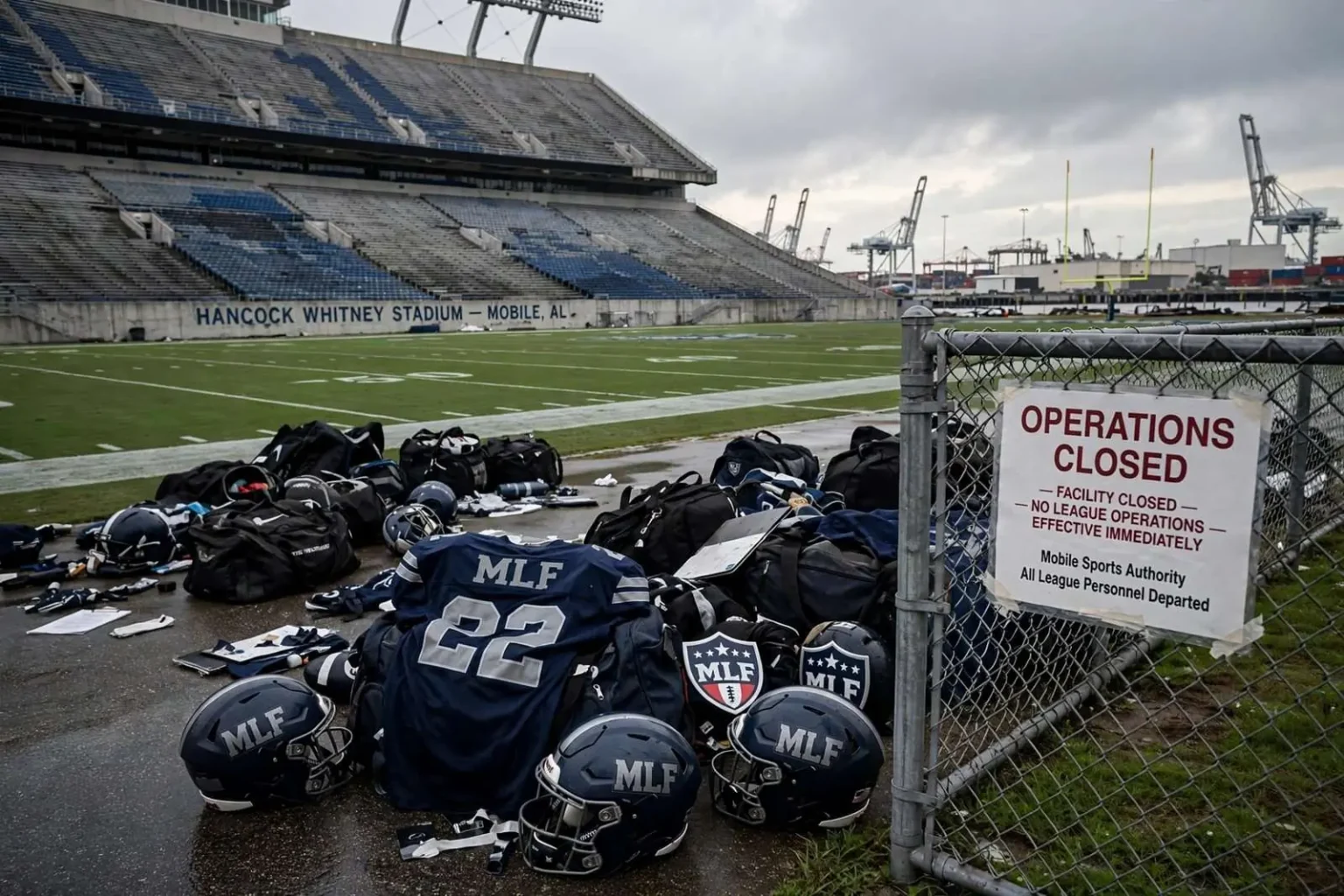
After the Major League Football league abruptly shut down, all players and coaches have left Mobile, according to officials with the Mobile Sports Authority. The departure marks the end of a troubled chapter for the professional football venture that had set up operations in the Port City, and it closes out a saga that unfolded almost as quickly as it began — a league arriving with promises of spring football, and leaving behind questions, unpaid bills, and players scrambling to get home.
The shutdown caught nearly everyone off guard. Many members of the league were left scrambling after the shutdown, with some not knowing how they would even get home. For athletes who had moved to Mobile for the season — many of them young players chasing one more shot at professional football — the collapse meant more than a lost job. Flights home, outstanding pay, and housing arrangements all became sudden uncertainties, and the people around the league spent the first days after the announcement sorting out logistics as much as logistics allowed.
The Mobile Sports Authority, the public-private organization that works to attract and support sporting events and organizations in the area, confirmed the full departure of the league’s players and coaches, putting a formal end to the venture’s presence in the city. What had been billed as a new professional opportunity for the region instead became a case study in the risks that come with start-up sports leagues — and in the exposure that host cities take on when they welcome them. The authority’s confirmation also settled the immediate question of the league’s local footprint: there are no players, no coaches, and no operations left in Mobile, only the obligations the venture left behind and the community now working to account for them.
Over $1 million owed to Mobile vendors
A lingering question remains whether league owner Frank Murtha will pay the money owed to Mobile vendors. Officials told media that the debt exceeds $1 million — a sum spread across the local businesses, hotels, service providers, and contractors who supplied and supported the league during its time in Mobile. For those vendors, the collapse converts weeks of work and inventory into receivables that may never be collected, and the total ranks among the more significant unpaid obligations a shuttered sports venture has left behind in the city.
On Friday, Murtha stated that he “fully intends to satisfy all obligations to vendors in Mobile.” The statement, delivered as questions about the league’s finances mounted, was an attempt to reassure creditors and the community that the debts would be honored. But insiders noted that his simultaneous claim about prioritizing getting players and coaches home was not accurate — a discrepancy that eroded confidence in the owner’s other assurances and left vendors and observers alike uncertain about which promises, if any, would be kept.
The gap between what the league said and what it did became a defining feature of the shutdown’s final days. Players and coaches have since left Mobile, but the questions about payment remain open, and local vendors are left weighing their options — from formal collection efforts to simply writing off accounts they had extended in good faith to a professional operation.
Questions about the league’s future
The situation raised serious questions about the league’s financial stability and its obligations to the Mobile community. Start-up football leagues operate on thin margins even in the best of circumstances, and the abruptness of this shutdown — with teams in place, staff employed, and games presumably scheduled — suggests the financial footing gave way suddenly rather than being managed through an orderly wind-down. Whether the league’s obligations to the city extended beyond vendor debts, and how its collapse affects Mobile’s standing with future ventures, are questions local officials continue to weigh.
Despite the financial turmoil, insiders said most people associated with the league were great to work with and genuinely cared about the players, the sport, and the future of the league. That distinction — between the operation’s leadership and the coaches, staff, and personnel who ran its day-to-day work — mattered to those who dealt with the organization in Mobile. The collapse, in other words, was not for lack of effort or commitment among the people on the ground; it was a failure at the top, where the money was managed.
An internal company conference call with investors and the executive committee was scheduled for Monday as the league attempted to address its future. The call represented the first formal step toward deciding what, if anything, remains of the venture — whether the league attempts to reorganize, seeks new capital, or winds down entirely. Agenda items were expected to range from outstanding player and staff obligations to the vendor debts in Mobile, though insiders cautioned that even the league’s own leadership appeared divided on whether a path forward existed. For Mobile, the outcome of those discussions determines whether the unpaid debts will eventually be settled or become another entry in the long history of sports ventures that promised much and left early.
What the shutdown means for Mobile
The league’s collapse carries lessons for a city that has worked to build its sports economy. Mobile has invested in athletic infrastructure and positioned itself — through the Mobile Sports Authority and related efforts — as a destination for tournaments, training camps, and new sporting ventures. Each arrival brings revenue to hotels and restaurants and puts the city in front of new audiences. But the same openness that attracts ventures also exposes local businesses to the risk that a partner will fail, and the Major League Football shutdown is the most vivid local demonstration of that risk in recent memory.
For vendors, the practical aftermath is a familiar one for anyone who has done business with a start-up: contracts signed in good faith, services rendered, and invoices now in question. Local businesses that extended credit to the league — from catering companies to equipment suppliers to housing providers — are the ones carrying the actual cost of the collapse, regardless of what the league’s ownership ultimately pays. The $1 million figure, spread across that many operations, represents real payroll and real inventory in a mid-sized city’s economy.
For the players, the shutdown is a personal setback layered on an already precarious profession. Spring and developmental leagues exist to give players a stage — undrafted rookies, veterans trying to return, and marginal prospects hoping to be seen. When a league folds mid-operation, it does not just cost those players a paycheck; it costs them film, exposure, and the season they had committed to. Several players left Mobile uncertain whether they would be paid at all for the work they had already done. For a league built on the promise of opportunity, the manner of its ending denied its own participants exactly that.
A pattern in spring football
The episode fits a long pattern in professional football outside the NFL. Spring and developmental leagues have repeatedly launched with ambitious plans and folded amid unpaid obligations — a history that includes multiple aborted starts over the past several decades. The economics are unforgiving: startup costs are high, ticket revenue is uncertain, television money is limited, and investors’ patience is short. Mobile’s experience with Major League Football mirrors what other host cities have seen when similar ventures stall, and it explains why seasoned vendors and venues approach new leagues with caution.
That history also explains the significance of the Monday conference call. Leagues rarely announce their own deaths; the formal wind-down, reorganization, or revival usually emerges from exactly the kind of investor and executive discussions the league had scheduled. Whether those talks produce a plan to pay Mobile vendors or simply a quieter end, the city’s businesses will be watching — and so will the players and coaches who left town still awaiting clarity on what they were owed.
What comes next
In the near term, Mobile’s exposure is financial and reputational but not structural. The facilities the league used remain, the vendors remain, and the city’s broader sports calendar continues. The Mobile Sports Authority’s confirmation that all players and coaches have left closes the operational chapter; the financial chapter remains open until the question of the $1 million in vendor debt is resolved, one way or the other.
For now, the episode stands as both a disappointment and a caution. The disappointment belongs to the players who came to Mobile to play, the coaches who came to coach, and the local fans who bought in early. The caution belongs to everyone who will evaluate the next venture that arrives promising to put professional football in the Port City: ask who is guaranteeing the money, and remember how the last one ended.