Power outage tracker: More than 3K outages in Baldwin County after severe storms
Severe storms and possible tornadoes knocked out power to more than 3,400 Baldwin EMC customers in south Baldwin County, with downed lines around Bon.
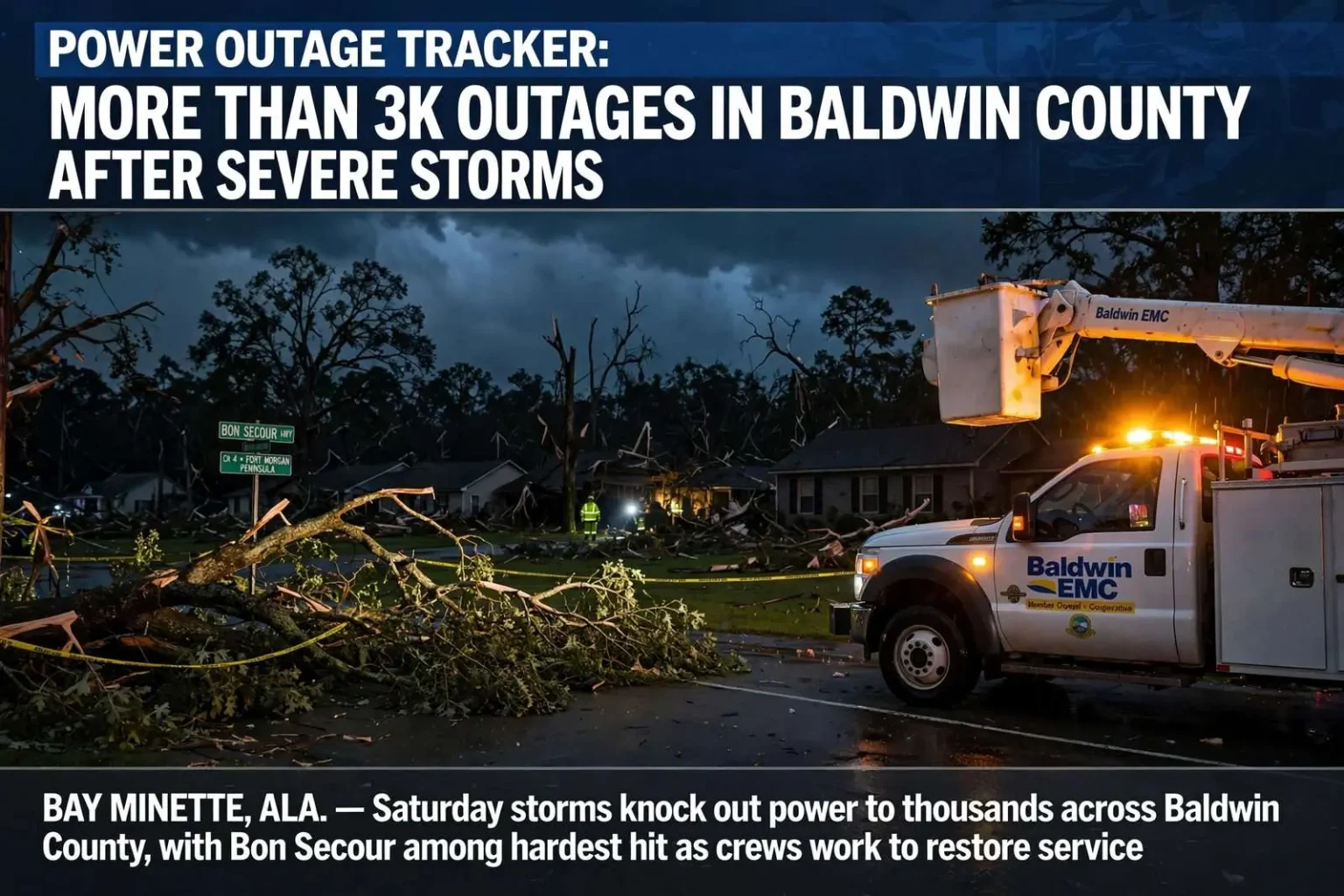
BAY MINETTE, Ala. — Strong storms and possible tornadoes swept across the Gulf Coast on Saturday, knocking out power to thousands of customers in south Alabama, with Baldwin County among the hardest hit. The storms moved through the region as the weekend wound down, toppling trees, snapping power lines and leaving pockets of darkness across neighborhoods from Mobile Bay east to the beaches.
Alabama Power reported more than 600 customers without power as of 7:23 p.m., while Baldwin EMC’s outage map showed about 3,400 customers dark in south Baldwin County. The combined outages pushed the county past the 3,000-customer mark and made Baldwin the focus of the region’s storm response as darkness fell.
Outages were concentrated around Bon Secour, where downed power lines were reported. The unincorporated community on the Fort Morgan peninsula corridor, known for its fishing heritage and riverfront landmarks, took some of the most visible damage from the storm cell that crossed southern Baldwin County on its path toward the coast.
Visually confirmed tornadoes reported
Visually confirmed tornadoes were reported in Mobile and Baldwin counties as the line of storms pushed through. Visual confirmations — tornadoes observed on the ground by trained spotters, law enforcement or the public, rather than inferred from radar — are significant because they convert a radar-indicated rotation into a verified event, and they help National Weather Service meteorologists in Mobile track exactly where and when a tornado touched down.
The confirmation process continues after the storm passes. Weather service damage survey teams, often joined by local emergency management officials, walk affected areas the following day to classify damage along the Enhanced Fujita scale, examining how buildings failed, which way trees fell and how far the damage path ran. Those surveys determine the official tornado rating and also help emergency managers target assistance where it is most needed.
Baldwin County’s position on the Gulf Coast places it squarely in the region where cool-season and springtime squall lines most often produce tornado warnings, and county emergency management officials maintain outdoor warning sirens, weather alert systems and damage-reporting channels across the county’s municipalities, from Bay Minette and Daphne to Foley, Gulf Shores and Orange Beach.
Who keeps the lights on in Baldwin County
The two utilities reporting outages serve different parts of the map. Alabama Power, the investor-owned utility based in Birmingham, provides electric service to much of Alabama, including communities across Mobile and Baldwin counties. Baldwin EMC, by contrast, is a member-owned electric cooperative headquartered in Summerdale that serves more than 80,000 accounts across Baldwin County and southern Monroe County, covering much of the fast-growing coastal and southern inland portions of the county — which is why its outage map lit up across south Baldwin during Saturday’s storms.
Cooperatives and investor-owned utilities restore power using similar priorities: first, dangerous situations such as downed lines; then major transmission lines and substations; then outages affecting the largest numbers of members; and finally individual service drops. That sequence means some neighborhoods come back in stages, and a home at the end of a rural line may stay dark longer than a subdivision near a main feeder even when the damage nearby is similar.
Utility crews worked to restore service as the storms continued moving through the region, a reminder that line work cannot begin in earnest in an area until the immediate threat has passed. Crews cannot safely raise a bucket truck or handle energized equipment while lightning and damaging winds are still overhead, so restoration often proceeds in waves behind the storm track.
Downed lines: the most dangerous aftermath
The downed power lines reported around Bon Secour represent the most serious hazard any storm leaves behind. Utility companies and emergency managers repeat the same guidance after every severe weather event: every downed line should be treated as energized, no matter how it looks. A line lying in a yard, draped across a fence or resting in a flooded ditch can carry lethal current, and electricity can travel through the ground, water, fences and tree limbs that contact the wire.
Residents who spot a downed line are urged to stay far away, keep children and pets inside, and report it to the utility or call 911. Drivers should never attempt to drive over a line on the roadway, and if a line falls across a vehicle while someone is inside, the guidance is to stay in the vehicle and wait for utility personnel unless a fire forces evacuation — in which case the occupant should jump clear without touching the car and the ground at the same time, and shuffle away with small steps.
Downed lines also complicate tree cleanup. Baldwin County’s landscape of oaks and pines is beautiful but vulnerable in severe storms, and limbs that fall into lines should be left to utility crews, not cleared by homeowners with chainsaws. Restoration crews clear lines first; property owners can safely handle debris only after the utility has confirmed the area is de-energized.
Tracking and reporting outages
Both utilities serving the county give customers online tools to follow restoration work. Alabama Power’s outage map shows the location and estimated extent of outages across its service territory, and Baldwin EMC’s outage map does the same for cooperative members, which is how the roughly 3,400 customers dark in south Baldwin County were tracked Saturday evening. Customers can report outages by phone or through the utilities’ apps and websites, and cooperative members who have updated contact information on file receive faster, more accurate status updates when their specific account is affected.
Utility officials ask customers not to report the same outage repeatedly and not to assume a call alone restores service — reporting helps the utility locate the problem, but restoration follows the repair sequence described above. Estimates for restoration times are issued as damage assessments come in, and in widespread storm damage the early estimates often shift as crews find additional problems.
What residents should do during an outage
Emergency management and utility officials recommend a handful of precautions for any extended outage. Refrigerators and freezers should stay closed; a full freezer holds its temperature for a day or more, and a refrigerator for several hours. Generators, if used, must run outdoors, far from windows, doors and vents, because generator exhaust kills people every storm season when units are run in garages or near open windows. Candles should be avoided in favor of flashlights, and any generator must be connected in a way that prevents power from feeding back into utility lines, which endangers line workers making repairs.
Residents who depend on medical equipment powered by electricity should make sure their utility knows about the medical need well before a storm, since both utilities maintain lists of customers with critical power needs, and those customers should have a backup plan that does not depend on the grid being restored quickly.
Saturday’s outbreak was part of a familiar pattern for Gulf Coast weather: a warm, humid air mass from the Gulf meeting a stronger system moving in from the west, producing a squall line capable of rotating storms. South Alabama’s tornado risk does not follow the Great Plains calendar; the region sees dangerous twisters in every season, and the National Weather Service office in Mobile routinely coordinates warning decisions with county emergency management agencies in both Mobile and Baldwin counties as storms approach the coast.
Warning reception matters as much as warning accuracy in those moments. Emergency officials across the region urge residents to have multiple ways to receive warnings — a NOAA weather radio, phone alerts enabled for severe weather, and local media — because a single channel can fail at the worst time, particularly overnight when cell phones may be silenced.
After the storm passes
Once the immediate threat clears, the work shifts to damage assessment and recovery. County and municipal crews clear roads of trees and debris, utilities restore power in the sequence described by their repair priorities, and residents document any property damage for insurance purposes. Photographing damage before cleanup begins, keeping receipts for temporary repairs and reporting damage to the county emergency management agency all help in the days that follow, particularly if the event grows into something larger that qualifies for state or federal assistance.
The storm also serves as a mid-season check on household readiness. Baldwin County emergency officials recommend that every household keep a basic kit — water, flashlights, batteries, a way to charge phones, any needed medications — and that coastal residents be ready for the possibility that a severe weather event that knocks out power for days precedes or overlaps with hurricane season threats.
For now, the priority is restoration. Alabama Power reported more than 600 customers without power as of 7:23 p.m. Saturday, and Baldwin EMC’s map showed about 3,400 members without service in south Baldwin County, concentrated around Bon Secour where downed lines were reported. Crews from both utilities worked through the evening, and customers can follow progress on the utilities’ outage maps or report new outages through their normal channels. Anyone who sees a downed power line should stay away and call it in — never assume it is dead.