
Power outages reported along the Gulf Coast due to severe storms
Severe storms left thousands without power across the Gulf Coast, with Alabama Power reporting more than 7,000 outages in Baldwin County.
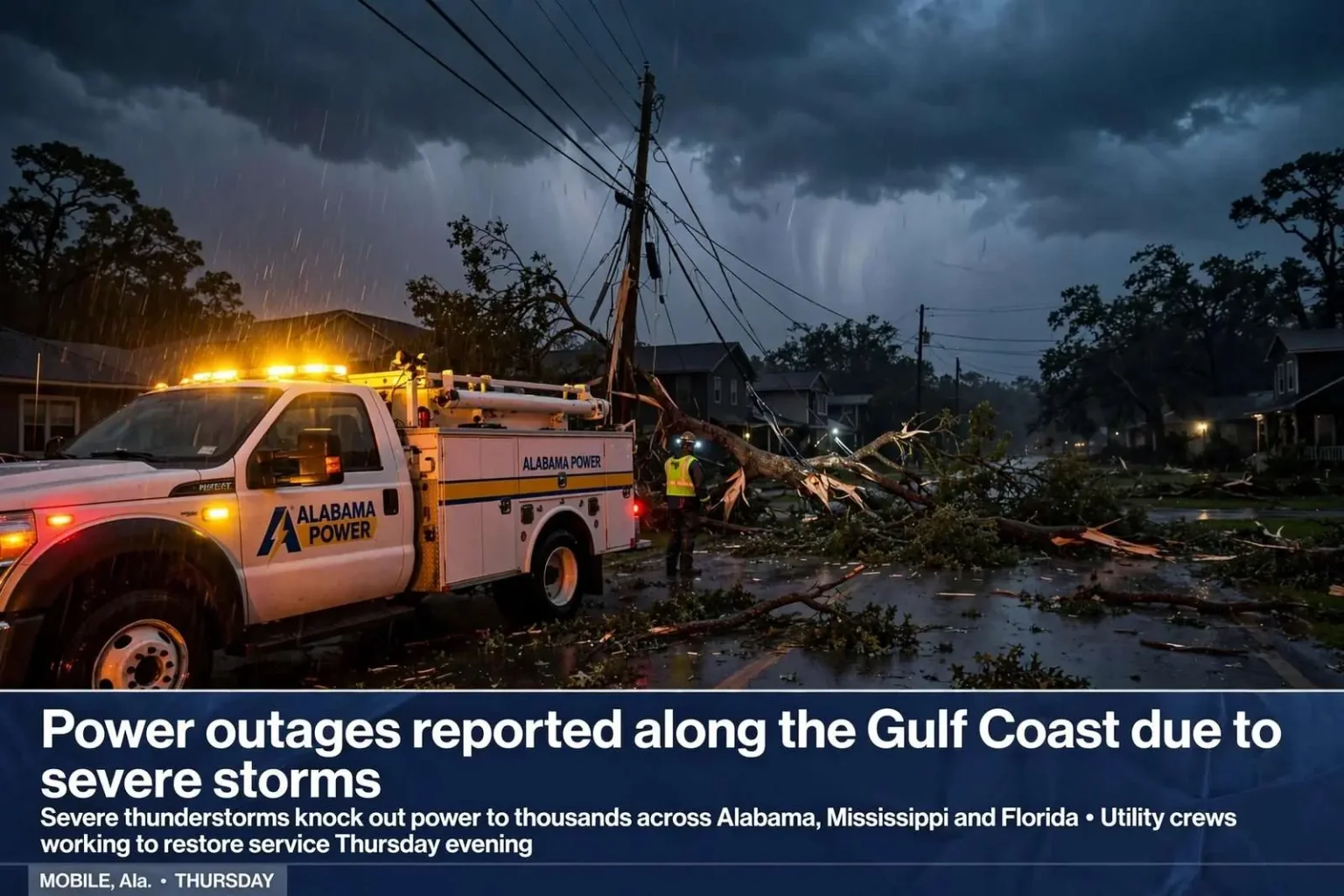
MOBILE, Ala. — Severe thunderstorms pushing through the Gulf Coast knocked out power to thousands of customers across Alabama, Mississippi and Florida on Thursday, according to utility reports. The line of storms swept across the region during the afternoon and evening hours, toppling trees and limbs onto distribution lines and interrupting electric service in communities from Mobile Bay to the Florida Panhandle.
Alabama Power reported more than 7,000 outages across its service area at the height of the event, with about 3,200 of those concentrated in Mobile. Outages were scattered across the city as the storm cell tracked through, and the utility’s outage map showed clusters popping up and disappearing as crews re-energized lines feeder by feeder. Alabama Power serves roughly 1.5 million customers across the southern two-thirds of Alabama, and Mobile is one of its largest service territories on the coast.
In Baldwin County, two electric providers accounted for most of the remaining Alabama outages. Baldwin EMC reported roughly 1,700 customers without power, while Riviera Utilities reported about 940 dark. Baldwin EMC is a member-owned cooperative that serves much of central and southern Baldwin County, including the fast-growing corridors around Spanish Fort, Daphne, Foley, Fairhope and Gulf Shores. Because the cooperative’s lines stretch across a wide, largely rural-suburban footprint, storm outages there often require crews to patrol long spans of line to find the exact point of failure before service can be restored.
Riviera Utilities, which is municipally owned by the city of Foley, serves customers in and around the southern part of the county, including Gulf Shores and Orange Beach. Utility officials in coastal Baldwin County routinely emphasize that hurricane-season preparations, including aggressive tree-trimming programs along main lines, reduce but cannot eliminate storm-related interruptions when strong thunderstorms move ashore from Mobile Bay.
Outages spread into south Mississippi and the Panhandle
The same storm system pushed eastward into south Mississippi, where Singing River Electric tracked outages across George, Greene and Jackson counties. The cooperative, headquartered in Lucedale, serves more than 70,000 meters across those counties and parts of the surrounding area, and its crews are accustomed to working after fast-moving summer and spring squall lines that drop trees across rural distribution lines. George and Greene counties, with their heavily wooded terrain and long stretches of single-phase line serving individual homes and farms, are typically among the hardest places to restore quickly after wind damage.
Across the state line, Gulf Power reported a few hundred customers without service in the Florida Panhandle. Gulf Power, which operates as part of Florida Power & Light, serves the Pensacola area and communities west and east of it, including much of Escambia and Santa Rosa counties. Panhandle outages during a single severe thunderstorm event tend to be localized, and the few hundred customers reported dark indicated that the storms’ most damaging wind gusts stayed mostly over south Alabama and south Mississippi as they moved through.
How utilities work a storm restoration
Utility crews follow a standard sequence after a storm like Thursday’s. Restorers first clear any downed lines that pose a public safety hazard, then repair transmission and substation equipment that serve large blocks of customers, then move to main distribution lines, and finally to individual service drops serving single homes. That triage approach restores the most customers in the shortest time, though it can mean some individual households wait longer than their neighbors for the lights to come back on.
Line technicians in the region also coordinate with tree crews, because in the Gulf Coast’s pine and oak forests, vegetation contact is the leading cause of storm outages. A single limb falling across a feeder can interrupt service to thousands of customers at once, and crews cannot safely re-energize a line until the debris is cleared and any damaged equipment is replaced.
What residents should do during and after outages
Emergency management officials across the three states repeat a familiar list of safety reminders whenever storms interrupt power. Anyone who sees a downed power line should stay away from it and anything touching it, assume every line is energized, and report it to the utility or to 911 rather than approaching it. Water is a conductor, and standing water after heavy rain can make even a seemingly dormant line dangerous.
Residents using portable generators are urged to keep them outdoors and well away from windows, doors and vents, because the carbon monoxide they produce can build to lethal levels inside a home in minutes. Generator-related carbon monoxide poisonings are a recurring cause of storm injuries along the Gulf Coast, and fire departments in Mobile, Baldwin and Jackson counties respond to such calls after nearly every significant outage.
Food safety also becomes a concern when outages extend beyond a few hours. Health officials advise keeping refrigerator and freezer doors closed, noting that a full freezer can hold a safe temperature for roughly two days and a refrigerator for several hours. Perishable food that has been above 40 degrees for more than two hours should be discarded.
Reporting an outage and tracking restoration
Each of the utilities affected by Thursday’s storms offers customers multiple ways to report an outage. Alabama Power customers can report and track outages through the company’s website and mobile app, and the utility maintains a live outage map that shows estimated restoration efforts by county. Baldwin EMC members can report outages by phone or through the cooperative’s app, and the co-op posts restoration updates on its social media accounts during major events. Riviera Utilities takes outage reports through its customer service lines, and Singing River Electric maintains an outage management system that shows affected areas for its Mississippi members. Gulf Power customers can report outages online or by phone and can view restoration information on the FPL outage map.
Utility representatives generally ask customers to report their outage once and avoid repeated calls, which can tie up phone lines and slow the process for everyone. Customers who use medical equipment that depends on electricity are encouraged to register with their utility in advance so their address can be flagged, though utilities stress that registration does not guarantee priority restoration and that such customers should always have a backup plan.
Storms a recurring challenge on the Gulf Coast
Severe thunderstorms are a routine fact of life along the central Gulf Coast, particularly during the spring severe weather season and the June-through-November hurricane season. Mobile and Baldwin counties sit in one of the more lightning-prone and storm-prone areas of the United States, and the region’s combination of dense vegetation, frequent frontal passages and tropical moisture means power interruptions can occur in any month of the year.
The Gulf Coast’s utilities have invested heavily in recent years in grid hardening measures, including stronger poles, undergrounding select lines, smart meters that can confirm outages automatically, and storm response partnerships that let utilities call in mutual aid crews from across the Southeast when damage is widespread. Those investments, along with improved forecasting, have generally shortened restoration times after routine severe weather, though direct strikes from stronger storms can still leave thousands of customers in the dark for days.
For Thursday’s event, no injuries or widespread structural damage were reported in connection with the outages, and utility crews expected to restore remaining customers as the storms exited the region and damage assessments wrapped up. Customers still without power late in the evening were advised to check their provider’s outage map for updated restoration information.
Local emergency management agencies in Mobile, Baldwin, George, Greene and Jackson counties monitored the storm line as it moved through, and no mass shelters or distribution points were opened. The National Weather Service office serving the central Gulf Coast had warned in advance of the potential for strong wind gusts and frequent lightning, and forecasters continued to urge residents to have multiple ways to receive warnings as the storm season continues.
Thursday’s outages also served as an early-season reminder for coastal residents to review their storm kits. Emergency managers recommend every household keep a basic kit with flashlights and spare batteries, a battery-powered or hand-crank weather radio, bottled water, nonperishable food, first-aid supplies, and any needed medications. Charging cables and portable power banks should be stored where they can be found quickly in the dark, and vehicles should be kept fueled so they can be used to charge devices or relocate if a longer outage follows a future storm.
Residents along the Gulf Coast are reminded that more storms are likely as the season progresses. Emergency managers recommend keeping phones and backup batteries charged when severe weather is forecast, securing loose outdoor items, and reviewing family communication plans before the next round of storms arrives. For now, utility crews across Alabama, Mississippi and Florida have restored service to the customers affected by Thursday’s storms, and the region’s lights are back on.


