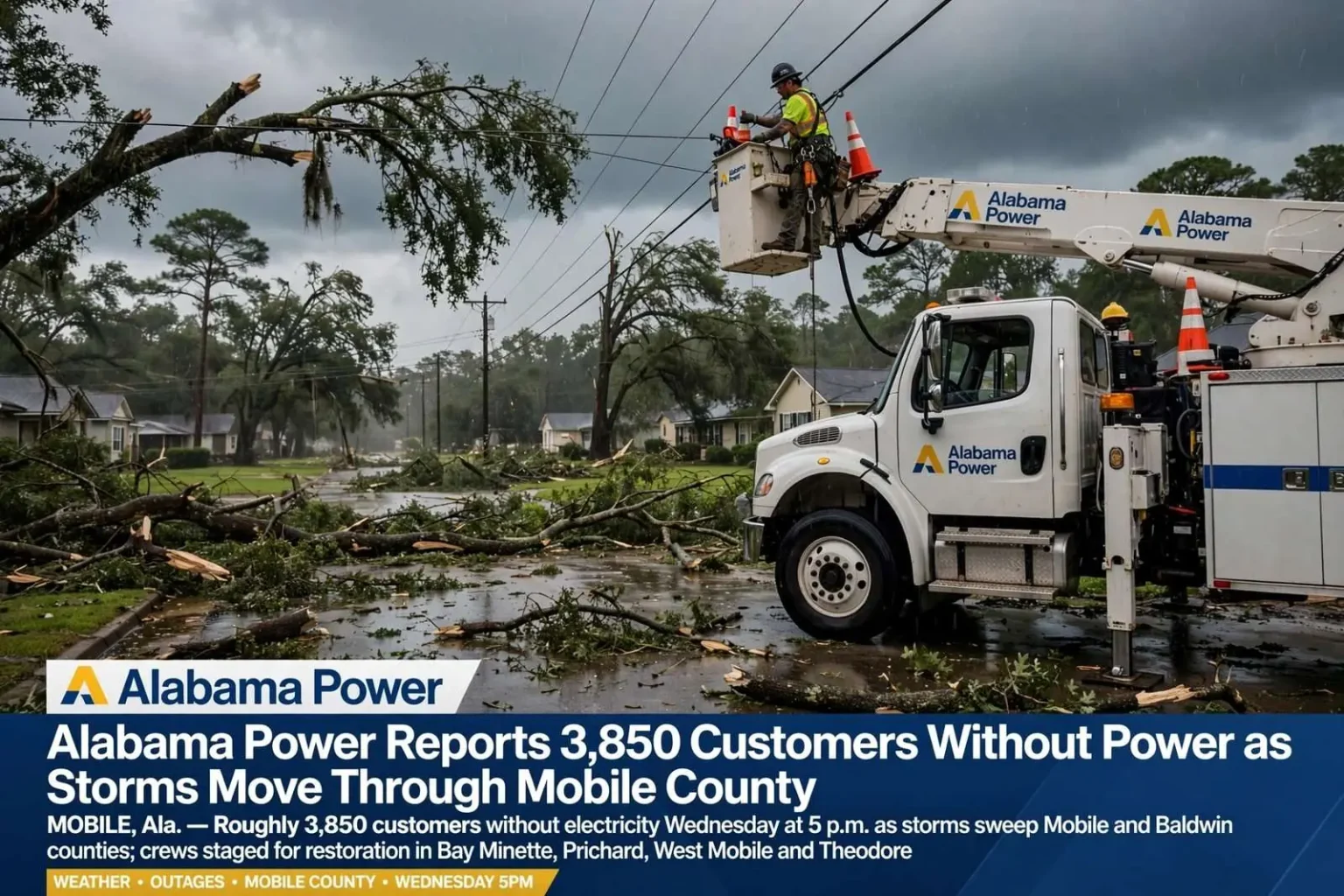
MOBILE, Ala. — Alabama Power reported at 5 p.m. Wednesday that roughly 3,850 customers were without electricity as a line of storms moved through the Mobile area. Most of the outages were concentrated in Bay Minette, Prichard, West Mobile and Theodore, the utility said. Crews were positioned to begin restoration work as soon as weather conditions allowed them to do so safely.
The concentration of outages in four separate communities — two on each side of Mobile Bay — showed how widely the storm system was scattered. Bay Minette, the seat of Baldwin County government, sits north of Interstate 10 and is served by long stretches of overhead line that run through heavily wooded neighborhoods. Prichard, just north of downtown Mobile, and Theodore, along U.S. 90 south of the city, are older communities where mature oaks and pines tower over the service drops that connect homes to the grid. West Mobile, the fast-growing suburban corridor along Airport Boulevard and Schillinger Road, mixes new subdivisions with thick stands of timber left from the area’s rural past.
In each of those places, the recipe for an outage is much the same. Summer thunderstorms moving in off the Gulf regularly produce wind gusts strong enough to snap limbs, and when those limbs fall across distribution lines they interrupt service to every home and business fed by that stretch of wire. A single large oak coming down on a main feeder can leave hundreds of customers dark at once, which is why outage numbers tend to jump in clusters rather than one household at a time.
Storms Hit Multiple Areas at Once
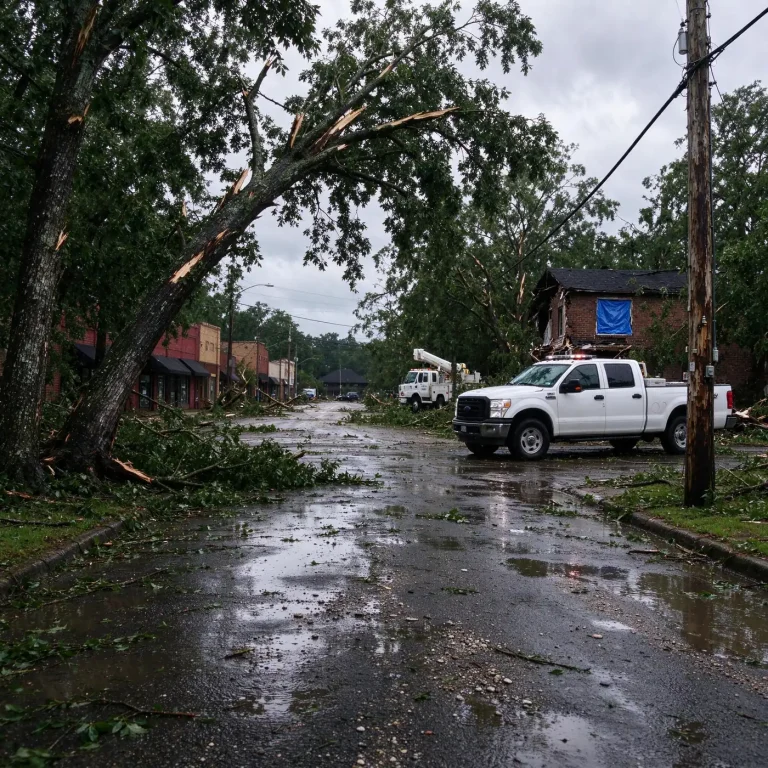
The scattered outages reflected the broad reach of the storms, which swept across Mobile and Baldwin counties during the afternoon. Downed tree limbs and power lines are a common cause of interruptions during summer thunderstorms in the region, and utilities typically wait until severe weather passes before sending line crews into the field.
The delay between a storm and a restoration effort is not caution for its own sake. Line work is performed on energized equipment under the best of circumstances, and sending bucket trucks into an active lightning and wind field puts crews at direct risk. Lightning strikes can energize equipment from a distance, and gusting winds can bring down additional limbs while workers are aloft. Utility practice along the Gulf Coast is to stage crews and equipment in advance, then release them into affected neighborhoods as soon as conditions clear.
That staging is what Alabama Power described in its Wednesday afternoon report. Rather than waiting for damage reports to accumulate and then assembling a response, the utility had crews positioned near the areas where outages were already known to exist. Once radar showed the line of storms moving out of a given service area, those teams could roll.
The pattern of damage during a fast-moving squall line is usually different from what follows a hurricane, and that difference matters for how quickly lights come back on. A summer thunderstorm tends to knock limbs and individual spans of wire, damaging the distribution system at the neighborhood level. Repair work in those cases proceeds circuit by circuit, and most customers are restored within hours. A hurricane, by contrast, can destroy transmission towers and substations, damage that takes days or weeks to repair. Wednesday’s storm produced the first kind of problem, not the second.
For the customers affected, the practical question is what happens next. Alabama Power operates a customer outage reporting system that residents can reach by phone or through the utility’s website and mobile app, and the company encourages anyone who loses service to report it rather than assume the problem is already known. Reported outages help the utility pinpoint trouble spots, especially in neighborhoods where a single tripped breaker or blown transformer might otherwise go unnoticed for hours.
Once a report comes in, restoration follows a familiar hierarchy. Damage to high-voltage transmission lines and substations is repaired first, because those facilities serve tens of thousands of customers and nothing downstream works until they are back. Distribution feeders — the main lines that run along arterial roads — come next, followed by the smaller tap lines that branch into subdivisions, and finally by individual service connections. Crews also give priority to locations where repaired lines are needed to support hospitals, water systems, traffic signals and other critical infrastructure.
That ordering means two neighbors on the same street can have very different experiences during a storm event. A house connected directly to a restored feeder may have lights within a couple of hours, while a home whose individual service line was torn down may wait considerably longer. Utility officials routinely ask customers to be patient during the final phase of restoration, when the remaining jobs are the smallest in scale but the most labor-intensive per customer served.
Why Gulf Coast Summers Are Hard on the Grid
Wednesday’s outages fit a seasonal pattern that Mobile and Baldwin county residents know well. From June through September, afternoon thunderstorms develop almost daily over the Gulf and push inland, feeding on heat and moisture. These cells can produce wind gusts in excess of 50 miles per hour even when they are not severe enough to trigger formal warnings, and the region’s dense tree canopy turns those gusts into a steady supply of fallen limbs.
The problem is compounded by the age and design of parts of the local distribution system. Much of the wire serving older neighborhoods like Prichard and Theodore runs overhead through residential streets, an arrangement that is cheaper to build and easier to repair than buried cable but far more exposed to trees. Buried service, common in newer West Mobile subdivisions, avoids most wind damage but can be slow to repair when it does fail, because crews must locate the fault underground before fixing it.
Utility tree-trimming programs are the other half of the equation. Alabama Power maintains an ongoing cycle of clearing vegetation away from its lines, and after major storms those efforts intensify in the hardest-hit corridors. No trimming program can eliminate the risk entirely, however, when a storm drops limbs from trees standing on private property well outside any easement — a routine occurrence in Mobile County’s oak-lined neighborhoods.
Area utilities also coordinate during widespread events. When storms affect both Alabama Power and the region’s electric cooperatives, crews and equipment can be shifted between systems, and additional line workers from neighboring utilities can be called in through mutual assistance arrangements. For a storm of Wednesday’s scale, local crews generally handle the workload without outside help.
While restoration crews do their work, safety around storm damage remains the most important thing residents can manage themselves. Alabama Power repeated its standing advice in connection with the Wednesday outages: stay clear of any downed lines, which should always be treated as energized.
The warning matters because a fallen wire does not have to be arcing or sparking to be dangerous. Line that appears dead can be re-energized at any moment by automatic switching equipment, and current can travel through wet ground, fences, tree limbs and standing water. During Gulf Coast storm season, heavy rain often pools around downed lines, extending the danger zone well beyond the wire itself. Residents who spot a fallen line are urged to stay away, keep children and pets clear, and report the location to the utility and to 911 rather than attempting to move or cover the wire.
Portable generators, which many households keep for storm season, add another layer of hazard that utility crews face every summer. A generator plugged into a home’s wiring without a proper transfer switch can feed electricity back onto the supposedly dead lines that crews are working to repair — a phenomenon known as backfeed that has injured and killed line workers. Safety guidance is to run generators outdoors, well away from windows and doors, and to connect appliances directly or have a licensed electrician install an appropriate transfer switch.
What Customers Can Expect After a Storm Like This
For most of the customers caught in Wednesday’s outages, the sequence ahead is short. Crews work through affected circuits, restore the main feeders, and clear individual trouble spots until the outage count on the utility’s map falls to zero. Customers who reported their outage can check status through the same channels, and those who see neighbors restored while their own home remains dark are asked to report again, since a localized fault can be missed on an otherwise healthy circuit.
There are practical steps homeowners can take in the meantime. Appliances and electronics should be switched off or unplugged during an outage so that they are not damaged by a surge when power returns, and refrigerators and freezers should be kept closed — a full freezer will hold its temperature for many hours unopened. Anyone using candles for light is reminded to keep them away from curtains and bedding, and battery-powered lanterns remain the safer choice.
The storm that moved through Wednesday left a familiar Gulf Coast picture in its wake: limbs in yards, water standing in low spots, and scattered pockets of darkness across four communities. By the utility’s account, the resources to fix it were already in place before the rain stopped falling. Residents were asked to do their part — report outages, give crews room to work, and treat every downed line as if it were live.