Mobile Ship Channel Closure Set for Friday as Former Carrier Enterprise Is Towed to Riverfront Scrapyard
Commercial traffic on the Mobile Ship Channel is expected to stop for several hours from 6 a.m. Friday, Nov. 13, as the former USS Enterprise is towed to the M.A.R.S. facility, with a 500-yard protection zone in place.
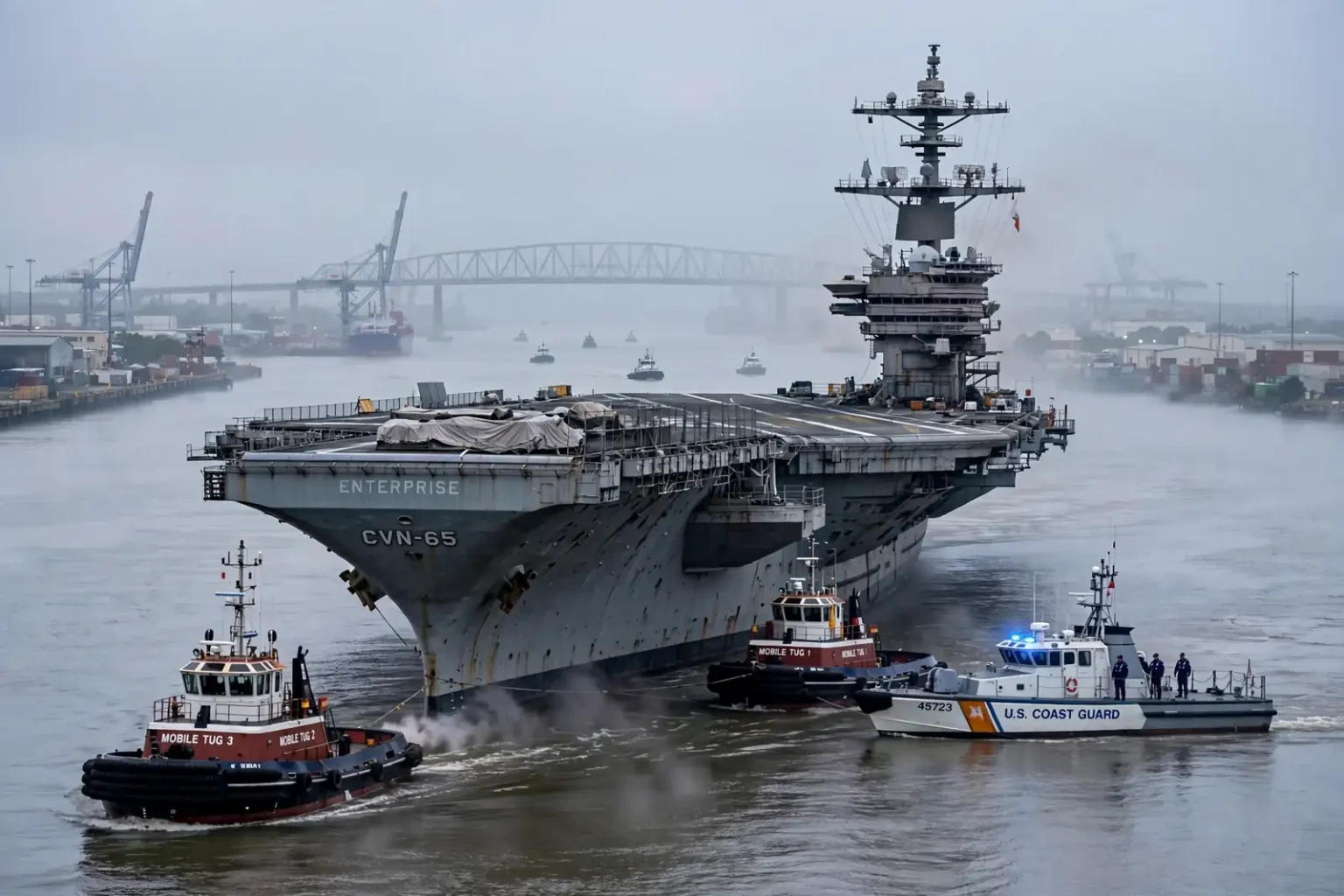
MOBILE, Ala. — Shipping traffic on the Mobile Ship Channel is set to pause Friday morning, Nov. 13, as the decommissioned aircraft carrier Enterprise is towed up from the Gulf to the riverfront yard where it will be dismantled. The Mobile Ship Channel closure is expected to begin with the tow at 6 a.m. Central time, provided the weather cooperates, and is expected to last roughly 8 to 10 hours depending on port conditions.
During that window, commercial vessels are expected to be kept off the entire route, which stretches from Mobile Lighted Buoy 1, offshore at the entrance to Mobile Bay, all the way up to the Africatown-Cochrane Bridge north of downtown Mobile. Every vessel, commercial or not, will need the U.S. Coast Guard’s go-ahead to come into or linger within the safety zone along the channel while the restrictions are active.
What Boaters and Mariners Need to Know
- When: The inbound tow is expected to start at 6 a.m. CST on Friday, Nov. 13, weather permitting.
- Where: The Mobile Bar Channel and the Mobile River Channel, between the Cochrane Bridge and the sea buoy known as Mobile Lighted Buoy 1.
- How long: The closure lasts as long as the tow itself, which is expected to take about 8 to 10 hours, depending on port conditions.
- Who is affected: Commercial shipping is expected to halt. Any boat, of any size, must get Coast Guard approval before entering the safety zone or staying inside it.
- Harbor hold: Some harbor traffic may keep moving while the carrier crosses Mobile Bay, but once it reaches the harbor, the Coast Guard will hold all vessel traffic until the ship is moored.
- Intracoastal Waterway: Traffic on the Gulf Intracoastal Waterway will be stopped where it crosses the ship channel until the carrier passes.
- Moving zone: The carrier will be surrounded by a Naval Protection Zone extending 500 yards.
- Radio: Keep VHF Channel 16 on for directions from the Coast Guard.
- Schedule changes: Updates will be issued by the Coast Guard’s Sector Mobile office.
The Rules Inside the Moving Protection Zone
The tightest restrictions will follow the carrier itself. A Naval Protection Zone with a 500-yard radius will surround the Enterprise and travel with it, starting when the hull crosses into the area overseen by the Coast Guard’s Captain of the Port for Mobile and lasting until the ship is secured at its berth.
Inside that bubble, two distance rules apply:
- Within 500 yards: Vessels must slow to the minimum speed needed to keep a safe course.
- Within 100 yards: No vessel may come this close without first getting permission from the Coast Guard or from a designated patrol boat.
Naval vessel protection zones are a standing feature of federal maritime rules and are used around U.S. Navy ships and certain other government vessels. They are designed to keep a protective buffer around a ship as it moves through busy or confined waters. Even though the Enterprise is no longer in service, the protection zone will be in effect for this tow.
Recreational boaters should expect to see law enforcement patrol boats along the tow route and should follow any directions given by officers on the water. Boaters who need to enter a restricted area can request authorization over VHF Channel 16.
Who Is Coordinating the Tow
The move involves several agencies. In the days leading up to the tow, the Alabama Port Authority Harbormaster’s office has been coordinating with the Coast Guard, the Navy and other partners to keep watch on weather and port conditions.
The harbormaster’s office manages the movement of ships within the Port of Mobile and helps schedule berths and traffic so that large vessels can move safely through the harbor. The Coast Guard, through Sector Mobile and its Captain of the Port, has authority to set safety zones, restrict traffic and enforce those limits on the water.
Because the 6 a.m. Friday start depends on the weather, the timing is not locked in. Wind, visibility and sea conditions can all affect whether a large, unpowered hull can be towed safely through the bar channel and up the narrow river. If the timing shifts, the Coast Guard’s Sector Mobile office will announce the change.
A Long Route From the Gulf to Downtown
The tow will cover much of the length of Mobile’s main shipping corridor. The Mobile Bar Channel carries vessels from the Gulf across the shallow bar at the mouth of Mobile Bay, between Dauphin Island and Fort Morgan. From there, the ship channel runs north up the bay to the mouth of the Mobile River, where the river channel continues past the downtown waterfront and the state docks.
The Cochrane Bridge, the northern limit of the closure, carries traffic across the Mobile River north of downtown. Closing the full stretch from the sea buoy to the bridge gives the tow a clear path from open water to its destination.
Along the way, the tow will also cross the Gulf Intracoastal Waterway, the sheltered inland route heavily used by tugs and barges moving along the coast. Vessels on the waterway will be held at the crossing with the ship channel until the carrier has gone by. Inside the harbor itself, the Coast Guard plans to stop all vessel movement until the Enterprise is tied up, although some harbor traffic may continue while the carrier is still working its way up the bay.
The channel is the backbone of one of the busiest ports on the Gulf Coast, serving container ships, bulk carriers, tankers and barges. A planned closure of 8 to 10 hours means commercial operators will need to adjust arrival and departure times, which is why the port and the Coast Guard are urging vessels to plan ahead.
Where the Carrier Will End Up
The Enterprise is headed for the Modern American Recycling Services yard, known as M.A.R.S., located on the Mobile River at 701 S. Royal St., where it will be taken apart.
Once the ship is moored there, the moving protection zone will give way to a fixed safety zone around the berth. Because that zone lies beyond the edge of the federal navigation channel in the river, the Army Corps of Engineers does not expect it to interfere with commercial shipping during the dismantling.
Specifics on the safety zones, such as exactly where the fixed zone at the berth begins and ends, appear in two Corps navigation bulletins, numbers 26-143 and 26-144, issued by its Mobile District and posted on the district’s Navigation Notices page. Mariners who operate near the downtown waterfront should review those bulletins before the carrier arrives.
About the Corps’ role
The Corps’ Mobile District maintains the federal navigation channels serving the port, including dredging that keeps them deep enough for large ships. Its navigation bulletins are routine notices that inform the maritime community about conditions, work and restrictions in those channels.
The Ship Behind the Closure
The vessel arriving Friday, hull number CVN-65 and long nicknamed the “Big E,” was the world’s first nuclear-powered aircraft carrier. Launched in 1960 and commissioned in 1961, it served for more than half a century, taking part in multiple conflicts, before being deactivated in 2012 and formally decommissioned in 2017. The ship measures more than 1,100 feet in length and carried about 5,000 sailors. Its nuclear fuel was removed before decommissioning, but its reactors still must be dismantled and disposed of.
The carrier left Newport News, Virginia, under tow on Monday, Nov. 9, on its final voyage to Mobile. The dismantling work in Mobile is expected to take several years, with the Navy targeting completion by September 2030, according to the Navy’s timeline for the project.
The Enterprise will be arriving at the same stretch of riverfront that recently said goodbye to another famous ship. The ocean liner SS United States, which had been docked at the M.A.R.S. yard since March 2025, was towed out of Mobile earlier this week under its own Coast Guard safety zone, headed for the waters off Okaloosa County, Florida, where it is to become an artificial reef.
Who Is Taking the Carrier Apart
The Enterprise is the first ship from the Navy’s fleet of nuclear-powered carriers to be scrapped. Rather than handle the job itself, the Navy put the dismantlement out to bid with private industry. The contract, awarded in 2026, went to NorthStar Marine Dismantlement Services LLC and its partner, Modern American Recycling and Radiological Services, with the work to be done in Mobile.
Under the terms the Navy described, the entire ship will be taken apart, and every material that comes out of it will be either recycled or disposed of properly. Hazardous materials, including low-level radioactive waste, are to be packaged and shipped to authorized, licensed disposal sites.
Some of that work is already visible. The superstructure that housed the ship’s bridge has been removed. And part of the old carrier will go back to sea: roughly 35,000 pounds of steel from the Enterprise’s hull is slated to be recycled into the construction of its successor, a new-generation nuclear carrier that will be the eighth Navy ship to carry the Enterprise name. That vessel is expected to enter service in 2031.
A Veteran Remembers the 1969 Fire
For some in the region, the carrier’s arrival carries personal weight. The Enterprise was the scene of one of the deadliest U.S. naval disasters after World War II. On Jan. 14, 1969, while the ship was off the coast of Hawaii preparing for live bombing exercises, a bomb accidentally ignited on deck. The ignition set off a chain reaction of explosions and a large fire, and 28 sailors were killed.
A Baldwin County man who served in the Navy during the Vietnam War was 19 and had reported aboard the Enterprise only two weeks before the fire. He was assigned to laundry duty, and his team gathered at the laundry when general quarters sounded. He was below deck near the stern when the follow-up explosions hit, and he recalled feeling the back of the ship drop and rise from the force of one of the blasts.
The ship then went to Condition Zebra, a damage-control setting in which watertight hatches are sealed and no one may leave a compartment until the captain orders it. Marines were posted at the hatches to enforce the order. The veteran said flames and thick black smoke began pouring from the fresh-air vents into his compartment, and sailors scrambled up a ladder to open a small escape scuttle. A Marine arriving at the hatch forced it shut, and a sailor just above the veteran repeatedly wrestled the handle back until he pushed the scuttle open. After the Marine confirmed there was smoke and fire below rather than flooding, he let the men climb out despite his orders. The veteran credits that decision for his survival.
He has kept in touch over the years with sailors who were injured in the fire and said that, while it saddens him to see the ship scrapped, he looks forward to seeing it again in Mobile and hopes to find a way to go aboard one last time.
How Safety Zones Are Enforced, and How to Watch Safely
Safety zones and naval protection zones are not suggestions. The Coast Guard creates them under federal law to keep people and vessels out of harm’s way during hazardous or sensitive operations, and it can enforce them with its own boats as well as with help from state and local marine law enforcement agencies.
Mariners who enter a zone without permission, or who ignore instructions from patrol vessels, can face civil penalties, and serious violations can lead to criminal charges. Beyond the legal risk, getting too close to a large vessel under tow is dangerous: a towed hull cannot stop or turn quickly, tow lines can stretch far behind the tug, and the wake and propeller wash from the tugs can be strong in a confined river.
For commercial operators, the practical advice is to check with the harbormaster’s office and their agents about scheduling, and to build in extra time for arrivals and departures around Friday morning. Pilots, tug operators and terminal managers are expected to coordinate closely so that traffic can resume quickly once the carrier clears the channel.
Watching the arrival safely
The arrival of a carrier-sized hull is likely to draw spectators along the bay and riverfront. People who plan to watch from shore should use public areas, stay off restricted property and keep clear of working docks and industrial sites.
Anyone watching from the water should keep in mind that the protection zone moves with the ship, so a spot that is legal one minute may fall inside the restricted area the next. The safest approach for recreational boaters is to stay well outside 500 yards, keep a radio tuned to Channel 16 and follow any instructions from patrol boats.
General boating safety still applies, too. November mornings on Mobile Bay can be cool and breezy, so boaters should wear life jackets, carry required safety gear, check the marine forecast before heading out and avoid crowding other vessels near the route.
What Comes Next
If the weather holds, the tow is scheduled to begin at 6 a.m. Friday and is expected to take about 8 to 10 hours, after which the channel will reopen to commercial traffic. Once the Enterprise is secured at the M.A.R.S. berth, the fixed safety zone will take over and dismantling work can begin.
Mariners should continue to check for updates from U.S. Coast Guard Sector Mobile on Thursday and early Friday in case the schedule changes, and should consult the Corps of Engineers navigation bulletins for the boundaries of the fixed zone that will remain in place during the dismantling.