Highway 45 Pedestrian Deaths: Two Men Hit by Vehicle at Kushla Station Road Near Eight Mile
Two men on foot died after a vehicle hit them Thursday evening where Kushla Station Road meets Highway 45 near Eight Mile. State troopers are leading the investigation with help from Mobile County deputies.
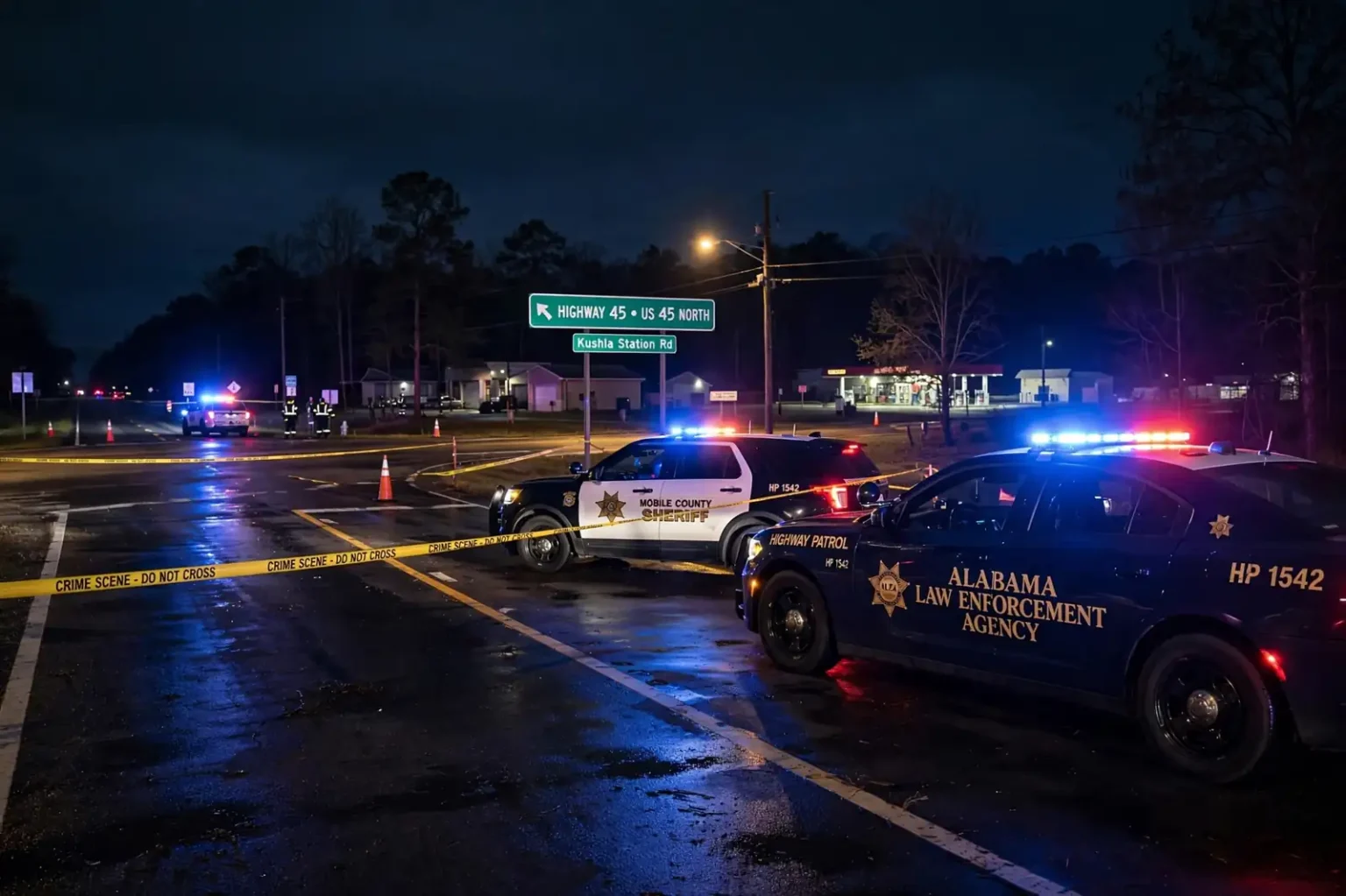
EIGHT MILE, Ala. — State troopers are investigating Highway 45 pedestrian deaths in north Mobile County after a vehicle hit and killed two men on foot Thursday night, Nov. 12, at the intersection of Kushla Station Road and Highway 45.
The collision happened before 8 p.m., the Mobile County Sheriff’s Office reported. Both men died. The Alabama Law Enforcement Agency has taken the lead in the investigation, and sheriff’s deputies are assisting troopers, the sheriff said.
What is known so far
Details released Thursday night were limited. Here is a summary of the information authorities have made public:
- Victims: Two men who were on foot
- Time: Before 8 p.m. Thursday, Nov. 12, 2026
- Location: The intersection of Kushla Station Road and Highway 45, near Eight Mile in Mobile County
- Lead agency: Alabama Law Enforcement Agency
- Assisting agency: Mobile County Sheriff’s Office
Authorities have not released the names or ages of the two men, and they have not described the vehicle involved or said whether its driver remained at the scene. Officials also have not said whether any charges are being considered. No information has been made public about what the men were doing near the highway at the time or which direction the vehicle was traveling.
Why state troopers are in charge
Residents sometimes wonder why a state agency, rather than local deputies, investigates a deadly crash in their own community. In Alabama, the Highway Patrol Division of ALEA is generally responsible for investigating traffic crashes on state and federal highways outside city limits. Highway 45, a federal route, falls into that category through much of north Mobile County.
Under that arrangement, troopers handle the scene investigation, collect evidence and determine how the crash unfolded, while local agencies such as the sheriff’s office often help with traffic control, scene security and other support. That is the pattern the sheriff described for Thursday’s fatal crash, with deputies working alongside ALEA.
In fatal cases, troopers may bring in investigators trained in crash reconstruction. They examine where the vehicle and pedestrians were positioned, look for marks on the road surface, review any available video, interview witnesses and inspect the vehicle. The work can take weeks, and official findings are often not released until the investigation is complete.
About the area
Eight Mile is a community in the northern part of Mobile County, just north of Prichard. U.S. Highway 45 is its main commercial artery. The four-lane highway begins in Mobile and runs northwest through Eight Mile, past Kushla and on toward Citronelle and the Mississippi state line, eventually continuing far into the Midwest.
Kushla Station Road meets Highway 45 in this stretch of the corridor. The area mixes neighborhoods, businesses and open land, and the highway carries a steady flow of commuters, delivery vehicles and trucks traveling between Mobile and the communities to the northwest. Like many suburban highways, the corridor was built primarily for vehicles, and stretches of it have limited sidewalks, crosswalks or street lighting compared with city streets.
A national problem with local consequences
Pedestrian deaths have been a growing concern for traffic safety officials across the country. Over roughly the past decade and a half, the number of people killed while walking on U.S. roads climbed substantially, even as vehicles became safer for the people riding inside them. Researchers and safety groups have pointed to several factors, including higher speeds on suburban arterial roads, larger vehicles, distracted driving and the spread of development along highways that were not designed with walkers in mind.
Corridors like Highway 45 fit a pattern that transportation planners often describe: multilane roads lined with homes, stores, restaurants and bus routes, where people need to walk or cross but long distances may separate signalized intersections. On such roads, a pedestrian may be tempted to cross mid-block or walk along the edge of the pavement, while drivers may be traveling at speeds that leave little margin for error.
Alabama, like many Southern states with large rural and suburban road networks, has recorded significant numbers of pedestrian fatalities in recent years. Each of those deaths represents a family and a community affected by a sudden and preventable loss.
A dangerous time of year for people on foot
The crash happened roughly three hours after sunset. In mid-November, darkness settles over south Alabama by around 5 p.m., following the end of daylight saving time earlier in the month. That shift means the evening commute, school and work activities, and errands now take place after dark for many families.
Authorities have not said whether lighting played any role in Thursday’s crash. In general, however, national traffic safety data has consistently shown that the large majority of pedestrian deaths in the United States happen in the dark, and that a significant share occur on higher-speed roads away from marked crosswalks. Drivers have less time to see and react to a person in dark clothing on an unlit roadway, and vehicles traveling at highway speeds are far more likely to cause fatal injuries when they strike a pedestrian.
Safety reminders for pedestrians
Traffic safety organizations offer a number of practical steps that can lower the risk for anyone walking near busy roads, especially after dark:
- Use sidewalks wherever they exist. Where there is no sidewalk, walk on the shoulder facing oncoming traffic so you can see approaching vehicles.
- Cross at intersections or marked crosswalks when possible, and use pedestrian signals where they are available.
- Wear light-colored or reflective clothing and carry a flashlight or use a phone light at night.
- Never assume a driver sees you. Try to make eye contact with drivers before stepping into the roadway.
- Stay alert by keeping headphones low and looking up from phones near traffic.
- Avoid walking along or across high-speed highways when impaired, since alcohol and other substances affect judgment and reaction time for pedestrians as well as drivers.
Safety reminders for drivers
Drivers share responsibility for protecting people on foot. Common guidance includes:
- Slow down, particularly in areas with homes, businesses and bus stops where people may be walking.
- Use headlights properly and keep the windshield and lights clean.
- Scan the roadside and intersections for pedestrians, especially at night and in poor weather.
- Put the phone away. A few seconds of looking down at highway speeds covers a long distance.
- Yield to pedestrians in crosswalks, and be cautious when another vehicle has stopped, since it may be stopping for someone crossing.
- Never drive impaired.
What the law requires of drivers after a crash
Authorities have not addressed whether the driver in Thursday’s crash remained at the scene. As a general matter, Alabama law requires any driver involved in a crash that results in injury or death to stop, remain at the scene, provide identifying information and render reasonable assistance to anyone who is hurt, including calling for medical help. Leaving the scene of a crash involving injury or death is a serious criminal offense in Alabama.
Whether a driver faces any charges after a pedestrian crash depends on the facts investigators uncover, such as speed, impairment, visibility and the actions of everyone involved. In many fatal crashes, those decisions are made only after the investigation is complete, sometimes in consultation with the district attorney’s office.
Help for those affected
Deadly crashes affect not only the families of those who died but also witnesses, drivers and first responders. People coping with the sudden loss of a loved one in a traffic crash can find support through grief counseling services, faith communities and victim assistance programs available in the Mobile area. Anyone involved in or present at a traumatic crash who is having trouble sleeping, concentrating or coping is encouraged to talk with a health care provider or counselor.
What happens next
ALEA will continue to investigate the crash with assistance from the Mobile County Sheriff’s Office. The agency typically releases the identities of people killed in crashes after their families have been notified. Any additional information about the two men, the vehicle and the circumstances of the collision would be expected to come from state troopers as their investigation moves forward.
Until then, the deaths of two people at a single intersection on a busy weeknight serve as a sobering reminder for everyone who walks or drives the Highway 45 corridor to take extra care, particularly in the long hours of darkness ahead this fall and winter.