Batesville, Texas, Driver Dies in I-65 Semi-Truck Crash South of Satsuma in Mobile County
A commercial truck driver from Batesville, Texas, died Wednesday evening after his tractor-trailer ran off Interstate 65 and hit a tree about two miles south of Satsuma. State troopers are investigating the single-vehicle wreck.
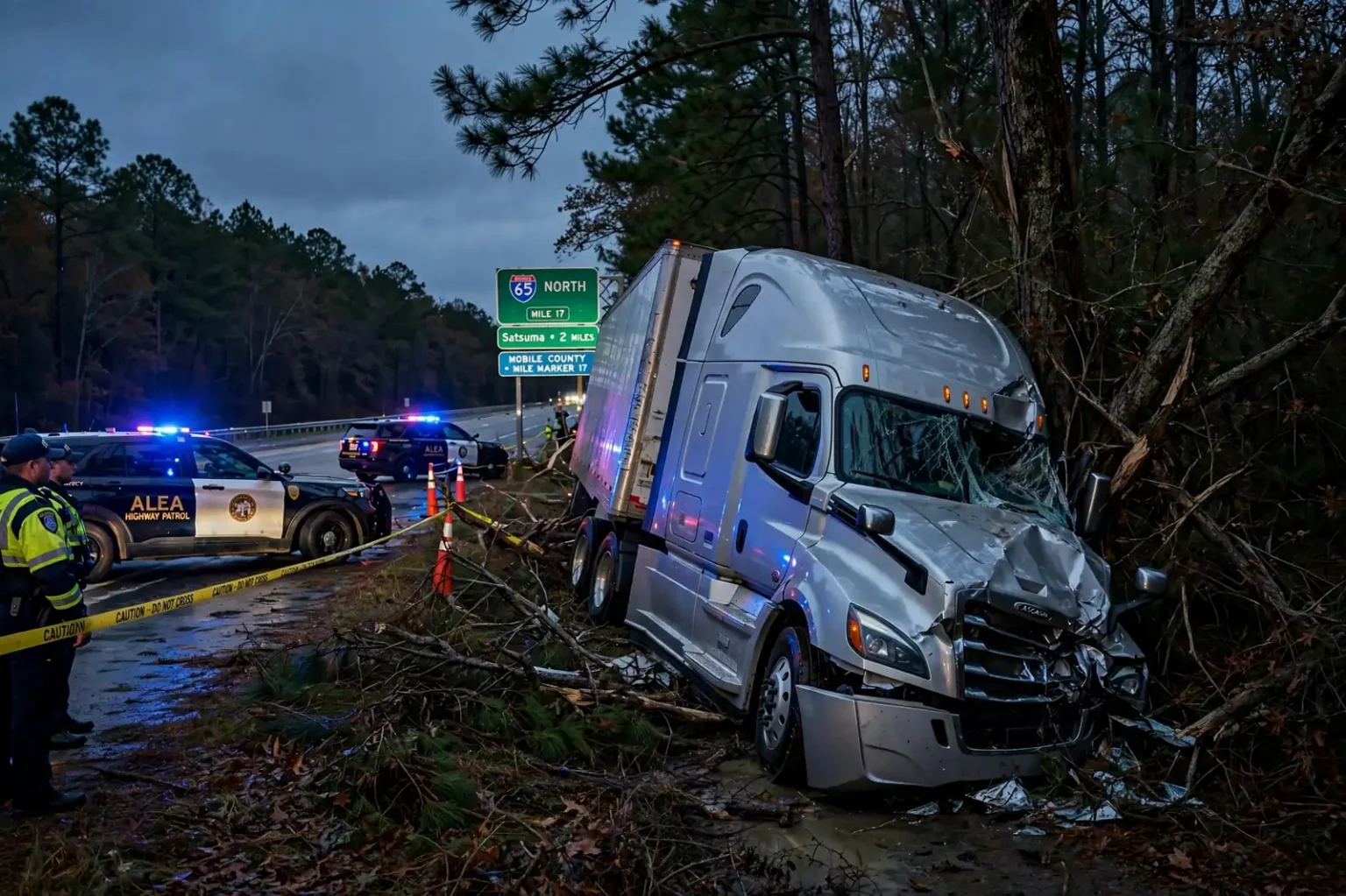
SATSUMA, Ala. — A 41-year-old commercial truck driver from Batesville, Texas, lost his life Wednesday evening in an I-65 semi-truck crash in north Mobile County, according to the Alabama Law Enforcement Agency. The tractor-trailer he was operating ran off the interstate and collided with a tree, and he died where the wreck came to rest.
The crash is being investigated by state troopers assigned to ALEA’s Highway Patrol Division. No other vehicles were involved, and the agency has not announced what caused the truck to leave the highway.
Key facts at a glance
- When: About 6:38 p.m. Wednesday, Nov. 11, 2026
- Where: Interstate 65 near the 17 mile marker, roughly two miles south of Satsuma, in Mobile County
- Vehicle: A 2019 Freightliner Cascadia semi-truck, classified as a commercial motor vehicle
- Type of crash: Single vehicle; the truck ran off the interstate and hit a tree
- Outcome: The driver, a 41-year-old Batesville, Texas, resident, suffered critical injuries and died at the crash site
- Investigating agency: ALEA Highway Patrol Division
Pinpointing the location
Although I-65 continues north into Baldwin County, this crash happened on the Mobile County side of the line. ALEA identified the site as Interstate 65 near mile marker 17, approximately two miles south of Satsuma. That stretch of highway lies in the northern part of Mobile County, in the corridor that links the city of Mobile with the communities of Saraland, Satsuma and Creola before the interstate crosses into Baldwin County farther north.
Mile markers on I-65 in Alabama are counted from the highway’s southern starting point in Mobile and climb as the road heads north toward Montgomery and Birmingham. A location near mile marker 17 is therefore well inside Mobile County, north of the city of Mobile and south of the bridges that carry the interstate over the Mobile-Tensaw River Delta.
Satsuma is a small city of the northern Mobile County suburbs, bordered by Saraland to the south and Creola to the north. Much of the land alongside the interstate in this area is wooded, which means a vehicle that departs the travel lanes can quickly encounter trees rather than an open shoulder or field.
What state troopers have said
ALEA’s account of the crash is brief. According to troopers, the tractor-trailer veered off the highway and collided with a tree at about 6:38 p.m. on Wednesday, Nov. 11. The driver was critically injured in the impact and was declared dead at the scene. No other vehicle was involved, and troopers have classified the truck as a commercial motor vehicle.
The agency has not released any further details, including the direction the truck was traveling, whether it was hauling a load, or what may have contributed to its departure from the highway. ALEA said nothing more was available while its Highway Patrol Division continues the investigation.
About the vehicle
The truck involved was a 2019 Freightliner Cascadia. The Cascadia is one of the most widely used heavy-duty highway tractors in North America and is a common sight on long-haul freight routes across the country. Trucks of this kind are typically paired with a trailer and are built for extended interstate travel.
Because the Cascadia is a commercial motor vehicle, the crash falls into a category that receives particular attention from investigators. Commercial vehicle crashes can involve additional lines of inquiry beyond those in a typical passenger car wreck, such as the condition of the equipment and the records that commercial drivers and carriers are required to keep.
Road departure crashes
Crashes in which a vehicle leaves its lane and the roadway are among the deadliest on American highways. Federal highway safety officials have long identified roadway departures as a leading factor in traffic deaths nationwide, in large part because a vehicle that runs off the road often strikes a fixed object such as a tree, pole or embankment, or overturns. Engineers address the risk with tools such as rumble strips, wider shoulders, guardrails and cleared roadside zones, but wooded corridors still leave little room for recovery once a heavy vehicle drifts off the pavement.
How a fatal crash investigation generally works
When a deadly crash occurs on an interstate or state highway outside city limits in Alabama, ALEA’s Highway Patrol Division is generally the lead investigating agency. Troopers secure the scene, document the position of the vehicle and any marks left on the road surface or shoulder, and gather physical evidence before the roadway is fully cleared.
In serious and fatal cases, the agency may call on troopers with specialized training in crash reconstruction. These investigators use measurements, photographs and data recovered from the vehicle to piece together the sequence of events, including speed, direction of travel and the point at which a vehicle left the roadway. Many modern heavy trucks carry electronic systems that record information about how the vehicle was being operated shortly before a crash, which can help investigators build a timeline.
Investigators in commercial vehicle cases also typically review factors such as the mechanical condition of the truck and its brakes and tires, the weight and security of any cargo, weather and lighting conditions, and the driver’s hours on duty. Toxicology testing is also a routine part of many fatal crash investigations. Determining the cause of a single-vehicle crash can take weeks or longer, and findings are not always made public quickly.
At this point, ALEA has not indicated what led to the crash, and no conclusions should be drawn until the investigation is complete.
The role of ALEA
The Alabama Law Enforcement Agency is the state’s primary law enforcement organization. It was formed through the consolidation of several state public safety and investigative agencies into a single department. Its Highway Patrol Division is responsible for traffic enforcement and crash investigation on the state’s rural roads and highways, including interstates such as I-65.
Troopers in the Mobile area routinely work crashes along I-65, Interstate 10 and the many U.S. and state highways that cross the region. The agency typically releases basic details of fatal crashes, such as the time, location, vehicles involved and the age and hometown of those who died, shortly after notifying next of kin.
Why this stretch of I-65 matters
Interstate 65 is one of the most important highways in the Southeast. Its southern end is in Mobile, where it meets Interstate 10, and from there it runs north through Alabama’s largest cities and on toward the Midwest, ending in northwestern Indiana. For the Port City, it serves as a main artery for freight moving between the Port of Mobile, the region’s industrial sites and destinations across the country.
That role means the highway carries heavy volumes of tractor-trailer traffic at all hours. In north Mobile County, the interstate serves both long-distance travelers and commuters who live in Saraland, Satsuma, Creola and nearby communities and work in Mobile. A crash in this area, particularly one involving a large truck, can affect travel for a significant distance in both directions while emergency crews and wreckers work.
Evening driving and highway safety
The crash happened at about 6:38 p.m. In mid-November, that is well after sunset in south Alabama, as the shorter days of late fall mean many evening commuters and truckers are driving in darkness. While ALEA has not linked lighting or any other condition to this particular wreck, safety officials generally note that nighttime driving brings added challenges, including reduced visibility, glare from oncoming headlights and fatigue.
For all drivers, and especially those who spend long hours behind the wheel, traffic safety advocates commonly recommend a few basic practices:
- Take regular breaks on long trips and pull over to rest when drowsy, since fatigue can slow reaction time much like impairment.
- Avoid distractions such as phones and in-cab devices while the vehicle is moving.
- Adjust speed to conditions, particularly at night, in rain or fog, or in work zones.
- Keep vehicles properly maintained, with special attention to tires, brakes, lights and steering.
- Always wear a seat belt, which remains one of the most effective ways to survive a serious crash.
Commercial drivers in the United States also operate under federal hours-of-service rules, which limit how long they may drive and require rest periods. Those rules are intended to reduce the risk of crashes caused by fatigue on long-haul routes like I-65.
Sharing the road with large trucks
Motorists who travel I-65 regularly share the road with a steady stream of tractor-trailers. Highway safety guidance typically urges drivers of passenger vehicles to stay out of a truck’s blind spots, avoid cutting in closely in front of a large truck, and allow extra room because heavy trucks need more distance to stop. Drivers are also reminded that Alabama law requires motorists to move over or slow down when passing emergency vehicles, tow trucks and other vehicles stopped with flashing lights on the side of the road.
Those precautions protect not only travelers but also the troopers, firefighters, paramedics and wrecker operators who respond to crashes along the interstate.
What comes next
The investigation remains open. ALEA’s Highway Patrol Division will continue to examine the scene evidence and the truck itself, and the agency has said no additional information was available while that work goes on. If investigators determine a cause or release further findings, those details would typically come from ALEA.
Further updates on the case, including any findings about what caused the truck to leave the highway, would be expected to come from ALEA once its review is complete.