Power Outage Sends Bryant High and Booth Elementary Students Home Early
Alma Bryant High and Anna F. Booth Elementary in south Mobile County dismissed students early Monday due to a power outage.
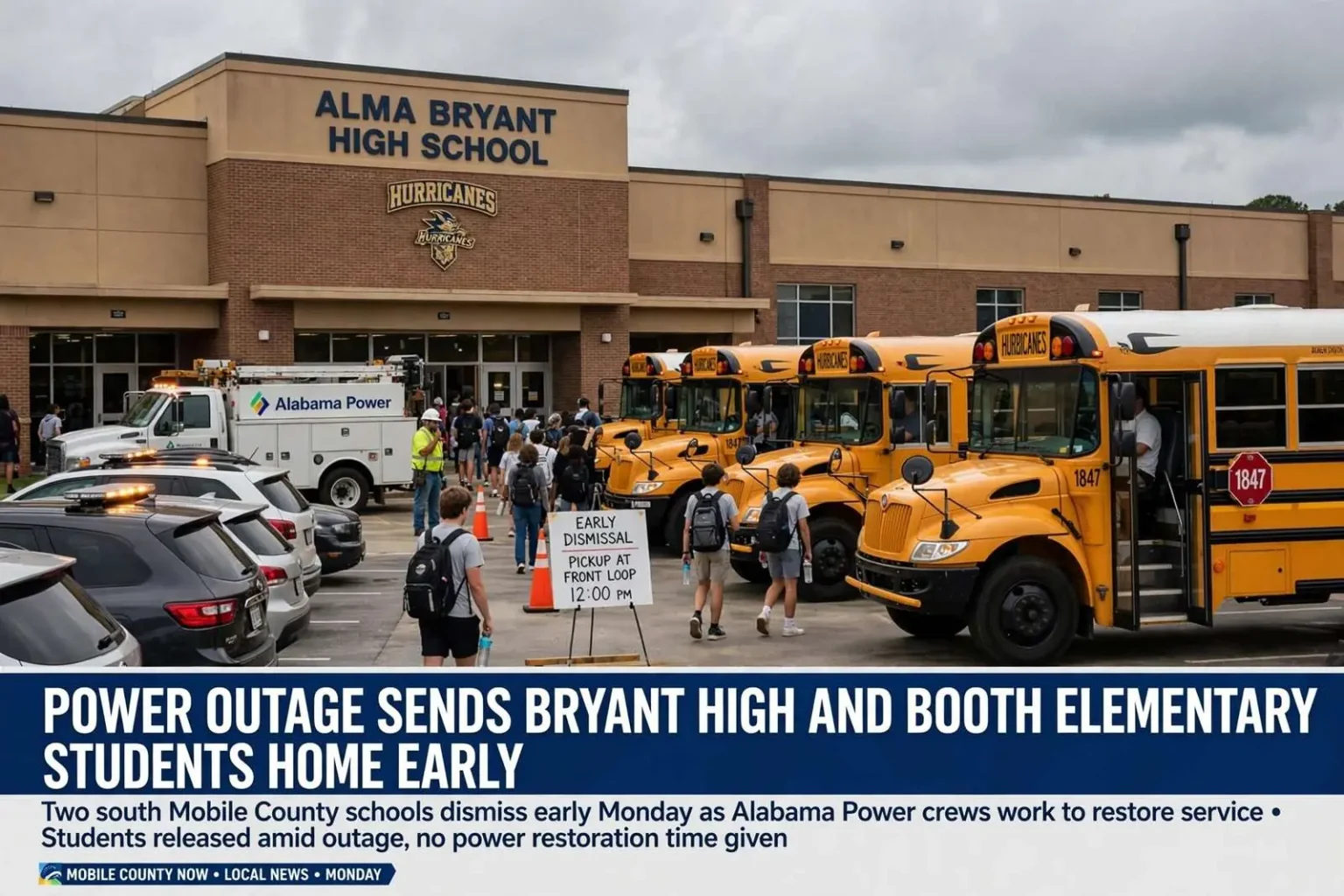
Two south Mobile County schools cut the school day short on Monday after losing electricity, dismissing students while Alabama Power crews worked to restore service. Alma Bryant High School announced its outage first, about an hour before Anna F. Booth Elementary followed with a similar notice.
At Bryant, student drivers were released to drive themselves home and buses rolled to take bus riders, while car riders’ families were asked to pick up their students as soon as possible. Over at Booth Elementary, bus riders were sent home around noon. Car rider dismissal began at 12:15 p.m., with the school urging parents to arrive promptly.
According to posts from both schools, Alabama Power was working on the outage, though crews could not say exactly when electricity would be back. Neither school indicated whether classes would return to a normal schedule the following day.
The early dismissals compressed a school day into a morning, and they tested the dismissal machinery that Mobile County schools rehearse for exactly this kind of disruption. Getting hundreds of teenagers and elementary students home safely in the middle of a school day requires the same choreography as a normal afternoon dismissal — just earlier, faster and with parents scrambling to rearrange their day.
How the Morning Unfolded
The outage hit Alma Bryant High School first, and the school’s announcement went out to families about an hour before Booth Elementary posted its own notice. The staggered timing suggests the two schools, which sit in the same corner of south Mobile County, were affected by related problems on the electrical system — a single feeder line or substation issue can knock out multiple campuses served by the same circuits.
Bryant’s dismissal plan reflected the reality of a high school campus. Student drivers — a large share of any high school’s population — were released to leave in their own vehicles, the standard first step in an early release because it clears the campus without waiting for parents. Buses were dispatched for bus riders, and the families of car riders were asked to pick up students as soon as they could manage.
At Booth Elementary, the sequence was reversed to match the needs of younger children. Elementary schools hold bus riders and car riders on campus until their rides arrive — no young student is released to walk or drive — so the school sent its bus riders home around noon and started car rider dismissal at 12:15 p.m., urging parents to arrive promptly so the campus could empty in an orderly flow.
Why Schools Close for Power Losses
A school without electricity is a school that cannot safely operate. Lighting, air conditioning, kitchen refrigeration, intercoms, fire alarms, telephone systems and the electronic controls of the building all depend on power, and state fire and health codes treat those systems as prerequisites for occupancy. In coastal Alabama’s late-summer heat, a classroom without air conditioning becomes unusable within an hour anyway — especially in a school of hundreds of students.
School administrators also weigh the uncertainty that defines outage situations. Alabama Power crews could not tell the schools when service would return, and a district cannot hold students indefinitely in a building without functioning systems on the chance that power comes back before 3 p.m. The decision to dismiss early is the predictable result: once restoration time is unknown and building systems are down, sending students home is the safe call.
Mobile County Public Schools, the state’s largest district, operates early-dismissal procedures that each campus adapts to its layout — which is why Bryant and Booth handled the same morning differently. High schools release drivers first; elementaries hold and dispatch in waves. The constants are communication with parents and accountability for every student until they leave with the right adult or the right bus.
The Schools and Their Communities
Alma Bryant High School serves the far southern end of Mobile County, drawing students from Irvington, Bayou La Batre, Grand Bay and the surrounding communities to a campus that stands among the county’s largest high schools. Its enrollment reflects the dispersed, rural-suburban geography of south Mobile County, where school bus routes stretch across long distances between the bayou communities and the agricultural land along the state line.
Anna F. Booth Elementary serves the same corner of the county from its campus in Irvington, feeding families whose older children ultimately move on to Bryant. The two schools’ proximity — both on the south end of the county’s road network — explains how a single electrical problem could touch them within the same hour, and how families with students at both schools spent Monday managing two dismissal schedules at once.
The area is no stranger to infrastructure strain. South Mobile County sits at the end of the utility grid’s reach, where storms, equipment failures and the long distances between substations make outages a recurring feature of life. Schools in such areas build outage response into their routine planning, and parents there are practiced at the midday scramble a notice like Monday’s sets off.
Alabama Power’s Restoration Work
The utility’s crews spent Monday working on the outage, with the company unable to give the schools a firm restoration time — a common situation while crews diagnose the fault. Electrical restoration follows a sequence: crews first identify where the failure occurred, then repair the primary lines that restore the largest blocks of customers, then work outward to smaller lines and individual service problems. Until the fault is found, no honest estimate is possible.
The schools’ posts conveyed what the utility had told them — work was underway, timing unknown. That transparency, while frustrating for parents hoping for a definitive answer, reflects the actual state of knowledge during a repair. Utilities that promise restoration times they cannot keep create bigger problems than those that acknowledge uncertainty.
For families, the practical questions stacked up quickly: who picks up which child, whether work schedules could flex, what to do with students sent home to houses that might also be without power. The release of Bryant’s student drivers raised an additional safety consideration the school managed by design — the same drivers who leave campus every afternoon at 3 p.m. left Monday at midday, on roads the school system does not control.
The Missed Instruction Time
An early dismissal costs instructional hours that schools must account for. Alabama districts build their calendars against state minimum-hour requirements, and days shortened by outages, weather or other emergencies can require makeup time depending on how many minutes were lost. A single shortened day usually leaves enough cushion in a district’s schedule that no formal makeup is triggered, but the hours still represent lessons compressed or postponed.
For teachers, a midday dismissal means abandoning the afternoon’s plans and re-sequencing the week. Exams scheduled for Monday afternoon moved, labs postponed, and the rhythm of a school week adjusted around a morning that ended at noon. For students, the early exit is the rare day that feels like a gift — until the calendar catches up.
Neither school indicated Monday whether classes would resume on a normal schedule the following day, leaving families to watch for updates that evening. That ambiguity is standard during outages: the decision to reopen depends on power restoration, and a school cannot commit to a normal morning until the lights — and the air conditioning — are confirmed working.
Communication in the Outage Era
The way Monday’s news reached parents — through posts from the schools themselves — illustrates how school communication has changed. Mobile County families now expect real-time updates on social media and text notification systems, and schools have adapted by pushing dismissal changes directly to phones within minutes of the decision. A power outage once might have reached parents only through rumor; now it arrives with dismissal times attached.
The announcements’ details — bus riders dispatched, car riders at 12:15, drivers released — are the products of plans each school maintains before they are needed. Districts require campuses to keep early-dismissal procedures current precisely for days like Monday, and the smooth staggered release of two schools within an hour shows the plans working as written.
School officials also reminded families to keep contact information current in the district’s systems, since early dismissals succeed or fail on whether a phone number rings. Monday’s coordinated release — announced, executed and documented within a few hours — showed why the district drills its campuses on procedures that most afternoons sit unused in a binder.
The episode ends the way most outage dismissals do: with crews restoring power after the students have gone, and campuses reopening the next morning as if the interruption never happened. For the schools of south Mobile County, Monday was an unremarkable disaster — the kind that happens often enough that everyone from the front office to the bus barn knew their part. The lights went out; the children went home; Alabama Power worked; and the school week continued around the gap the outage left behind.