Woman Charged After Firing Gun Into Vehicle at Mobile Restaurant
A 24-year-old woman faces domestic violence and weapons charges after Mobile police say she fired a gun into an unoccupied vehicle in a restaurant lot.
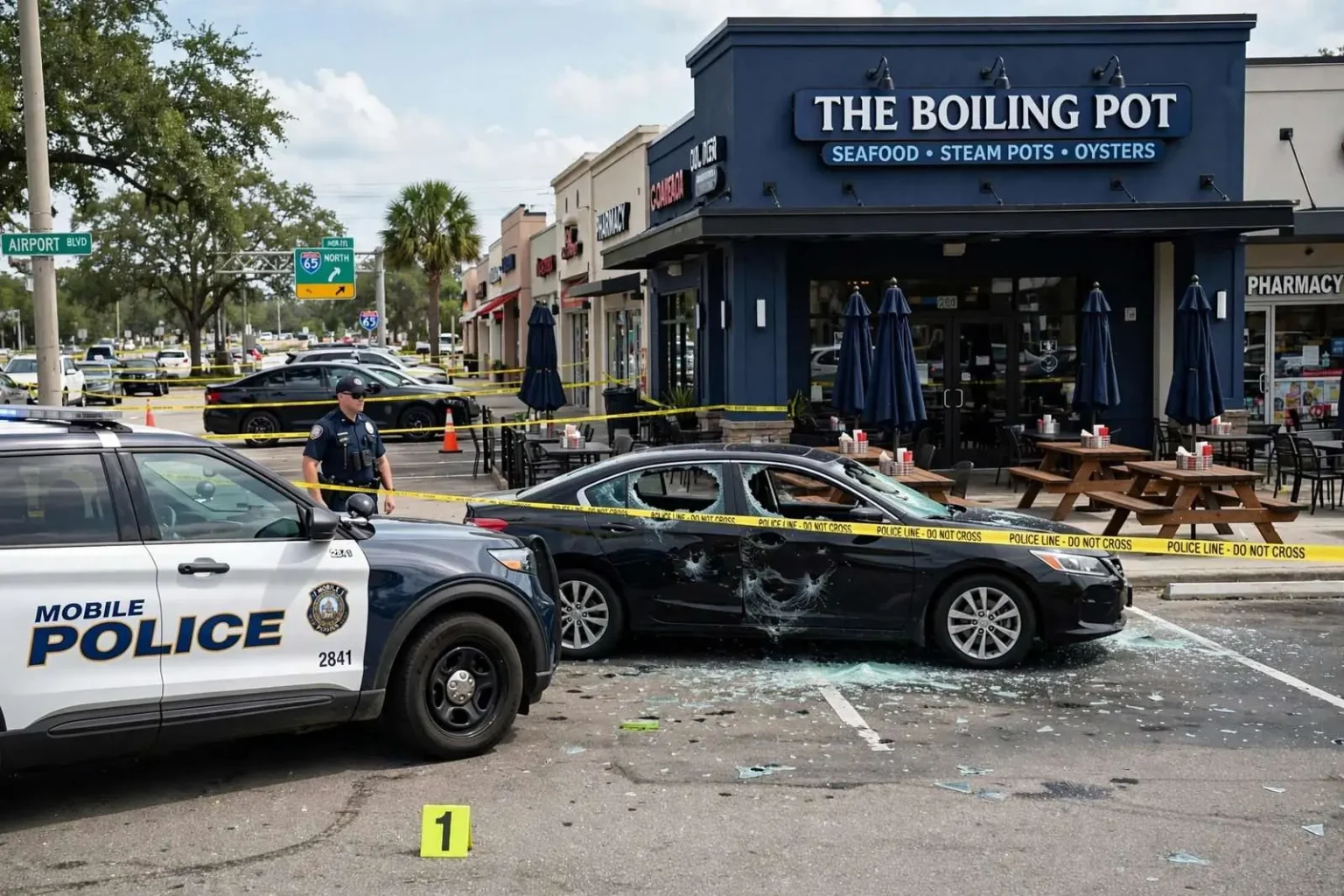
Mobile police arrested a 24-year-old woman on domestic violence and weapons charges after she allegedly fired a handgun into an unoccupied vehicle parked outside a restaurant on Airport Boulevard. No one was hurt, but the daytime gunfire outside a busy dining spot in one of the city’s busiest commercial corridors set off a police response that ended with the woman in custody within hours of the report.
What police say happened
Investigators say the incident happened in broad daylight in the parking lot of the Boiling Pot, a seafood restaurant located near the Interstate 65 exit along one of Mobile’s busiest commercial corridors. According to police, the woman discharged the weapon into the empty vehicle during what authorities described as a domestic dispute, though no one was inside the car and no injuries were reported. The midday timing put the shooting in front of a parking lot full of lunch customers and staff — the kind of population that turns a single gunshot into dozens of witnesses.
The Boiling Pot sits in a heavily trafficked stretch of Airport Boulevard that draws a steady stream of lunch and dinner customers, and the daytime timing of the shooting drew attention from nearby businesses and passersby. The corridor around the I-65 interchange concentrates restaurants, retail and medical offices into a stretch of road thousands of drivers traverse daily, and any incident there unfolds against that backdrop of constant movement.
Officers responded quickly after employees or customers reported hearing gunfire in the parking lot, though the exact sequence of events leading up to the shooting was not detailed in the initial police report. What is clear from the charges filed is that investigators moved fast enough to identify a suspect, take her into custody and book her on both the weapons count and a domestic violence charge the same day — a pace that suggests the dispute, the vehicle and the shooter were identifiable from the scene without an extended search.
Mobile police arrested the 24-year-old and booked her on charges of discharging a firearm into a vehicle and domestic violence. Court records show she was released on bond shortly after her arrest and was scheduled to appear in court later in the month to face the charges. Police records reviewed at the time of the arrest indicated she had no prior history of violent offenses — a detail that placed the incident closer to a personal dispute that escalated than to the patterned violence that typically follows repeat offenders.
The charges and what they carry
Firing a weapon into an unoccupied vehicle might sound less serious than other shootings, but Alabama law treats it as a felony precisely because of what it represents: a bullet that misses its target travels on, and a parking lot near Interstate 65 at midday is full of people, cars and structures a stray round can reach. The charge covers the act of discharging the weapon into an occupied or unoccupied vehicle regardless of whether anyone is struck, and it is frequently paired with domestic violence counts when the shooting arises from a household or intimate-partner dispute.
Prosecutors in Mobile County treat domestic violence cases with particular attention, and the pairing of charges matters procedurally. The domestic violence count reflects the relationship between the parties; the firearms count reflects the danger to the public around them. Together they give a court leverage — bond conditions, protective orders, treatment requirements — that a single count would not, and they document a pattern that becomes significant if the same parties appear again.
The scene and its context
The parking lot of a busy restaurant is among the more public places a domestic dispute can spill into, and that public dimension changes the calculus for everyone involved. Employees who hear a gunshot are trained to call 911 and lock down; customers dial while still in their cars; cameras from the restaurant and neighboring businesses preserve the sequence. That saturation of witnesses and recording devices is why daytime commercial-corridor shootings are usually solved quickly — and why they generate the community alarm that a midnight shooting in an empty lot does not.
Mobile police did not release additional information about the relationship between the woman and the presumed target of the domestic dispute, and no other arrests were announced in connection with the incident. The case remains an active domestic violence investigation, and additional charges are possible depending on the outcome of the court proceedings. Domestic investigations often develop after the initial arrest, as witnesses are interviewed and evidence from the vehicle and the scene is processed.
The episode adds to a string of daytime gunfire incidents reported in commercial areas of Mobile in recent months, prompting renewed attention from residents and business owners about safety in parking lots along major corridors. Airport Boulevard, Government Street and the Spring Hill Avenue corridor have all seen incidents that followed the same basic template — a dispute that reaches for a gun in a place where families are shopping or eating — and each one renews the conversation among business owners about cameras, lighting and coordination with police.
Domestic violence and guns
The case sits at the intersection of two problems public safety officials have flagged repeatedly: domestic disputes that escalate to firearms, and the speed with which a private conflict becomes a public danger. A vehicle fired into during a dispute is, in the accounting of domestic violence advocates, rarely the first act of the relationship’s violence — it is usually a step along an escalation that began with threats or property damage that never reached a police report. The arrest interrupts that escalation, which is why advocates press victims to report early and why courts treat the first firearms incident as the warning it is.
For the woman charged, the path forward runs through the court system: the scheduled appearance later in the month, the decisions of prosecutors, and the conditions the court imposes while the case is pending. Bond in domestic cases typically carries no-contact provisions, and violations of those conditions bring separate charges. Given her lack of prior violent history, the disposition will likely turn on the details investigators documented — the relationship, the target of the gunfire and the circumstances that put a loaded handgun in a dispute in a public parking lot.
The corridor and its policing
Airport Boulevard between the I-65 interchange and the city’s western neighborhoods is one of Mobile’s commercial spines, lined with restaurants, shopping centers and offices that generate steady traffic from early morning until late evening. Policing that corridor means policing incidents that can unfold in seconds in front of hundreds of people — and it means patrol coverage that can reach a parking lot within minutes of a 911 call. The rapid response and same-day arrest in this case reflect the advantage a dense, camera-covered commercial strip gives investigators compared with the harder-to-witness incidents that dominate the city’s overnight violence statistics.
Police have not indicated whether the incident will lead to any changes in patrol patterns near the Airport Boulevard business district, but officers continue to encourage anyone who witnesses similar incidents to contact Mobile police immediately. The encouragement is practical: calls made in the first minutes after a shooting — with descriptions of people, vehicles and direction of travel — are what turn a fast arrest from possible to likely. Witnesses to this incident, whether employees at the Boiling Pot or drivers in neighboring lots, provided that first layer of information that made the case resolvable within hours.
What business owners can do
For the restaurants and shops along the corridor, the incident renewed attention to the basics of parking lot safety: coverage of lot entrances and exits with cameras, adequate lighting through the day and night, and staff protocols for locking down and calling 911 the moment gunfire or a violent dispute is observed. Business owners who coordinate with the police department’s precinct commanders on recurring problems — loitering, disputes, traffic pattern issues — generally see faster responses when something serious occurs, because officers arrive already familiar with the property and its layout.
Employees, meanwhile, are the corridor’s informal early-warning network. Server, hosts and kitchen staff see the disputes that build in parking lots before any shots are fired, and training that empowers them to call police on a suspicious or escalating situation costs a business nothing and occasionally prevents everything that follows. The response in this case — reports from employees or customers, a rapid police arrival, an arrest the same day — is the system working as designed.
The broader picture
The events described in this report connect to broader patterns across the Gulf Coast region, where growing cities are working to keep commercial corridors safe as they expand. Local institutions, government agencies, and community organizations all play roles in addressing these issues — police departments and prosecutors on the enforcement side, domestic violence advocacy organizations on the prevention side, and the businesses whose lots and lobbies are where these incidents actually occur.
The outcomes of these efforts will shape the region’s future development and resilience. A corridor where families feel safe eating lunch at midday is economic infrastructure as real as the pavement, and cases like this one — an arrest within hours, charges filed, a court date set — are how that infrastructure is maintained. The woman arrested now moves through the court system; the restaurant reopens its lot to the lunch crowd; and the residents of Mobile watch a familiar sequence play out on one of the city’s busiest streets, with the same reminder at the end of it: when gunfire erupts in a public place, the fastest call anyone can make is to the police.