Mobile Fans Roar as Hometown’s Aron Johannsson Takes the World Cup Stage
A packed crowd at a downtown Mobile pub erupted Monday night as the United States edged Ghana at the World Cup, celebrating a dramatic late goal and the tournament debut of Mobile native Aron Johannsson.
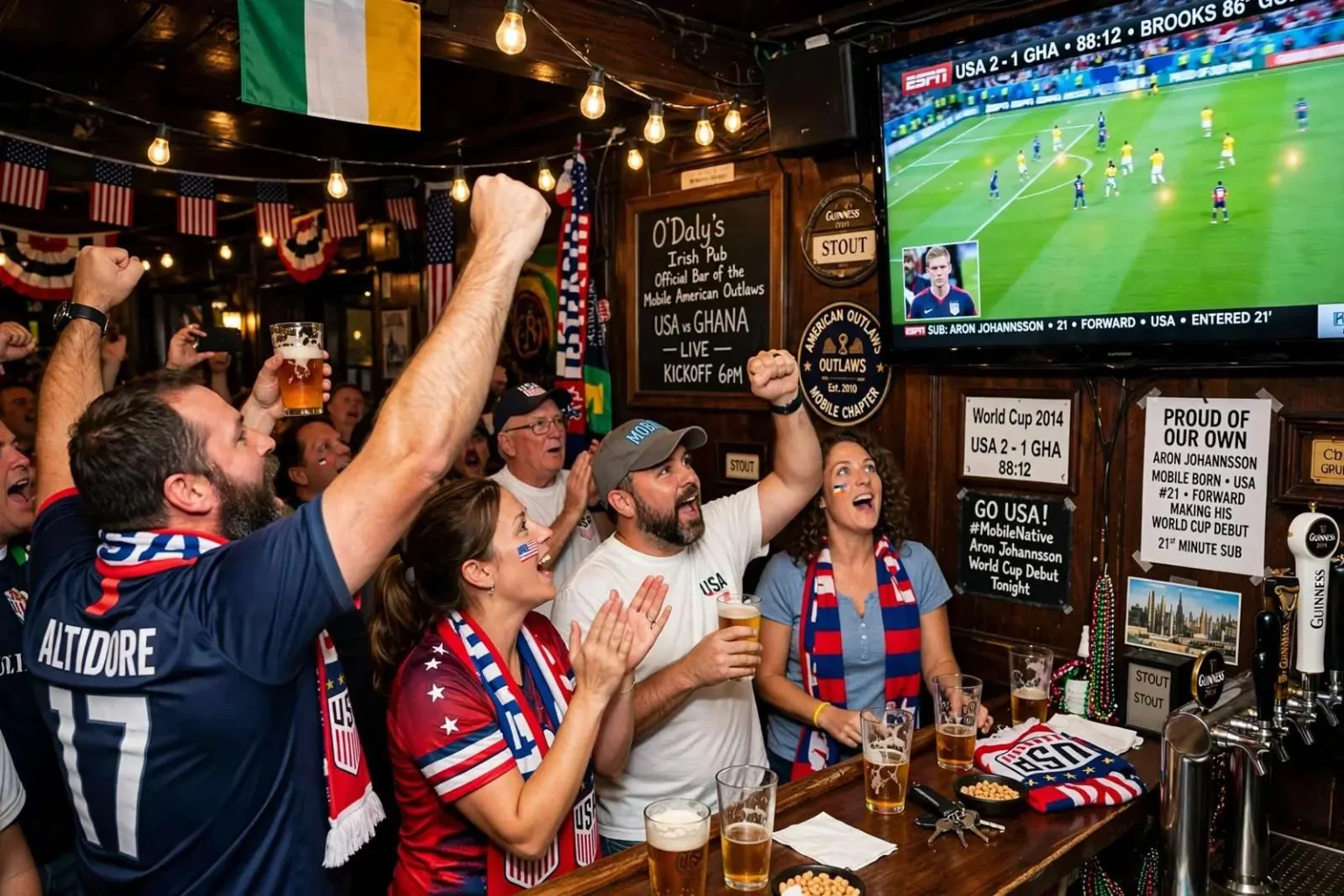
For one electric night in downtown Mobile, the world’s game belonged to the Port City.
On Monday, June 16, 2014, hundreds of fans crammed into O’Daly’s Irish Pub to watch the United States open its World Cup campaign against Ghana, and by the final whistle the crowd was a sea of raised arms, sprayed beer and shouted names.
The match tested their nerves. When Ghana scored an equalizer in the 83rd minute, the packed room fell quiet, fans staring at their feet in frustration. Minutes later the mood flipped entirely: defender John Brooks rose to meet a corner and buried a header that sealed a crucial first win for the Americans. The pub exploded.
“It was insane,” said Mobile resident Dan McMillan. “Here, tonight, this was as America as it can get.”
The emotional whiplash was the World Cup distilled. Ghana had haunted the United States before — knocking the Americans out of the 2010 tournament in South Africa and doing the same four years earlier in Germany — so the opener carried the weight of unfinished business. For nearly an hour the room rode a 1-0 lead that never felt safe, and when the equalizer came, all of that history crashed down at once. Then Brooks, a 21-year-old making only his second international appearance, leapt above the defense at the near post and sent the game — and downtown Mobile — into a frenzy.
A Hometown Debut
For local fans, the night carried an extra charge. The game marked the World Cup debut of Mobile native Aron Johannsson, the Icelandic-American striker who came on after forward Jozy Altidore left in the 21st minute with a hamstring injury.
As Johannsson entered, the crowd cheered and began chanting his name.
“I’m very happy to see our Mobile boy come in,” said McMillan, 42. “He looked a little intimidated at first, but he was starting to pick up. You know, he can grow into this spot and ride the momentum.”
Johannsson’s path to that moment was unlike any other player in the squad. Born in Mobile, he was raised in Iceland, where his family moved when he was a child, and he came up through the youth systems of the country where soccer is played on artificial turf through arctic winters. He developed into a goal-scorer in Denmark before his decision to play for the United States gave American fans one of the more promising young strikers in the program. On the sport’s biggest stage, in the opening match of a tournament the country had spent four years waiting for, his birthplace got to claim him back.
For a city that had never had one of its own on a World Cup roster, the substitution in the first half of the opener was a landmark nobody in the pub had to explain. The chants that greeted his entrance were equal parts celebration and adoption papers.
Word of the hometown angle had circulated in the days before the match, and local news coverage gave casual viewers a reason to care about a name most had never pronounced before Monday night. By the time Johannsson stripped off his warm-up, everyone in the room knew exactly who he was.
A Bar Built for the Moment
O’Daly’s, which serves as the official bar of the Mobile chapter of the American Outlaws, the national U.S. soccer supporters’ club, filled all three of its drinking areas for the match.
The American Outlaws have become the connective tissue of American soccer fandom — local chapters that pack the same bars for every qualifier and tournament match, organize watch parties, and give the national team a traveling support section wherever it plays. A city with an official Outlaws bar does not simply watch a World Cup match; it communes. By kickoff, the pub’s three rooms were shoulder to shoulder, with fans who had claimed their spots well before the pregame show.
McMillan said the turnout dwarfed what he remembered from the 2006 World Cup, when only a handful of fans and international residents gathered to watch.
“It’s not even in the same league,” he said.
The growth he described mirrors what happened across the country in those eight years. In 2006, World Cup viewing in American cities was a niche affair, followed by expatriates and hardcore supporters. By 2014, the tournament had become a national event — broadcast in the open, streamed in offices, and celebrated in bars from Seattle to Mobile. The American Outlaws’ growth ran parallel to it, and Mobile’s chapter had grown with it.
When the match ended, the bartender cued up a run of America-themed songs, from Bruce Springsteen’s “Born in the U.S.A.” to the theme from the film “Team America: World Police,” and the celebration carried on.
New Fans in the Crowd
The energy drew in newcomers as well as die-hards.
Burn Pelton, 31, who had recently moved to Mobile from Nashville, called the atmosphere unforgettable.
“It was an excellent atmosphere,” Pelton said. “Unbelievable energy in the bar, it’s fantastic.” He said he expected Altidore to return later in the tournament but was thrilled to watch Johannsson step onto the game’s biggest stage.
The injury that opened the door for Johannsson cast a shadow over the night even amid the celebration. Altidore, the team’s first-choice striker, pulled up chasing a long ball and could not continue, and his absence forced the coaching staff to reshuffle an attack that had barely settled into the tournament. Johannsson inherited a thankless situation — entering cold, against a Ghana side pressing for an equalizer, in his first meaningful World Cup minutes. That he grew into the match at all, as fans in Mobile judged from a barroom screen, counted as a promising sign for a striker who would likely be called on again before the group stage ended.
Courtney McNaughton, of Mobile, said it was the first soccer match she had ever watched, and that it had made a convert of her.
“I like the energy,” she said. “I like soccer, I’m getting a soccer scarf.”
That is how the sport has always grown in America — not primarily through broadcasts, but through rooms like the one at O’Daly’s, where the unconverted come for the party and leave as fans. A scarf bought the next morning is a small purchase with a long shelf life, and every World Cup seeds thousands of them in cities that had never bothered before.
For a city that has produced its share of athletes, watching one of its own compete on soccer’s grandest stage gave the evening a hometown resonance that went beyond the scoreline. The win lifted the United States to an early advantage in a difficult group, and in Mobile it left a room full of new and longtime fans already counting down to the next match.
The group ahead was unforgiving — Ghana first, then Portugal, then a final group match against Germany, the tournament’s eventual runner-up favorite. Opening with three points changed the mathematics of everything that followed, turning what is often a survival exercise into a genuine bid to advance. For the fans at O’Daly’s, the standings suddenly had a hometown stake in them: every minute Johannsson might play was a minute Mobile would be watching, wherever the game was actually staged.
Johannsson’s path to the national team had wound from Mobile to Iceland and back into the American setup, and on this night the connection between the player and his birthplace felt tangible in the chants echoing through the pub.
Whatever came next in the tournament, the fans at O’Daly’s had claimed a small piece of the World Cup as their own.
Nights like that one explain why the American Outlaws’ chapters keep multiplying. A watch party turns a national team into a local one; a hometown player turns a group-stage opener into a civic event. The choreography was unplanned but familiar to anyone who has stood in a bar when the winning goal goes in — strangers embracing, phones raised, the whole room moving at once. For ninety-plus minutes, downtown Mobile was connected to a stadium in Brazil by nothing more than a television and shared nerves, and the connection held until the final whistle.
It is a story Mobile knows how to tell. The city has hosted championship bowl games, sent athletes to professional franchises in every major sport, and built its identity around big stages — Mardi Gras, the Senior Bowl, a downtown that fills for football on autumn Saturdays. But a World Cup debut belongs to a different category altogether, a global audience watching one of its own. For one night in June, with Springsteen on the speakers and a defender’s header still echoing, the Port City’s soccer fans had their moment, and the next four years of waiting began before the last glass was cleared.