Elberta Man Facing $1 Million Bond Seeks Reduction After Marijuana Bust
An Elberta man held on a $1 million bond after a marijuana growing operation was found at his home sought a reduction to $25,000.
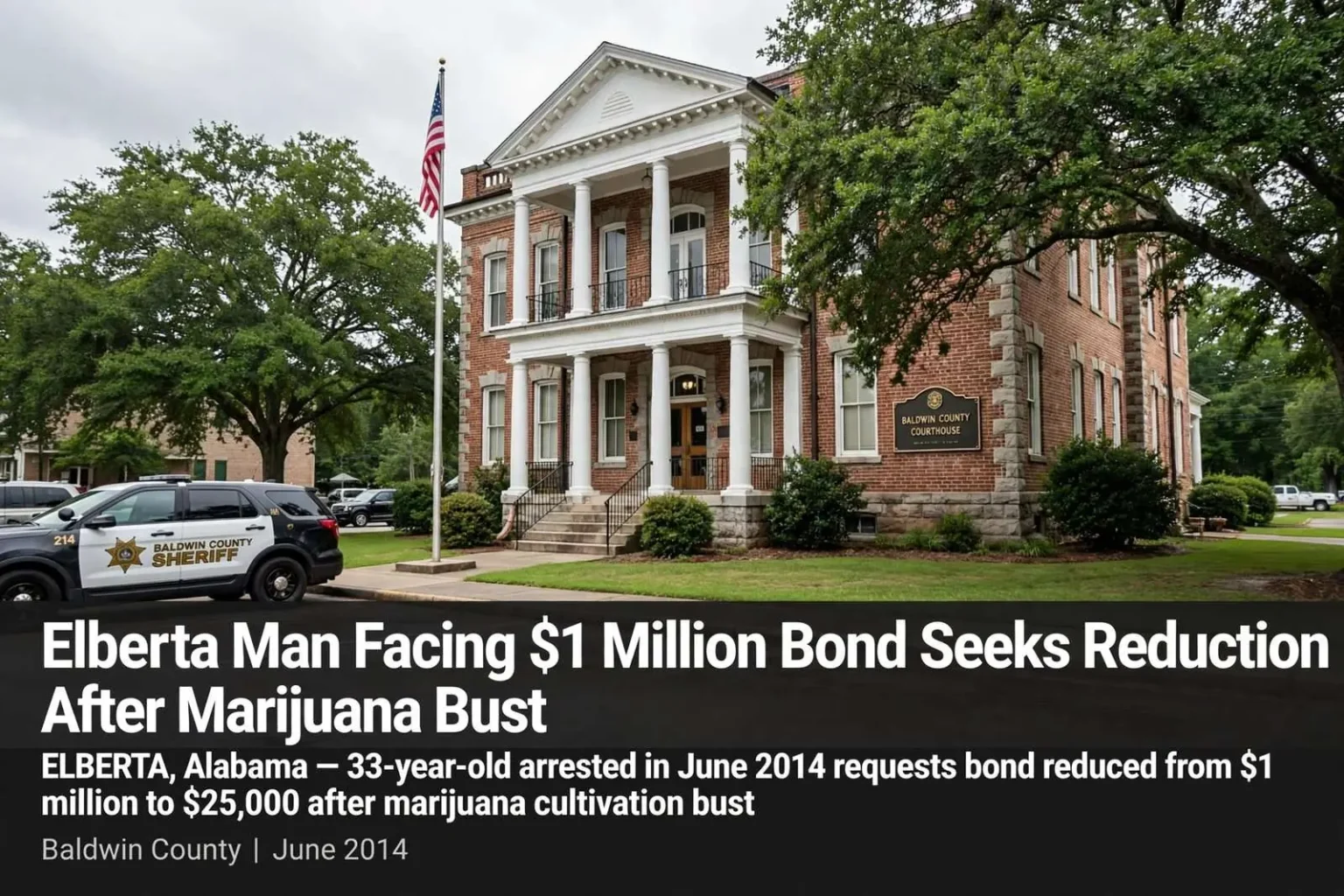
ELBERTA, Alabama — A 33-year-old Elberta man arrested in early June 2014 on drug trafficking charges asked a Baldwin County judge to dramatically reduce his bond, arguing that the $1 million figure set after his arrest was unreasonable given the circumstances of the case.
Justin Goldman, who lived in the 10000 block of Baldwin County Road 83, was taken into custody on June 3 after the Baldwin County Sheriff’s Office executed a search warrant at his residence. Deputies reported finding roughly twenty marijuana plants growing on the property along with marijuana-infused butter, a product commonly used to prepare edible foods containing the drug.
The charges and the bond
Following the search, Goldman was booked on a drug trafficking charge carrying a $1 million bond, along with a separate drug paraphernalia charge carrying a $1,000 bond. He remained in custody at the Baldwin County Corrections Center while his case moved through the courts.
Bond amounts in Alabama drug trafficking cases are set with reference to the statutory weight thresholds that trigger trafficking charges, and judges have wide discretion in setting the figure. A $1 million bond is at the high end of what drug cases typically draw, and defense attorneys frequently challenge such amounts as effectively unpayable — a bond that cannot be met functions, in practice, as pretrial detention.
Trafficking charges in Alabama can arise from the quantity of marijuana involved rather than any evidence of sales, and the discovery of a growing operation — plants, cultivation equipment and processed products like the infused butter deputies reported — is the kind of case that prosecutors routinely file under the trafficking statute.
The paraphernalia charge that accompanied it carries far lower stakes on its own, but its presence in the file reflects how such cases are assembled: the items found alongside a growing operation are charged separately, piece by piece.
Family and friends rally in support
A defense motion filed with the court requested that the bond be lowered to $25,000, a figure attorneys argued would still ensure Goldman’s appearance at future hearings without keeping him detained indefinitely on a bond many considered excessive for the alleged offense.
The motion was accompanied by thirteen letters of support written by family members, friends, and others in the community who vouched for Goldman’s character. Letters of support serve a specific purpose in bond hearings: they present the defendant as a rooted member of the community — someone with family, work history and people who will vouch that he will show up for court.
Among those who wrote on his behalf was Frances Henson of Mobile, who described the toll the arrest had taken on Goldman and his family. According to her letter, Goldman had accepted responsibility for his actions and expressed deep remorse for the pain the situation caused his parents and son, noting that phone calls between Goldman and his mother routinely ended in tears for both of them.
Defense filings in bond motions typically emphasize exactly those ties — a child, parents, a home in the community — as evidence that the defendant is not a flight risk. The argument is straightforward: a person with those anchors has every reason to appear, and no realistic means of disappearing.
How bond works in Alabama courts
Bond in Alabama serves a single legal purpose: to reasonably assure that a defendant appears for trial. The amount is supposed to be calibrated to that goal, taking into account the seriousness of the charge, the defendant’s ties to the community, prior record and financial means — not to punish, since punishment is what trial and sentencing are for.
That distinction is the heart of most bond-reduction motions. A defense argument that a bond is excessive rests on the claim that the figure was set to keep the defendant in jail rather than to secure appearance — and courts are asked to set a figure the defendant can actually post, whether through a bondsman’s percentage fee or a property pledge.
In Baldwin County, drug cases routinely appear on the dockets of the circuit court, and bond hearings for defendants who cannot post the initial amount are a routine feature of the early weeks of a case. Judges consider the defense arguments, the prosecution’s response and the letters and record offered in support before ruling.
A defendant who remains in custody while awaiting trial faces practical consequences beyond the loss of freedom: difficulty working with counsel on the case, loss of employment, and the strain on family finances that detention imposes. Defense motions typically lay out those consequences as part of the argument for release pending trial.
The case in context
The case arrived in the courts at a moment when marijuana policy was beginning to diverge across the country, even as Alabama law continued to treat cultivation at scale as a serious felony. The gap between states created the legal landscape cases like Goldman’s move through: conduct treated as a regulated market elsewhere remained a trafficking offense in Alabama’s courts.
For Baldwin County’s sheriff’s office, cases built on search warrants at residences are standard work, and the eastern shore and south county areas — including the agricultural stretches around Elberta — see their share of cultivation investigations. Elberta sits in the county’s southern reaches, near Gulf Shores and the state line, an area of small farms and residential parcels where deputies execute warrants on tips ranging from utility anomalies to informants.
The road where Goldman lived, Baldwin County Road 83, runs through that southern part of the county, where addressing by road number rather than municipal street name is the norm. The county’s grid of numbered roads covers territory outside the small municipalities, patrolled by the sheriff’s office rather than city police.
What comes next
As of the filing, a Baldwin County judge had not yet ruled on the request to lower the bond. Goldman remained held at the county corrections facility while the trafficking and paraphernalia charges moved forward.
The ruling on the motion would set the terms of Goldman’s pretrial release — or keep him in custody through the rest of the case. Either way, the charges themselves remained ahead of him: arraignment, pretrial hearings, and the decisions by prosecutors and defense counsel that determine whether a case ends in plea negotiations or a trial.
What the thirteen letters could influence was the bond question only. The merits of the trafficking case — the warrant, the search, the evidence deputies collected on the property — would be decided on their own, in the months of motions and hearings that follow any felony arrest in the county’s courts.
For Goldman’s family, the immediate question was simpler and more urgent: whether the figure that kept him at the corrections center would come down to something they could pay. The court’s answer would come on its own schedule, as bond motions in Baldwin County generally do.
The people behind the letters
Letters of support in bond motions are written by the people who know a defendant outside the courtroom — parents, siblings, longtime friends, employers, church members. Prosecutors and judges read them for signals the official file does not contain: whether the defendant has people watching, whether he has work waiting, whether the community would notice if he failed to appear.
The letters filed in Goldman’s case, by accounts described in the motion, portrayed a man with deep family ties and genuine remorse. Frances Henson’s account of phone calls ending in tears on both ends of the line was the kind of detail intended to humanize a defendant whose file, at that point, consisted of charges, evidence lists and a bond figure.
Family members writing such letters also take on a practical role if bond is granted. A defendant released to await trial needs a place to live, supervision, transportation to court dates and often a co-signer on the appearance bond. The letters are, in part, an advance commitment to provide those things.
The presence of a child in the household picture — Henson’s letter referenced Goldman’s son — carries particular weight in bond arguments. Courts recognize that a defendant supporting a child has both a reason to appear and a family already bearing the consequences of detention.
Life inside a pending felony case
The months between arrest and resolution are the invisible stretch of every felony case, and for defendants in custody, they are measured in scheduled phone calls and visitation days at the corrections center. The Baldwin County Corrections Center in Bay Minette houses defendants awaiting trial across the county, including cases from the southern end like Goldman’s.
Defense counsel working a case while the client is detained face logistical hurdles at every step: meetings happen through jail visits rather than an office, documents are reviewed in interview rooms, and the client’s ability to help gather witnesses or records is limited by the walls around him. That reality is part of every argument that excessive bond damages a defense.
The trafficking charge carried potential prison exposure measured in years, which is why both sides treat the pretrial period seriously. Prosecutors building the case will process the evidence from the search — the plants, the processed product, the items charged as paraphernalia — while the defense evaluates the warrant and the search for any grounds to challenge what was seized.
Where the case ends depends on all of that: a plea agreement resolving the charges, or a trial before a Baldwin County jury. Bond decisions do not predict the outcome — but they determine who sits at the defense table for those months, and under what conditions.
Until the court ruled, the question the thirteen letters had been written to answer — whether $1 million was a bond or a verdict before trial — remained open, and a 33-year-old Elberta man remained at the corrections center, waiting like everyone else for the judge’s decision.