Home Builders Back Bradley Byrne in Fairhope as Governor’s Race Money Trickles In
The Home Builders Association of Alabama endorsed Bradley Byrne in Fairhope, his third major business endorsement, while Ron Sparks and Robert Bentley worked the Mobile Bay donor rolls.
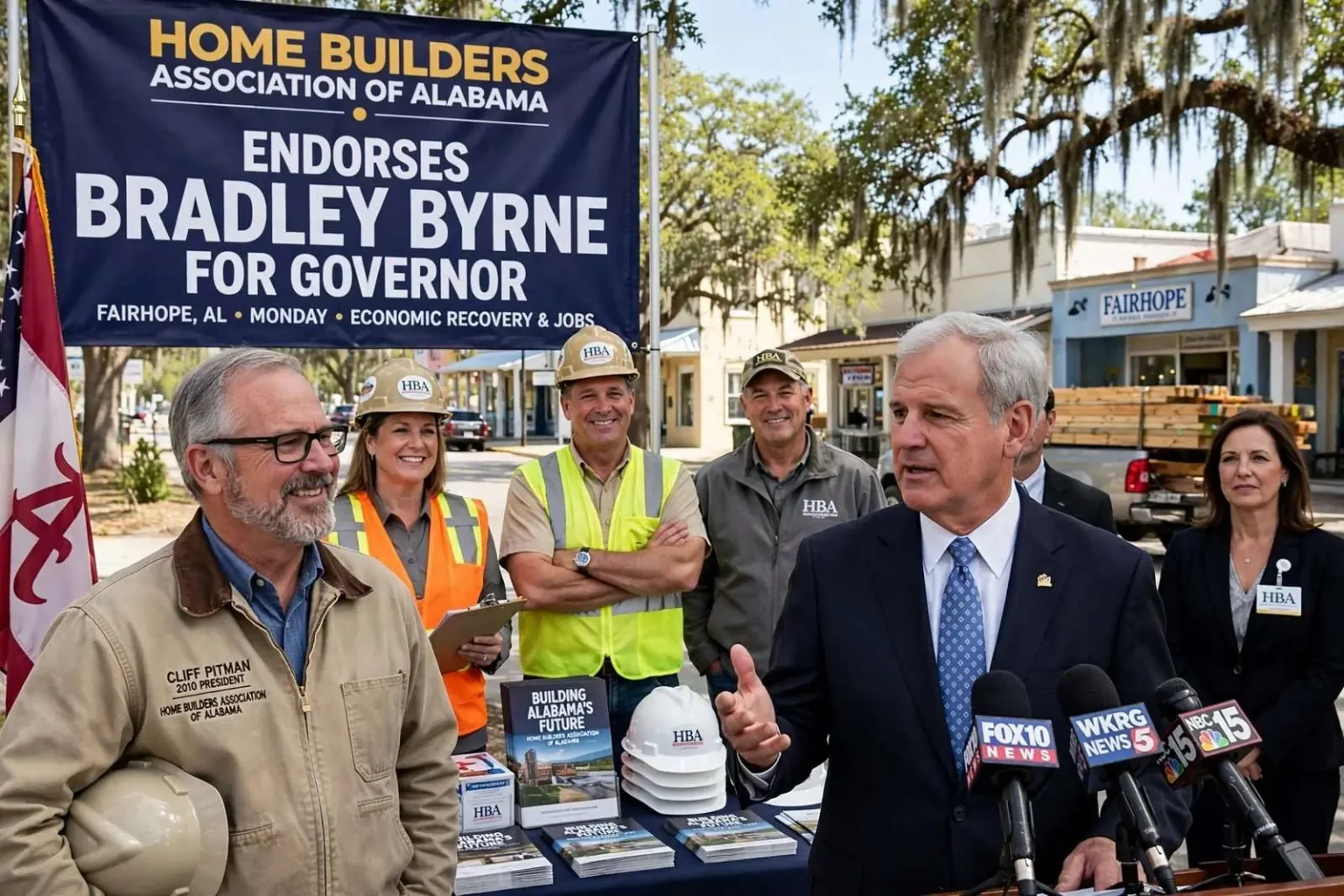
The Home Builders Association of Alabama announced in Fairhope on Monday that it is endorsing Bradley Byrne in this year’s race for governor, adding a third major business group to the Montrose Republican’s column as the June 1 primaries approach. The announcement, made in one of Baldwin County’s fastest-growing cities, gave Byrne a bloc of organized supporters whose members build, sell and finance the houses that have reshaped the Eastern Shore over the past two decades.
The association, which counts some 12,000 members across the state, chose Byrne over seven other candidates in the field. Its membership spans a wide slice of the construction economy — builders, developers, architects, engineers, suppliers and other industry figures — and in a coastal region where the housing collapse hit especially hard, its members have an obvious stake in who occupies the governor’s office. Homebuilding in south Alabama has been whipsawed by the national downturn, and the group’s leadership framed the endorsement as a decision about economic recovery as much as partisan preference.
‘Construction fuels the families of all Alabamians’
Cliff Pitman, the association’s 2010 president, said construction “fuels not only the economies of local and state governments, it fuels the families of all Alabamians.”
“We are certain that the wealth of experience Bradley brings to the table will help him lead us through these tough economic times and put our state back on a path of growth that will benefit all of Alabama,” Pitman said. The language tracked the association’s long-standing message that every new house sets off a chain of local spending — wages for tradesmen, purchases from suppliers, permit fees and property taxes for city and county governments — and that a governor sympathetic to the industry’s regulatory and tax concerns matters to every community’s bottom line.
Byrne had previously collected endorsements from the Associated Builders and Contractors of Alabama, the Alabama Association of Realtors and the Alabama Retail Association. Taken together, the four amount to a coordinated show of support from the state’s business establishment for a candidate whose campaign has emphasized his record as chancellor of the two-year college system and his fights with entrenched interests there. Byrne’s tenure as chancellor, during which he moved to strip improper influence from the two-year college board and pushed reforms through a system long criticized for nepotism and waste, has been the centerpiece of his pitch to business groups wary of Montgomery’s old arrangements.
The coastal money map
The endorsement season has been accompanied by the first concrete evidence of fundraising geography, and it shows where the region’s political money is sitting. Campaign finance reports filed in the closing weeks before the primaries trace contributions through Fairhope, Point Clear and Mobile, and they tell two different stories — one on each side of the party line.
For south Alabama voters, the endorsements now landing — and the checks now being written in Fairhope, Point Clear and Mobile — offer the first hard evidence of where the region’s political establishment intends to plant its flag. Endorsements do not vote, but the organizations behind them do things campaigns cannot do alone: they turn out their members, raise money from their industries and lend a candidate the credibility of people who sign the front of a paycheck.
Sparks keeps grinding on the Democratic side
Across the aisle, state Agriculture and Industries Commissioner Ron Sparks continues to hang on in the Democratic primary against U.S. Rep. Artur Davis. Sparks has had opportunities to fold his campaign — the conventional wisdom for months has been that Davis’s fundraising and name recognition made the race unwinnable — and has instead covered up and trudged forward, campaigning in every corner of the state while his rival built a national donor base.
Davis remains the favorite for the nomination, but the longer Sparks stays upright, the better his odds of extracting a price from a rival who has spent the primary season running what looks in many respects like a general election campaign. Davis has tailored his message to independent and Republican-leaning voters, a strategy that risks leaving his own party’s base unmoved, and a Sparks campaign that survives to June forces Davis to spend money and attention at home that he would rather have banked for the fall.
Sparks has also found a base of support around Mobile Bay, and the reports show it in dollars as well as sentiment. Contributors in the area include Taylor Harper, $1,100; Terry Joe Debrow, $250; J. Cecil Gardner, $200; Steve Dampier of Fairhope, $500; Elliot Maisel, $2,500; Ed Kahalley, $500; Ben Sumrall, $250; Gary Tanner, $2,000; Mike Windom, $500; Julie Kittrell, $250; Sam Marston, $200; Martha Sessions, $500; Terry McLeod, $250; and Desi Tobias, $500. The list is a who’s-who of south Alabama Democratic politics and business — former legislators, restaurateurs, developers and longtime party hands — and it suggests Sparks has consolidated the region’s Democratic establishment in a way that could matter in a low-turnout primary.
The names also carry some history. Harper and Tanner both spent long careers in the Legislature representing Mobile County, and Gardner is a prominent coastal attorney whose family name is attached to one of the Eastern Shore’s best-known firms. Maisel’s restaurant and hospitality interests give Sparks a foothold in the Gulf Coast’s tourism economy, while Windom, a former Mobile County commissioner, represents the county’s old-line Democratic machinery. Whatever else the primary produces, the Mobile Bay lists indicate that Sparks’s campaign has real roots in the region rather than being a statewide name-recognition exercise.
Bentley the survivor
On the Republican side, Tuscaloosa physician and state Rep. Robert Bentley shares some of Sparks’ qualities of endurance. Written off early by nearly everyone watching the race, Bentley has not faded, and with less than two months to go he is arguably more of a factor than most political forecasters would have predicted. His campaign has run lean, relied on personal appearances and targeted advertising, and benefited from a crowded field in which the better-funded candidates have spent as much time attacking each other as introducing themselves.
What he does not yet have is a coastal money network. His local supporters are few, and they gave modestly: T.P. Amhadi, $25; Fred and Julie Bodie, $200; Rick Sheffield, $50; Rawson Trucking, $500; and R&S Grading & Paving, $500. Where Byrne’s coastal ledger is measured in organized endorsements and established donors, Bentley’s amounts to a handful of neighbors and small-business owners — a contrast that illustrates how differently the Republican candidates are building their coalitions, and how much of the state’s political money is concentrated along the corridor from Mobile to Baldwin County’s fast-growing suburbs.
A wide-open field
With both parties’ primaries two months away, the Alabama governor’s race remains genuinely unsettled, according to polling released this week by Rasmussen Reports — a rarity in a state where the identity of the next governor is often clear long before the votes are counted. The survey’s finding that no Republican has broken away from the pack, and that the Democratic contest remains contested despite Davis’s advantages, has kept donors engaged and candidates campaigning through what would otherwise be the drowsy stretch of a primary spring.
The unsettled quality of the race traces to the structure of the field itself. Byrne, who lives in Montrose on the Eastern Shore, is one of two candidates with strong Baldwin County ties in a crowded Republican field that also includes Greenville businessman Tim James, the son of a former governor with his own base of name recognition and personal money; Attorney General Troy King’s allies, organized around the incumbent’s anti-Washington message; and several others dividing the traditional Republican constituencies of business, social conservatism and anti-tax activism. With no run-off-proof frontrunner, the possibility of a July run-off hangs over every calculation, and a candidate who can consolidate even a plurality on June 1 may find himself in a second contest rather than a victory party.
For the Home Builders and the other business groups that have lined up behind Byrne, the unsettled polls are both an opportunity and a warning. An endorsement from a 12,000-member association can move a candidate from single digits into contention, particularly in a field where every point counts. But it also commits the group’s credibility to a race that may extend deep into the summer, with the possibility that the eventual Republican nominee emerges from a run-off in which new alliances and new money reshape the field one more time.
What is already clear is that south Alabama’s political establishment, after months of listening, has begun to choose. The builders announced their choice in Fairhope on Monday, and the checks written in the weeks since show the region’s money following much the same path — toward Byrne on the Republican side, toward Sparks among coastal Democrats, and toward a June 1 primary that will finally convert speculation into votes.