Former Prichard Police Chief Speziale to Stay On as Consultant
Jerry Speziale, who resigned as Prichard's police chief, will remain on as a consultant to help the city for another year, former Mayor A.J. Cooper says.
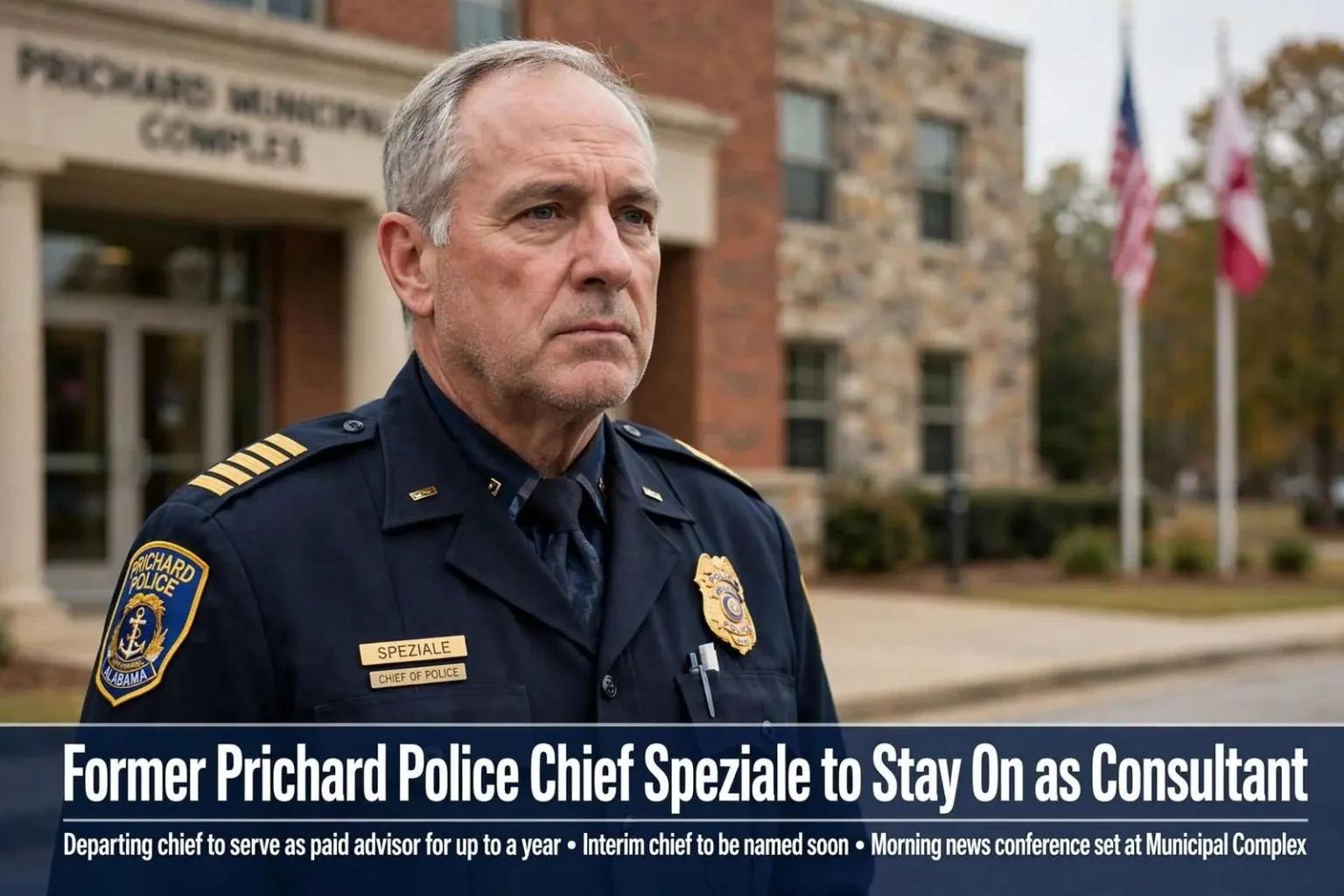
Jerry Speziale, who stepped down as Prichard’s police chief, will keep working with the city as a paid advisor on law enforcement matters, according to former Prichard Mayor A.J. Cooper. Cooper, who led the search committee that originally recommended Speziale for the job, said he and current Mayor Troy Ephriam spent the past couple of weeks negotiating the terms of Speziale’s departure.
The two sides ultimately agreed that Speziale would remain available to the department for up to a year to help however he can. “We worked through it and he will continue to be a consultant to the city and do everything he can for the next year to help us out,” Cooper said. “We pray for him. God knows we love him.”
City leaders have not yet worked out whether Speziale will be paid for his consulting role or receive any continuing compensation tied to his resignation. Officials were expected to lay out additional details at a morning news conference at Prichard’s municipal complex.
Cooper added that an interim police chief will be named soon, though a timeline for hiring Speziale’s permanent replacement has not been set.
The arrangement reflects the delicate position Prichard found itself in when the resignation landed. Speziale had led the department long enough to put his stamp on its operations, its staffing and its relationships with county and federal partners, and an abrupt severance would have left the city’s second-largest municipality with a leadership vacuum at precisely the moment its crime-fighting momentum was building. Keeping the departing chief in arm’s reach for a year — even informally, even without a settled salary — buys the city time to choose a successor rather than scramble for one.
Consulting arrangements of this kind are uncommon in Alabama municipal policing, where chief departures typically come with a clean break. The structure speaks to the regard both administrations — Cooper’s and Ephriam’s — held Speziale in, and to the reality that the man recruited from New Jersey to turn the department around was leaving on his own terms for reasons no one in city hall could dispute.
A tenure credited with results
Speziale joined the Prichard Police Department in the fall of 2013, and Cooper credited him with helping bring down crime in the city during his time leading the force.
“This man has done a tremendous job for our city,” Cooper said. “For that, we are very grateful. We think our new chief, with Chief Speziale’s help over a period of time, will be able to keep that momentum going.”
Prichard, a city of older neighborhoods wedged between Mobile and Chickasaw along the U.S. 43 corridor, had spent years working to shed a reputation for violent crime that depressed investment and pushed families to the suburbs. The department Speziale inherited had been through leadership churn and budget strain, and the city’s hopes for the incoming chief were high from the day he was announced.
Cooper’s search committee had found its man in the Northeast. Speziale’s résumé was unlike anything typically seen in a Mobile County police chief’s seat: senior law enforcement posts with the Port Authority of New York and New Jersey, service as sheriff of Passaic County, New Jersey, and a start as a New York City police officer earlier in his career. He arrived in Prichard with decades of big-agency experience, command-level credentials and a career spent policing dense urban communities — background his supporters said was exactly what the department needed.
His departure, when it came, was the product of personal tragedy rather than professional failure. Speziale is leaving Prichard to take a position as acting police director in Paterson, New Jersey, a city where he has deep professional roots.
His departure, when it came, was the product of personal tragedy rather than professional failure. Speziale is leaving Prichard to take a position as acting police director in Paterson, New Jersey, a city where he has deep professional roots — and where he will be raising his sons without their mother.
A family’s loss behind the move
City officials have said the driving factor behind Speziale’s resignation was personal: the recent death of his wife.
Cooper said Speziale had hoped to eventually relocate his wife and sons to Alabama once she was well enough to make the move, but that outcome never came to pass.
“It had been his intention for his wife and boys to move down here,” Cooper said. “Obviously, it was his hope she would be well enough to do that. It was a great loss, as you can imagine, to the chief, but a much greater loss to his boys. His first obligation was to his children.”
The detail reframed a resignation that might otherwise have read as a step backward or a failure of commitment. Speziale had not merely taken another job; he had moved his life back to the state where his career was built because his family’s circumstances changed overnight. The Paterson position returns him to the professional community that knew him before Prichard, within reach of the support system his sons now need, and the acting director’s role puts decades of command experience to use in a city that has long struggled with its own public safety challenges.
For Prichard’s leadership, the loss was tempered by the manner of it. Cooper’s remarks — grief for the family, gratitude for the service — captured a sentiment that spanned the city’s political factions. Few departments lose a chief to circumstances so sympathetic, and the goodwill carried directly into the transition negotiation that kept Speziale attached to the city he was leaving.
The news conference at the municipal complex was expected to formalize what the negotiations had produced: the consulting arrangement, the interim chief’s identity, and the shape of the search for a permanent replacement. City officials declined to preview those details ahead of the announcement.
Preserving the gains
City officials say the transition plan is designed to preserve the crime-reduction gains made under Speziale’s leadership while Prichard searches for its next permanent chief.
That task will fall first to the interim chief, who inherits a department mid-transformation. The strategies Speziale brought north — intelligence-led policing, tighter command accountability, partnerships with county, state and federal agencies — are only as durable as the leadership that sustains them, and transitions of command are where such reforms most often stall. The year-long consulting window is meant to prevent exactly that: institutional memory on retainer while the department’s own command staff absorbs the practices that produced the results.
The search for a permanent chief, once it begins, will likely weigh two models: an internal promotion that preserves continuity, or an outside hire that repeats the 2013 experiment of importing proven big-city experience. Whichever path Prichard chooses, the standard the next chief will be measured against is the one Speziale’s tenure set — a standard Cooper, for one, made clear the city intends to defend.
Speziale’s year of availability also cushions the department’s federal and county relationships, which a chief personally built and which a successor will need time to re-establish. In a city where every grant, task force seat and mutual aid agreement matters, a familiar voice answering the phone during the handoff is worth more than the title it carries.
The consulting arrangement also answers a question every Alabama municipality faces when a transformational department head leaves: how much institutional knowledge walks out the door. In Prichard’s case, the answer is now, deliberately, less than it would have been. Policies drafted under Speziale’s command, cases worked with his oversight, and the day-to-day judgment calls that never make it into policy manuals all remain accessible through the year-long window — a buffer most cities forgo when the farewell is final.
For the officers of the department itself, the transition carries its own adjustments. Chiefs set culture as much as policy, and the command habits Speziale imported from a career in New Jersey agencies became part of the force’s working rhythm over his tenure. An interim chief from within the ranks can preserve that culture; an outsider would need months to learn it. The consulting arrangement gives whichever successor arrives a resource for questions no transition binder fully answers.
Paterson, meanwhile, gains an acting director whose appointment carries the weight of homecoming rather than experiment. The city — New Jersey’s third largest, and one of the Northeast’s most persistently challenged for violent crime — has cycled through leadership instability of its own, and Speziale’s history there, combined with the command record he built in the intervening years, made him a natural choice when the post opened. The move returns him to familiar ground professionally at a moment when his family needs familiar ground personally.
Prichard’s city hall, for its part, turned a resignation that could have destabilized the department into a staged transition: an interim chief imminent, a consultant on call, and a search to follow. Officials say the goal is simple — no lost ground while the city finds the next chief.