Prichard Police Chief Jerry Speziale Steps Down, Citing His Children and a New Jersey Post
Prichard Police Chief Jerry Speziale resigned to become acting police director in Paterson, New Jersey, saying the move was about being closer to his two children after his wife's death.
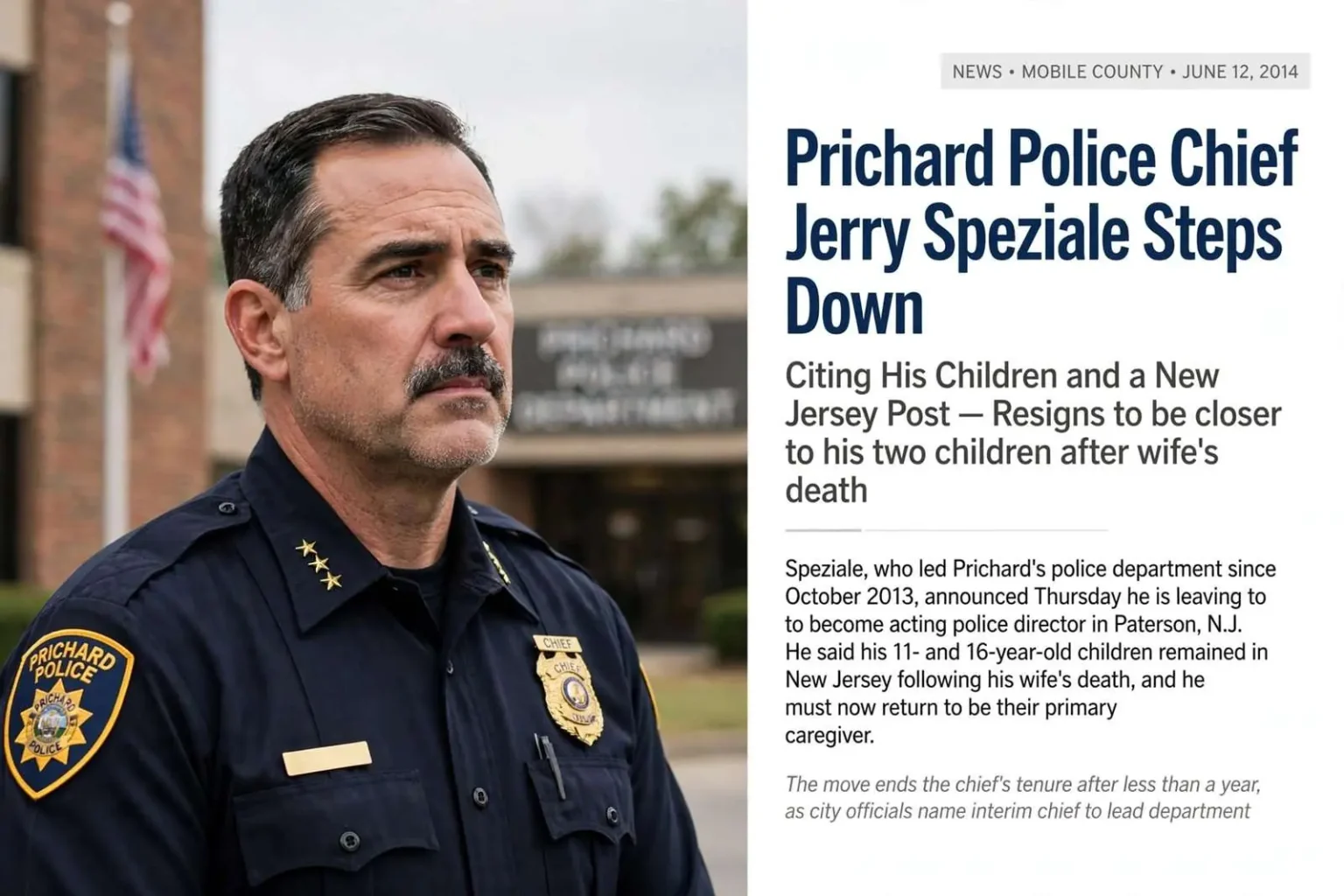
Prichard Police Chief Jerry Speziale, who had led the city’s department for less than a year, resigned to take a job in New Jersey, saying the move was driven by his desire to be closer to his two children after the death of his wife.
Speziale, who stepped down as chief on a Thursday in June 2014, praised Mayor Troy Ephriam even as he explained that he was leaving to become the acting police director of Paterson, New Jersey. His children, ages 11 and 16, had not moved to South Alabama with him, and he said they were not prepared to relocate.
The resignation brought an abrupt end to a tenure that had begun with unusual fanfare in October 2013, when Prichard introduced a chief with a national resume and a mandate to professionalize a department serving one of the largest cities in Mobile County. Instead, it ended as a story about family, distance and the limits of any job to compete with a father’s obligations at home.
Family at the center of the decision
The children, he said, were not ready to transition to Prichard after their mother passed away. The move came a couple of months after his wife died following a battle with cancer.
Neither she nor the couple’s two children had moved to the area after Speziale became chief in October 2013; the plan, he said, had been for them to follow. When that plan unraveled, so did his ability to remain in Alabama.
He spoke of his children as the center of his life, describing his devotion to them as a father. For a chief who had made accountability a theme of his short tenure, the explanation was unflinching: the job could be filled by someone else, but his children had only one parent left, and no professional opportunity 900 miles away could substitute for being present in their lives.
The circumstances underscored a reality familiar to executives who take jobs far from home. Relocation timelines matter little when a family crisis hits, and municipalities that recruit from out of state accept the risk that personal circumstances can undo even a well-received appointment in a matter of months. Prichard’s experience is a case study in that risk: the city invested in a high-profile search, secured a chief with an impressive record, and still saw the appointment end for reasons no vetting process could have anticipated or prevented.
A mayor caught off guard
Ephriam said he first learned that his police chief, selected by a blue-ribbon committee headed by former Prichard Mayor A.J. Cooper the previous year, had taken the Paterson job through media reports.
Speziale’s hiring in New Jersey had first surfaced publicly on a Wednesday, a day before he formally resigned. The sequence left City Hall reacting to headlines about its own police department, an awkward position for an administration that had touted the chief’s arrival as a turning point for public safety in the city.
Speziale praised both Ephriam and Cooper but did not say why he had not personally informed the mayor of the change. He described Ephriam as one of the most honest governing officials he had met, and he singled out council members and officers he had worked with, including one who had not voted for his appointment — a gesture that suggested genuine goodwill even as the mechanics of the exit left questions unanswered.
The episode highlighted the strained communication that can develop between a city’s executive branch and an appointed chief, particularly when a departure is negotiated quickly. In municipalities across Alabama, police chiefs serve at the pleasure of the mayor and council, and an abrupt resignation can leave elected officials scrambling to reassure both residents and rank-and-file officers. Prichard, a city that has weathered severe fiscal crises over the past two decades — including a municipal bankruptcy that made it a cautionary tale statewide — could ill afford a perception of instability in its police leadership.
An interim chief with local experience
To lead the department in the interim, officials named former Bay Minette Police Chief Michael Rowland as acting chief during a news conference on Thursday.
Rowland’s appointment gave the city a familiar hand from just across Mobile Bay. Bay Minette, the seat of neighboring Baldwin County, runs a small-city department by comparison, but long tenure there gave Rowland credibility on the practical matters that dominate daily police work: patrol staffing, budgets, evidence handling and interagency cooperation. Those relationships matter for Prichard, which sits just north of Mobile along the U.S. 45 and U.S. 43 corridors and depends on coordination with the Mobile County Sheriff’s Office, state troopers and surrounding municipal departments.
Interim leadership also buys time. The priority for city officials in such transitions is continuity — keeping patrol schedules intact, maintaining ongoing investigations and reassuring a workforce that had watched its chief come and go in under a year. Departments of Prichard’s size routinely take six months or more to complete a permanent chief search, and the city’s blue-ribbon process, led by Cooper, gave it a ready template should it choose to conduct another national recruitment rather than elevate from within.
A high-profile career cut short in Alabama
Speziale arrived in Prichard with an unusually prominent law-enforcement background for a city its size. His career in New Jersey included senior leadership roles in urban departments, and his return to Paterson as acting police director placed him back atop one of that state’s largest and most closely watched agencies. For Paterson, the hire reunited the city with a familiar executive; for Prichard, it meant losing a chief whose credentials had been the centerpiece of his recruitment.
The pattern of his tenure was, in a sense, two stories told in one year. The first was the story Prichard told when it hired him: a city working to rebuild confidence in its institutions choosing a chief with big-city experience and a reputation for candor. The second was the story of June 2014: a father whose family plans collapsed after his wife’s death, choosing his children over a career. Both are true, and neither diminishes the other.
What comes next for Prichard
For residents, the practical question is whether the turnover slows the momentum the department had built. Chiefs set priorities — visibility in neighborhoods, response to property crime, relationships with churches and community groups — and each transition risks resetting that agenda. Rowland’s task in the interim is to hold steady while the city decides how it wants to search for a permanent leader.
For Prichard’s elected officials, the episode is also a reminder of the limits of marquee hires. A chief’s resume can open doors, but retention depends on the fit between the job and the person’s life. Cities that recruit from out of state increasingly build support around the hire — helping families settle, connecting spouses to schools and communities, and checking in on the human side of a relocation. Whether a different approach would have changed the outcome in this case is unknowable; what is certain is that Prichard’s next chief search will happen with this experience in view.
Speziale’s departure closes a brief but eventful chapter in a city that has rarely had quiet ones. His praise for the mayor, the council and the officers he led suggests he left without rancor, and his reasons were personal rather than political. Prichard now turns the page with an experienced acting chief, a recruitment playbook already written, and the challenge of finding a leader whose family — this time — can make the move to South Alabama too.
The blue-ribbon search that brought him
Speziale came to Prichard through a process the city had framed as deliberate and independent. A blue-ribbon committee headed by A.J. Cooper, the former mayor whose name still carries weight in Prichard politics, screened candidates the year before and recommended the appointment the council ultimately confirmed. Cooper’s involvement signaled that the city wanted a search above politics, and Speziale’s New Jersey pedigree fit that ambition: he offered a level of executive experience few small-city departments in Alabama could attract.
That pedigree was also part of his message to the department. New chiefs typically spend their first months reviewing procedures, meeting commanders and touring beats, and Speziale did so in a city where the police department is one of the most visible symbols of municipal government. Prichard’s residents, like those of comparable Mobile County cities such as Chickasaw and Saraland, measure their department by responsiveness — how quickly patrol cars answer calls, how neighborhoods are treated — and a chief’s visibility in those neighborhoods counts as much as any policy memo.
His resignation does not erase what the selection process accomplished. The city demonstrated it can run a national search, attract serious candidates and manage a professional transition. Those are assets, and they will be needed again. Cooper’s committee work, Ephriam’s stated commitment to public safety and the officers’ day-to-day performance all remain in place regardless of who holds the chief’s office, and the acting leadership in the meantime keeps the department operating normally.
A familiar story on the Gulf Coast
Police chief turnover is hardly unique to Prichard. Across Mobile County and Baldwin County, departments of every size have seen chiefs depart mid-contract for personal or professional reasons — health, family, politics or opportunities elsewhere — and each time the institution absorbs the change and moves on. What makes the Speziale case notable is the speed of the turn: recruited in October 2013, gone by the following June, with the destination being a top job in the state he came from.
For the two children at the center of the decision, the move restores what the past year had taken away: a parent at home. And for Prichard, it leaves a lesson that municipal leaders across the Gulf Coast have learned in one form or another — that public safety leadership, like every other human endeavor, is ultimately shaped by family, and that even the best-managed searches cannot plan for grief.