Prichard Police Catch Driver After Elderly Man Struck Outside Greer’s Grocery
A 70-year-old man was struck and seriously hurt outside a Prichard Greer's grocery store, and police caught up with the driver who had fled the scene, according to reports.
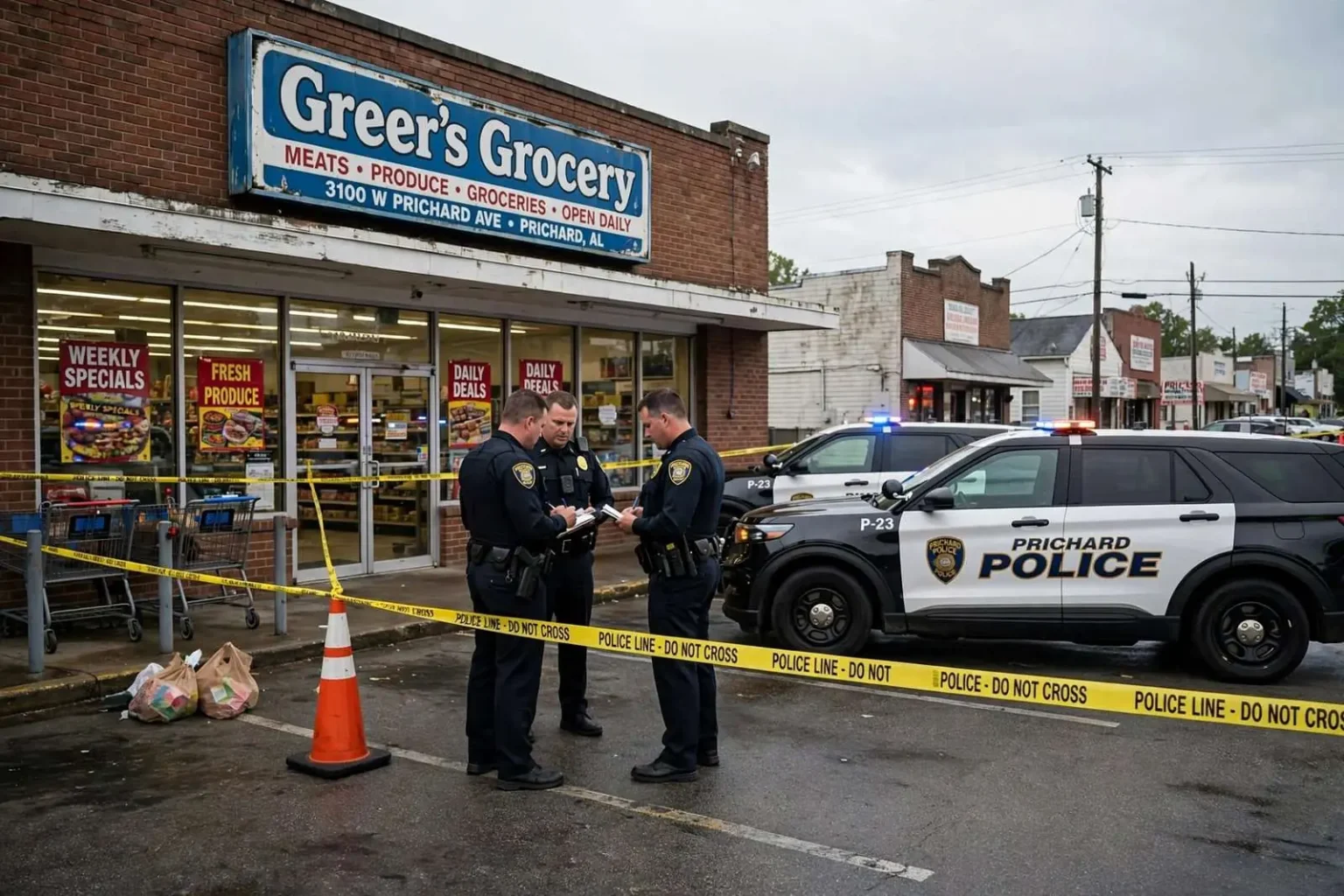
An elderly man was struck and seriously injured outside a Prichard grocery store on a Friday afternoon, and police caught up with the driver who had fled the scene, according to reports.
Thomas Hutt, a 70-year-old man, was reportedly hit outside a Greer’s grocery store in Prichard. The driver who struck him left the area afterward, but officers located the suspect a short time later. The driver’s name had not been released.
The speed of the apprehension was the one unambiguous fact in an early account that otherwise offered more questions than answers — where exactly the collision occurred, what the driver’s circumstances were, and how serious the injuries would prove over the days that followed.
A frightening scene at the store
Details of the crash were limited in the initial account, but the basic outline pointed to the kind of incident that unsettles a neighborhood: a routine errand, a trip to the grocery store, interrupted by a vehicle striking a pedestrian in the lot or along the roadway nearby. Hutt was said to have narrowly escaped death in the collision, an indication of how serious his injuries were.
Grocery store parking lots and their entrances are among the more common settings for pedestrian crashes, where drivers maneuvering for spaces and shoppers crossing on foot share tight, busy space. The transition from road to parking lot is where drivers’ attention shifts — from traffic to a parking spot — and it is precisely where a walker’s path and a car’s path most often cross at low speed and close range.
For an older pedestrian, even a low-speed impact can cause grave harm. Bone strength, balance and the body’s ability to absorb a fall all decline with age, which is why a collision that a young adult might walk away from can put a 70-year-old in the hospital. Emergency physicians treat pedestrian strikes among the elderly as presumptively serious, whatever the speed involved.
Friday afternoon adds its own traffic to the setting. Grocery stores at the end of a workweek carry their heaviest volume of the day, with cars cycling through the lot and shoppers crossing with bags in both hands — the least alert and least agile a pedestrian will be all week.
Greer’s stores have been fixtures of the Mobile area’s grocery landscape for generations, a locally rooted chain whose neighborhood locations — Prichard among them — serve customers who walk to shop more often than the big-box stores at the edge of town do. A store of that kind sits in the middle of daily life on its block, which is why a crash at its door registers with the whole community.
A driver who did not stay
What set the case apart was that the driver did not remain at the scene. Leaving after striking a person is a serious matter under Alabama law, which requires motorists involved in a crash resulting in injury to stop, render aid and provide identifying information. Failure to do so can transform a traffic case into a criminal one.
The duty to stop is the oldest rule of the road, and its violation carries a distinct moral weight. A driver who stays can summon help, explain what happened and take responsibility for the consequences; a driver who leaves converts the injured person’s survival into a matter of luck. In the hours after a fleeing driver’s departure, the injured pedestrian’s greatest danger is not the collision itself but the delay in care that the collision’s concealment causes.
Alabama’s courts treat the departure as an aggravating circumstance in nearly every case that reaches them. The law’s reasoning is practical rather than punitive: the state cannot require compassion, but it can require presence, because a driver who stays is a witness, a first responder and, in the earliest minutes, the injured person’s best chance at an ambulance. Remove that presence and the crash’s outcome is left entirely to whoever finds the victim next.
Prichard officers, according to the report, tracked down the suspect after the driver fled. The apprehension spared investigators a prolonged search and allowed the case to move forward, though authorities had not yet publicly identified the person taken into custody.
The work behind an apprehension “a short time later” is rarely as simple as the phrase makes it sound. Officers work from fragments — the description of a vehicle shouted by a witness, the direction it was last seen traveling, the partial plate someone remembered. Every minute of delay multiplies the number of similar cars between the scene and the county line.
A community familiar with its own streets
Prichard, just north of Mobile, is a close-knit city where a neighborhood grocery store is more than a place to shop; it is a gathering point where residents run into neighbors and catch up on the day. An incident like the one that injured Hutt tends to ripple quickly through such a community, prompting concern for the victim and questions about safety at a familiar location.
Prichard’s neighborhoods are, in the main, the mid-century blocks of a small industrial city — houses close to the street, sidewalks that go somewhere, and stores within walking distance of the front porch. That urban fabric is what puts shoppers on foot in the first place, and it is why pedestrian safety is not an abstraction in a city like Prichard but a daily condition of running errands.
As of the report, the focus remained on Hutt’s recovery and on the investigation into how the crash occurred. Authorities were expected to weigh whether the driver would face charges connected to leaving the scene of an injury crash, a determination that typically follows a review of the circumstances, any witness accounts and the condition of the person struck.
That review runs along two tracks. The first is the collision itself: speed, right of way, the pedestrian’s path, anything that explains the impact. The second is the flight: how long the driver waited, whether aid was summoned before leaving, and what the delay cost the injured man. Prosecutors weigh both when deciding what the departure will cost the driver in court.
For residents who frequent the store, the episode was a sober reminder to stay alert in parking lots and along the busy approaches where cars and pedestrians so often cross paths.
The case also highlighted the value of a quick police response in hit-and-run investigations. When a driver leaves the scene, the window to identify a vehicle and its occupant can close rapidly, which is why witness descriptions, nearby cameras and prompt reporting matter so much. In this instance, officers were able to locate the suspect before the trail went cold, an outcome that is far from guaranteed.
The economics of a hit-and-run investigation favor speed on every front. A vehicle involved in a collision carries evidence — paint transfer, a cracked lens, a dent shaped by the impact — that a driver has only hours to wash away or hide in a garage. Witnesses’ memories fade within a day, and surveillance footage, where it exists, is often overwritten within days. Every hour between the crash and the arrest is an hour the case’s foundations erode.
Prichard’s police department, like those of the small cities that ring Mobile, answers a full city’s calls with a modest roster, and its investigators know their territory in a way that suburban departments with higher turnover often cannot. Officers who have worked a city for years recognize its cars, its corners and its regulars — an advantage that matters most in exactly the kind of case that broke on this Friday, when the fastest route to a suspect ran through local knowledge.
For Prichard, a city that has worked to strengthen its police department in recent years, the swift apprehension offered a measure of reassurance to residents who count on officers to answer calls close to home.
The reassurance runs in both directions. Residents who see a fleeing driver caught within hours are more likely to call in the next witness account promptly; a department that can show results from those calls keeps the information flowing. Hit-and-run cases, more than almost any other, are solved by the community before they are solved by the laboratory.
The episode also sharpened the familiar arithmetic of the neighborhood store’s parking lot. Shoppers crossing with carts, drivers backing out of spaces, delivery trucks idling at the curb — the daily choreography works until one participant’s attention lapses, and the margin between an ordinary Friday and an ambulance call is a few feet of pavement.
Neighbors, meanwhile, were left hoping for a full recovery for a 70-year-old man whose routine trip to the store had ended in the back of an ambulance. Whatever the courts eventually decided about the driver who left the scene, the community’s first concern was the man himself — the same neighbor who had walked to the store, as people in Prichard’s neighborhoods have done for decades, on an errand that was never supposed to make the news.