No Deal on the Table: Prichard Mayor-Council Lawsuit Heads Back to Court After Failed Mediation
Court-ordered mediation between Prichard Mayor Carletta Davis and city council members ended without agreement, sending the dispute over spending and city authority back to a Mobile County judge.
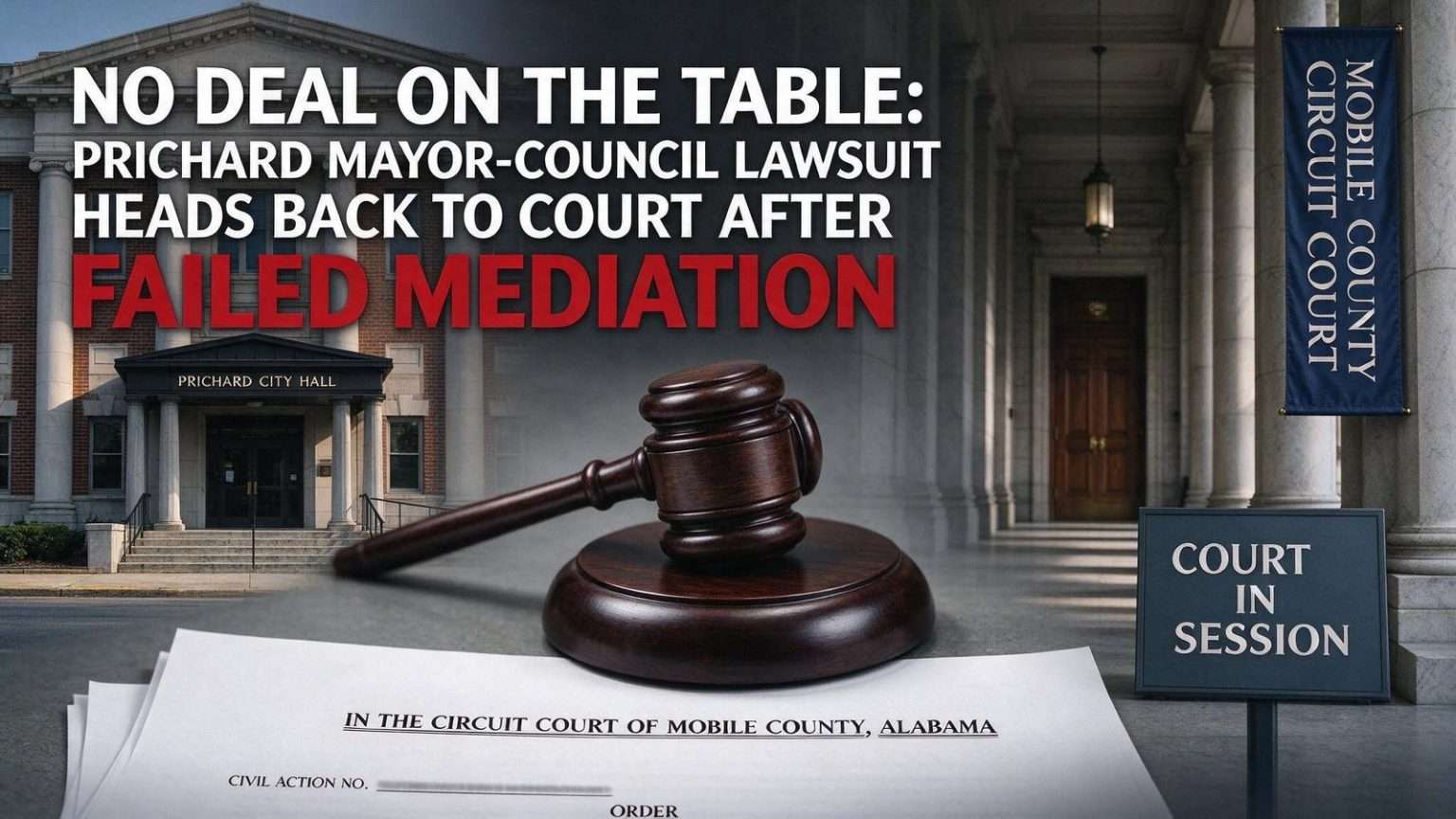
Court-ordered mediation between Prichard Mayor Carletta Davis and the city council has collapsed without a resolution, sending the long-running fight over spending, contracts and city authority back into the hands of a Mobile County judge.
Circuit Judge Jill Parrish Phillips issued an order this week confirming that she had received the mediator’s report and that no agreement was reached between the parties. The development means one of the Mobile County area’s most closely watched municipal disputes will continue through the courts rather than ending at the negotiating table. Prichard, one of Mobile County’s larger cities, has been operating under a cloud of governance uncertainty for months as the case has wound its way through multiple hearings.
What the Judge Ordered Next
With mediation off the table, Phillips is requiring the mayor and council to lay out how the case should proceed. She directed the parties to jointly submit a proposed scheduling order within seven days covering discovery deadlines, any additional testimony they intend to present, whether any issues in the case have become moot, and whether they want the judge to rule on pending matters without further evidence.
If the two sides cannot agree on a joint proposal, each will be free to file its own proposed scheduling order — leaving the shape of the remainder of the litigation in the judge’s hands. The judge’s order signals that the case will move forward methodically, with concrete deadlines for both sides rather than further open-ended negotiations.
Prichard residents who have been following the case have urged the court to move efficiently, citing concerns that prolonged uncertainty is making it harder for the city to retain staff, pay vendors on time, and plan routine business. Several routine matters — including approval of certain contracts and personnel decisions — have effectively been on hold while the litigation has been pending.
How Mediation Fell Apart
Former Mobile County Circuit Judge John Lockett had been appointed to mediate the case after Davis requested the process. The council objected to mediation, arguing that the dispute turns on legal questions about who holds authority over city finances, property, contracts and personnel decisions — questions the council contended should be decided by the court, not negotiated away.
The underlying fight has already produced competing requests for preliminary injunctions. Council members have asked the court to block Davis from making nonessential expenditures, entering into financial obligations above $10,000 without council approval, and continuing payments under contracts they contend were never properly authorized. The council’s filings argue that several of those contracts were signed without the legal notice and review procedures required under Alabama’s mayor-council form of government.
Davis, for her part, has argued that state law gives her the authority to appoint her own executive staff and that the disputed positions were included in the city budget. She has also asked the court to halt the council’s financial investigation of her administration, while the council has asked the court to uphold that investigation and invalidate two mayoral vetoes. The mayor’s filings emphasize that day-to-day administration of city departments falls within her executive authority.
What’s at Stake for Prichard
The case is more than a procedural spat. Prichard, one of Mobile County’s largest cities, has operated under a cloud of uncertainty as the mayor and council battle over fundamental questions of governance: whether the council can investigate how city money is spent, whether the mayor can unilaterally commit the city to contracts, and how the balance of power carved out in state law applies in a mayor-council form of government.
The dispute has dragged on across multiple court hearings, with each side accusing the other of overstepping its authority. Residents have watched the fight play out in contentious council meetings while routine business — budgeting, contracting and personnel decisions — has been tangled up in the litigation. Outside vendors and contractors have at times been reluctant to commit to new city work without clear direction on who actually has authority to sign agreements on the city’s behalf.
With no settlement in sight, the proposed scheduling filings due in the coming days will determine the next steps in the case, including how long discovery will last and when the parties might see a ruling on the injunction requests. Discovery is the formal pre-trial process in which both sides exchange documents and take depositions from witnesses.
What Comes Next
Until then, Prichard’s city government remains effectively at war with itself, with a judge — not a mediator — now positioned to decide how the story ends. Residents who want to follow the case can monitor filings at the Mobile County Courthouse, where the clerk’s office makes civil docket records available for public inspection during normal business hours.
Beyond the immediate litigation, both sides will also be looking ahead to the broader financial picture in Prichard. The city is operating under tight budget constraints, public-safety services are being provided by the Mobile County Sheriff’s Office under a temporary arrangement, and the mayor and council remain split over how to fill the gap. Whatever the court ultimately decides, officials on both sides agree that resolving the authority question is a necessary first step before any of Prichard’s other fiscal problems can be addressed in a durable way.
Why the Case Has Captured Local Attention
Prichard is one of the older cities in Mobile County, and its internal political battles tend to reverberate beyond city limits. Residents and former officials have watched the dispute closely because it touches questions that come up in almost every Alabama mayor-council city: who has authority to spend money, who has authority to hire and fire, and how those powers are divided when the city’s charter and state law appear to say different things.
How Similar Disputes Have Played Elsewhere
Mayors and councils in other Alabama cities have found themselves in similar fights, with outcomes often turning on the precise language of local charters and on how courts interpret state law. The Prichard case is unusual because both sides have filed competing injunction requests, leaving a judge to sort out who can do what in the meantime. Until that ruling comes, day-to-day governance in Prichard will continue to feel frozen.
How the Dispute Affects Daily Operations in Prichard
Behind the legal arguments, the governance fight has practical consequences for Prichard residents. Permitting questions, vendor contracts and routine personnel decisions have at times been delayed while the mayor and council wait for clarity from the court. Some contractors have been reluctant to take on new city projects without clear authority from both sides, and city employees have had to navigate uncertainty about who has final say on routine matters. A definitive ruling from the court would go a long way toward removing that ambiguity, regardless of which side ultimately prevails.
What Comes After the Scheduling Order
Once the scheduling order is in place, both sides will begin discovery — exchanging documents and written questions about the other side’s evidence. That process can take months in complex public-law cases, particularly when city records and personnel files are involved. After discovery, the court will likely hear oral argument on the pending injunction motions before deciding whether any of them should be granted. Each step will draw public attention, and council meetings and court hearings are likely to remain well-attended until the underlying dispute is finally resolved.
What Residents Are Saying About the Standoff
Residents who have spoken at recent council meetings have urged both sides to find common ground on the basic business of running the city. Routine items — street repairs, garbage pickup, public-safety coverage — have at times been delayed by the dispute, and many residents have asked the council and the mayor to set aside their differences on those issues even as the larger fight works its way through the courts. Council members have echoed that request, and Hale’s statement is in part an effort to keep the focus on residents’ day-to-day concerns.
How the Case Will Affect Future Elections in Prichard
Beyond the immediate legal fight, the case is likely to shape the city’s politics for the foreseeable future. Mayoral and council elections in Prichard have historically drawn low turnout, but the public attention on this dispute could change that. Several community leaders have already begun talking about the importance of the next election cycle, and voter-registration drives ahead of any future municipal vote are likely to draw strong interest from residents on both sides of the governance fight.
How the Court’s Ruling Could Affect Other Cities
Practitioners who follow Alabama municipal law say the Prichard case could set useful precedent for other cities navigating similar disputes between mayors and councils. The court’s eventual ruling on the pending motions will help clarify how state law applies to spending authority, contract approval and personnel decisions in a mayor-council form of government. Cities across Alabama are likely to look to the Prichard ruling for guidance on how to structure their own governance arrangements and how to avoid the kind of impasse Prichard has been working through.
The mediation track that ultimately failed began in July, when city attorney Josh Briskman filed a motion on Davis’ behalf asking Mobile County Circuit Judge Jill Phillips to send the dispute to a mediator. Phillips approved the request and appointed retired judge John Lockett to lead the discussions — but the council, through its attorney Moshae Donald, filed an objection to the mediation order almost immediately.
“Testimony and evidence demonstrate that there is no authority the mayor considers herself bound to respect — not Alabama Supreme Court precedent requiring council approval of contracts, not the council’s statutory authority over municipal finances and property, and not the multiple Attorney General opinions directly on point,” the council’s objection read. “The defendants have no confidence that the mayor would heed any resolution reached through mediation, even one ratified by this honorable court.”
Davis, for her part, said publicly at the time that she remained willing to work out the differences between her and the council. “My focus has never been on political conflict. My focus has always been on the people of Prichard and improving their quality of life,” she wrote in a statement posted to Facebook after the mediation was ordered. “Every day we spend in disagreement is a day we could be spending creating opportunities and improving services. Let’s move our city forward!”