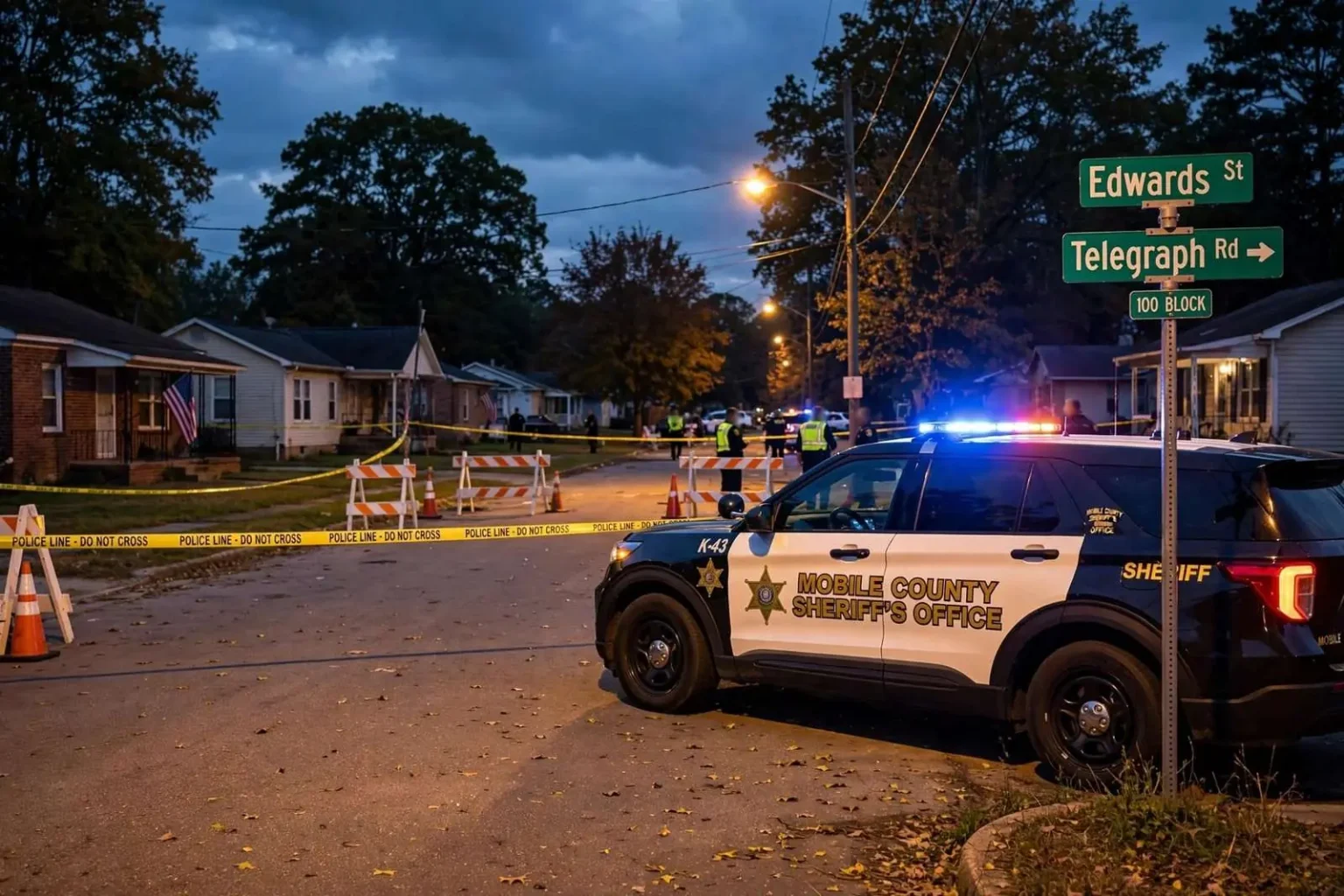
Yellow police tape across a residential street, illustrating the shooting investigation on Edwards Street in Prichard, AlabamaDeputies closed both sides of Edwards Street while investigating Sunday's shooting.

One person was shot Sunday evening on Edwards Street near Telegraph Road in Prichard, according to the Mobile County Sheriff’s Office.

The victim was transported to a hospital with injuries that were not considered life-threatening. Deputies blocked off both ends of Edwards Street while they processed the scene and canvassed the area.

What Investigators Have Released

Authorities have not identified the person who was shot, have not announced an arrest, and have not described a motive or a suspect. The Sheriff’s Office has not said whether the shooting is believed to have been targeted or the result of a dispute between people who knew each other.

The Mobile County Sheriff’s Office holds jurisdiction over the investigation. Prichard has its own municipal police department, but the Sheriff’s Office frequently handles or assists with investigations in and around the city, and the location near Telegraph Road places the scene in an area where both agencies routinely operate. This arrangement reflects a longstanding pattern in Mobile County: the Sheriff’s Office has primary jurisdiction in unincorporated areas and often takes the lead on felony investigations even within municipal boundaries when specialized resources — such as the Major Crimes Unit, Crime Scene Unit, or Cold Case Unit — are needed.

Telegraph Road Corridor

Edwards Street runs off the Telegraph Road corridor, a heavily traveled north-south route connecting Prichard to Mobile’s industrial waterfront and the Chickasaw and Saraland areas to the north. Road closures along the smaller residential streets that branch off it can back traffic up quickly, and deputies moved to reopen the roadway once the scene had been cleared. The corridor is a vital commercial and commuter artery; Alabama Department of Transportation counts show average daily traffic volumes in the tens of thousands along segments of Telegraph Road, making any extended closure a significant disruption for freight, shift workers, and residents alike.

The industrial waterfront accessible via this corridor includes the Port of Mobile, Austal USA’s shipbuilding facilities, and numerous logistics and warehousing operations. To the north, Telegraph Road provides access to Interstate 65 and the growing commercial corridors in Saraland and Chickasaw. For Prichard residents, the road is a primary link to employment centers, healthcare facilities in Mobile, and retail corridors.

See also  Carter Bradley Throws Three Touchdowns as South Alabama Rallies Past Old Dominion 27-20

How to Help

Anyone with information about the shooting is asked to contact the Mobile County Sheriff’s Office. Tips may also be submitted anonymously, and residents who saw or heard anything in the area Sunday evening — including doorbell or vehicle camera footage — are encouraged to come forward, as that footage has become one of the most useful sources of evidence in neighborhood shooting investigations.

This is a developing story and will be updated as more information is released.
Context: Gun Violence Patterns in the Mobile Metro Area

Sunday’s shooting on Edwards Street is one of numerous firearms incidents that Mobile County law enforcement agencies respond to each year. The Mobile County Sheriff’s Office and Prichard Police Department both participate in regional crime reduction strategies, including the federally supported Project Safe Neighborhoods initiative, which coordinates federal, state, and local prosecutors to target the most violent offenders and illegal firearms trafficking. In recent years, both agencies have invested in gunfire detection technology — acoustic sensors that can triangulate the location of shots fired and alert dispatchers in real time — as part of a broader effort to reduce response times and improve evidence collection in areas where witnesses may be reluctant to call 911.

Data from the Alabama Statistical Analysis Center and local law enforcement annual reports consistently show that a majority of non-fatal shootings in the metro area involve victims and suspects who know each other — disputes among acquaintances, domestic conflicts, or arguments that escalate. Stranger-on-stranger shootings, while they occur, represent a smaller share of overall gun violence. Investigators in Sunday’s case will be examining whether the Edwards Street shooting fits the more common pattern of a known-party dispute or represents something different.

Trauma Care and Hospital Response

When a shooting victim is transported to a hospital in the Mobile area, they are typically taken to one of the region’s designated trauma centers. USA Health University Hospital in Mobile is the only Level I trauma center in southwest Alabama, meaning it maintains 24-hour in-house coverage by trauma surgeons, anesthesiologists, and specialized nursing staff capable of managing the most severe injuries. USA Health Children’s & Women’s Hospital provides Level II pediatric trauma care. For patients with non-life-threatening wounds, transport may go to the nearest appropriate facility — which, from the Prichard area, could include Mobile Infirmary, Springhill Medical Center, or other hospitals in the Infirmary Health system — based on EMS protocols and current capacity.

See also  Wilmer Couple and Their Five Adopted Children Escape House Fire Unharmed

The fact that Sunday’s victim was reported to have non-life-threatening injuries suggests the wound did not involve major vascular structures, vital organs, or the central nervous system. Even so, any gunshot wound requires thorough surgical evaluation, imaging, and often admission for observation, antibiotics, and pain management. The long-term physical and psychological impact on survivors can be significant, including chronic pain, mobility limitations, and post-traumatic stress.

Community Impact and Resources

Shootings in residential neighborhoods like the area around Edwards Street affect more than the immediate victims. Residents who hear gunfire, see crime scene tape, or learn that a neighbor was injured often experience heightened anxiety, reluctance to use outdoor spaces, and concern for children’s safety. The Mobile County Sheriff’s Office and Prichard community organizations have worked to address these ripple effects through neighborhood walks, town hall meetings, and partnerships with groups such as the Mobile County Community Action Agency and faith-based organizations that provide counseling referrals and victim advocacy.

For anyone affected by gun violence — whether directly or as a witness — the Mobile County District Attorney’s Office operates a Victim Services Division that can assist with victim compensation applications, court accompaniment, and referrals to mental health providers. The Alabama Crime Victims Compensation Commission provides financial assistance for medical expenses, counseling, lost wages, and funeral costs to eligible victims of violent crime. The National Suicide Prevention Lifeline (988) and Crisis Text Line (text HOME to 741741) offer 24-hour confidential support for those experiencing trauma-related distress.

The Investigative Process: What Happens Next

In the hours and days after a non-fatal shooting, investigators typically focus on several parallel tracks. Crime scene technicians collect ballistic evidence — shell casings, projectiles, trajectory data — that can link a specific firearm to the scene and, through the National Integrated Ballistic Information Network (NIBIN), potentially connect it to other shootings. Detectives canvas for witnesses, review surveillance footage from homes and businesses, and analyze cell phone location data (with appropriate legal process) to establish who was in the area at the time of the shooting.

See also  South Alabama Honors Joel Erdmann's 17-Year Legacy as Athletic Director Retires

If a suspect is identified, the case proceeds toward an arrest warrant and, ultimately, presentation to a Mobile County grand jury for indictment. Assault charges in Alabama range from third-degree (a misdemeanor) to first-degree (a Class B felony punishable by 2 to 20 years), with the specific charge depending on factors such as the severity of injury, whether a deadly weapon was used, and the intent of the actor. If the shooting resulted in death, the charges could escalate to murder or, under certain aggravating circumstances, capital murder.

Throughout the process, the Sheriff’s Office and the District Attorney’s Office coordinate on case strategy, witness preparation, and evidence disclosure obligations under Alabama’s criminal discovery rules. The timeline from shooting to resolution varies widely; some cases are resolved through plea agreements within months, while others — particularly those with limited witness cooperation or complex forensic evidence — can take a year or more to reach trial.