Foley ‘Super Armory’ Funding Back on Track, Mayor Says
Foley Mayor John Koniar says federal funding for a massive new National Guard training center is moving forward again after a budget-driven delay.
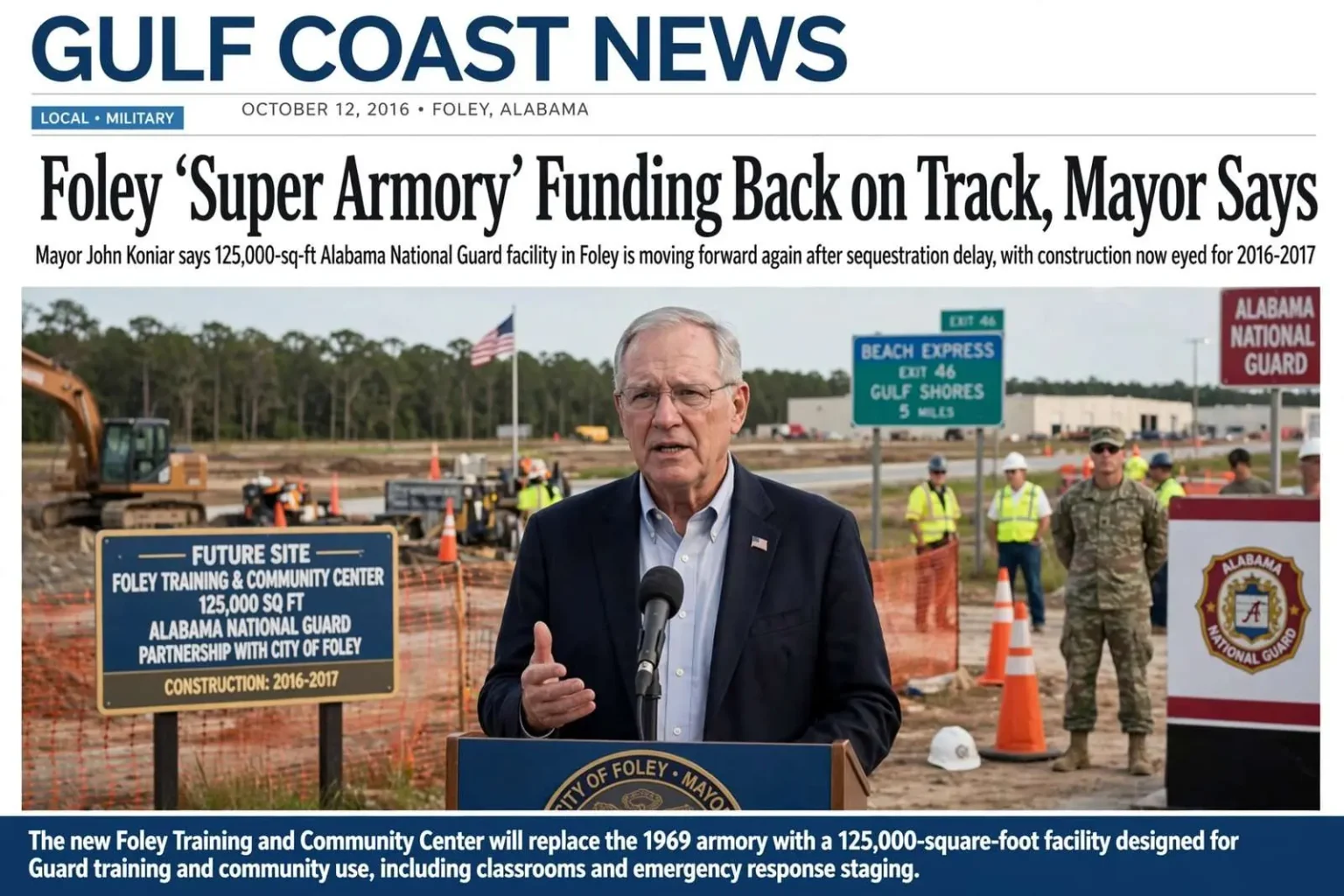
Plans for a large new Alabama National Guard training facility in Foley are moving forward again after federal budget cuts stalled the project last year, according to Mayor John Koniar. The proposed 125,000-square-foot Foley Training and Community Center, planned for a site along the Beach Express, had originally been expected to break ground by 2015.
Automatic federal spending cuts known as sequestration pushed that timeline back to 2019, but Koniar said the city is now working with Alabama’s congressional delegation to move construction up, with hopes of starting as early as 2016 or 2017. The mayor’s renewed optimism reflects a shift in how military construction priorities are being argued in Washington, where Guard facility projects that were frozen during the worst of the budget standoff have begun advancing again as funding bills move through Congress.
Sequestration, the across-the-board budget mechanism triggered after the 2011 Budget Control Act, cut deeply into military construction accounts, and National Guard facility projects across the country were among the most visible casualties. For Foley, the freeze meant a project the city had spent years preparing sat in limbo while the Guard sorted out which facilities it could fund first.
A statewide consolidation effort
The Foley project is part of a broader consolidation effort by the Alabama National Guard, which has closed 13 armories statewide over the past two years in favor of fewer, larger regional facilities. The logic behind the consolidation is the same one driving Guard structures nationwide: maintaining dozens of small, aging buildings spread across the state is expensive, while a smaller number of modern, well-equipped regional centers can serve more soldiers more efficiently.
For communities, the tradeoff is bittersweet. Towns that lose an armory lose a fixture that has anchored civic life for decades, while the communities that land the new regional centers gain facilities that serve far broader populations. Foley positioned itself to be a winner in that reshuffling, and the city’s willingness to trade land for the project was central to its pitch.
The city has been planning for the new armory since 2011, when the Foley City Council agreed to hand over 30 acres in its Beach Express Industrial Park, located just south of U.S. 98, in exchange for the Guard’s existing Fort Smith Armory property behind City Hall. The land swap gave the Guard a modern site with room to grow while returning the older armory parcel to the city’s control for redevelopment near its downtown.
The industrial park site sits near the U.S. Navy’s Barin Field, which is expected to eventually house Air National Guard units as well. That adjacency is more than a coincidence of geography — it creates the possibility of a joint-use military presence on the south Baldwin County corridor, with Navy, Army National Guard and potentially Air National Guard operations clustered along the Beach Express.
A facility five times the old armory
Once built, the new facility would dwarf Foley’s current armory, built back in 1969, coming in at more than five times its size. The scale difference reflects how Guard training requirements have changed in the decades since the old armory opened, when a drill hall, offices and modest storage satisfied the needs of a much smaller footprint of equipment and personnel.
Beyond housing Guard operations, the building is designed to double as a community resource, with plans for a commercial-grade kitchen and partnerships allowing local colleges to offer distance-learning courses on site. The dual-purpose design has become a hallmark of newer Guard facilities, which are increasingly built to serve as storm shelters, training centers and classroom space for the surrounding community, not just drill sites for soldiers one weekend a month.
“They’re already meeting with people like Faulkner (State), South Alabama, etc. for the educational part of it,” Koniar said. “They’re not your daddy’s or granddaddy’s National Guard anymore. They’re pretty progressive and do a lot of good stuff.”
Distance-learning classrooms inside a Guard facility would give south Baldwin County residents access to college courses without a commute to campuses in Mobile or Pensacola, a meaningful option in a fast-growing part of the county where educational infrastructure has struggled to keep pace with population. Partnerships with institutions such as Faulkner State Community College and the University of South Alabama would put coursework within reach of residents in Foley, Gulf Shores, Orange Beach and the surrounding communities.
Design plans call for roughly 100,000 square feet of heated and air-conditioned space along with another 25,000 square feet of unheated area, giving the Guard room for both emergency response equipment and the indoor training space modern units require. The conditioned portion would house administrative offices, classrooms, the kitchen and the drill hall, while the unheated bays would store vehicles and equipment that do not require climate control.
That storage capacity has a public-safety dimension. Gulf Coast communities rely on Guard facilities during hurricane season, when armories and their equipment caches become staging points for response and recovery, and a 125,000-square-foot facility in south Baldwin County would position personnel and supplies closer to the coastal areas that need them first after a storm.
What the facility means for Foley
The economic case for the project extends beyond construction jobs. A regional Guard facility brings permanent personnel — full-time staff as well as the drilling soldiers who report for weekend training — whose paychecks, lodging and spending flow into the local economy every month. For a city that has grown from a quiet farming community into one of Baldwin County’s commercial centers, that steady presence complements the retail and tourism economy that dominates the region.
Foley’s growth along the Beach Express corridor gave the city leverage in its negotiations with the Guard. The Beach Express, the toll road that originally connected Foley to the Gulf Shores coastline, has become one of the county’s principal growth axes, with industrial park acreage, residential subdivisions and commercial development clustering along its length. Locating the facility in the industrial park put it on infrastructure already built to handle heavy traffic.
The exchange also solved a problem for the city. The Fort Smith Armory property behind City Hall was aging, and its return to city control opens prime land near downtown for redevelopment that fits Foley’s longer-term plans for its civic core. Land swaps of this kind — city land for federal property — require coordination and approval on both sides, which is why the 2011 agreement took years of negotiation to complete.
The military’s long history in south Baldwin County
The Guard facility would extend a military presence in the area that dates back generations. Barin Field, the Navy installation adjacent to the industrial park site, began as a World War II-era training field named for Lt.(jg) Wiley J. Barin, and it has trained Navy and Marine Corps flight students for decades as part of the region’s network of airfields serving Naval Air Station Pensacola. The sound of training aircraft overhead is a familiar part of life in south Baldwin County, and the base has long been an economic anchor for the area.
Adding National Guard operations next to an active Navy airfield would mirror a model used elsewhere in the state, where Guard units share or neighbor active installations to reduce costs and improve coordination. For the Air National Guard units expected to eventually use the Barin Field area, the proximity offers training opportunities that a standalone armory cannot provide.
The Alabama National Guard’s statewide restructuring has been closely watched by the dozens of communities whose armories were on the closure list. Guard officials have emphasized that consolidation is about readiness as much as budgets: modern units train with equipment that requires large bays, secure storage and reliable utilities that 1960s-era armories were never designed to support.
From stalled to moving
The path from sequestration freeze to renewed momentum has run through Alabama’s congressional delegation, which has advocated for Guard construction projects as federal budget cycles have loosened. Military construction funding is appropriated through annual defense bills, and projects that survived the freeze — like the Foley center — move forward as money becomes available, with local officials lobbying to move their projects up the queue.
Koniar’s timeline — construction as early as 2016 or 2017 — depends on that advocacy succeeding, and the mayor was candid that the city is working the issue rather than waiting on it. Cities competing for Guard investment have learned that congressional attention, land contributions and community support all weigh in how quickly a project advances once funding exists.
If the timeline holds, Foley would see design and bidding work lead into construction within a few years, with the facility replacing a training space that has served Guard units since the Nixon administration. The 1969 armory that the new building would replace is typical of the facilities being retired statewide: functional, but far below the standard the modern Guard expects for its equipment and its soldiers.
For residents, the most visible changes would come in stages — site work in the industrial park first, then construction traffic along the Beach Express corridor, then the opening of a building that will double as a community asset. The commercial kitchen and college classrooms mean the facility’s doors will open to the public regularly, from emergency-management functions to evening classes.
What began in 2011 as a land swap negotiated by the city council has survived a federal budget crisis and emerged as one of the most significant public construction projects on Foley’s horizon. Whether the groundbreaking lands in 2016, 2017 or on the delayed 2019 schedule, the city will get the regional facility it has spent years arranging — and the Guard will get the modern home its statewide consolidation plan promised.