Coastal Alabama Cities Enforce Different Fireworks Rules Ahead of Fourth of July
Fireworks rules vary sharply across Mobile, Orange Beach, Gulf Shores and Spanish Fort as officials urge caution for the holiday.
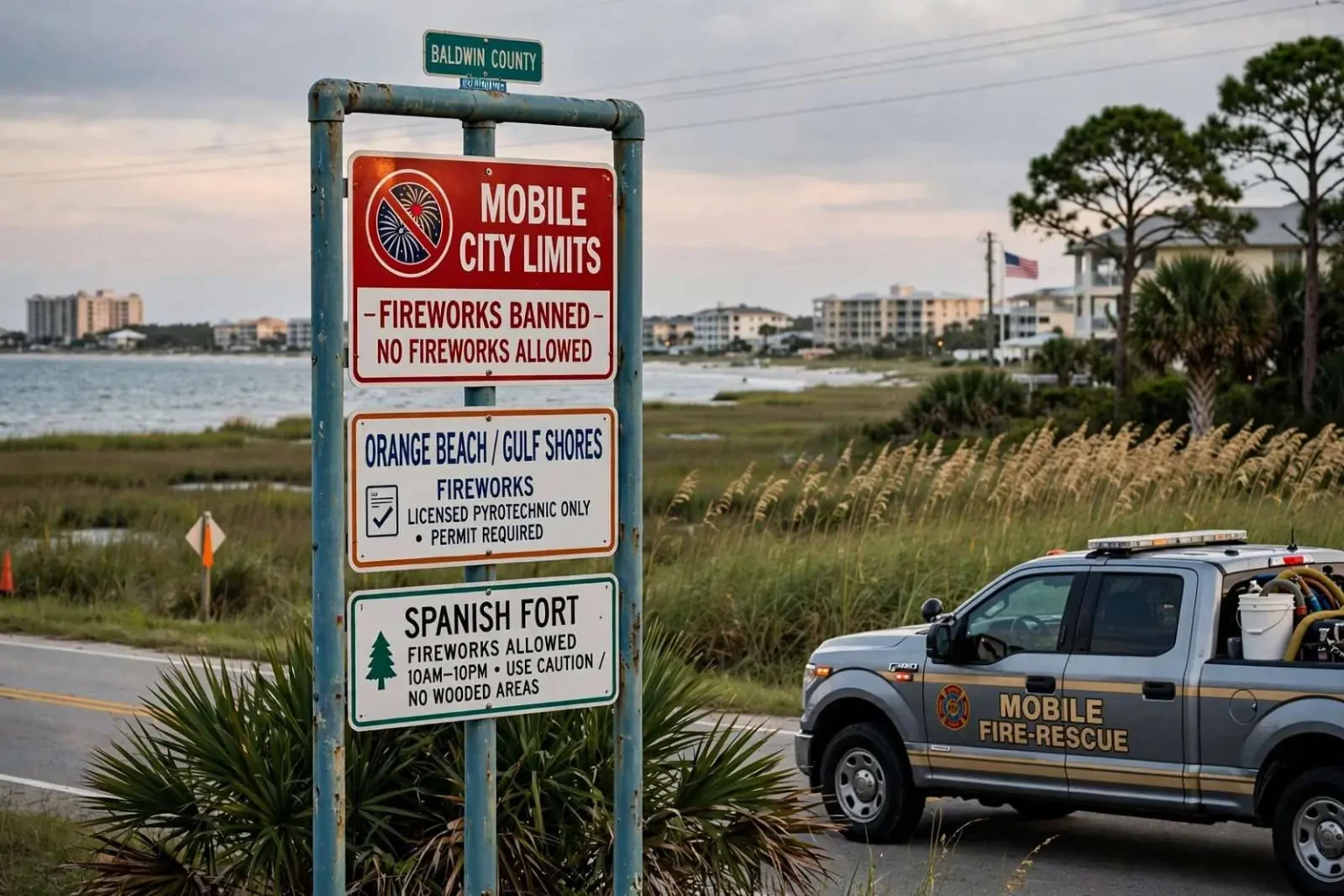
As South Alabama families prepare to celebrate the Fourth of July, local fire officials are reminding residents that fireworks rules vary dramatically from one coastal community to the next, and that a fireworks display legal in one town could bring a citation just a few miles away. The patchwork of ordinances along the Gulf Coast catches visitors and new residents off guard every holiday season, and fire departments spend the days before July 4 fielding calls from residents trying to sort out what they can legally light in their own backyards.
Mobile maintains the strictest stance in the region, banning fireworks outright within city limits. A Mobile Fire-Rescue spokesperson put it bluntly: residents cannot possess, sell, manufacture, buy, or use fireworks anywhere inside the city, full stop. Officials there consistently recommend leaving pyrotechnics to licensed professionals rather than risking injury or a citation, pointing to the public displays staged across the city each Independence Day as the safe alternative.
The logic behind a complete municipal ban is straightforward from a fire service perspective. Dense neighborhoods, older housing stock and closely spaced homes give a single stray rocket the potential to start a structure fire, and emergency crews already face their busiest workload of the year on the holiday. A ban also simplifies enforcement: rather than parsing times, dates and types of fireworks, officers can act on any use at all.
Rules shift along the coast
Along the coast, the rules shift depending on the municipality. Orange Beach prohibits fireworks use within town limits unless handled by a licensed pyrotechnics company. Gulf Shores takes a similar approach, allowing fireworks only when fired by a company holding both a city assembly permit and a state license. Fire officials in both beach towns acknowledged that residents regularly attempt their own displays anyway, even though enforcement can result in citations.
The beach cities’ rules reflect the particular hazards of their environment. Multi-story condominiums and vacation rentals pack thousands of seasonal visitors into a narrow strip of coastline, and a rooftop or balcony launch over those structures multiplies the risk of both fire and falling debris. Licensed pyrotechnic operators, by contrast, carry insurance, follow distance tables and coordinate with fire officials, which is why both cities channel holiday displays through permit-holding professionals.
Visitors account for a large share of fireworks complaints in the beach towns, since many arrive from states where consumer fireworks are common and assume Baldwin County’s beach communities follow the same practice. Police and fire crews patrol the beach road and public access points heavily through the holiday weekend, and officials urge vacationers to check local rules before unpacking sparklers, fountains or aerial cakes.
Spanish Fort offers slightly more flexibility, permitting fireworks use within city limits between 10 a.m. and 10 p.m. Fire officials there cautioned residents to steer clear of heavily wooded areas, where a stray spark could easily ignite dry brush. The Eastern Shore’s mix of subdivisions and forested tracts makes that warning more than boilerplate; a bottle rocket landing in dry undergrowth can smolder unnoticed before flaring into a woods fire that threatens homes.
Statewide safety rules apply everywhere
Statewide, the Alabama Fire Marshal’s office emphasized several basic safety rules that apply no matter where fireworks are legal. Users should never discharge fireworks within 600 feet of a building or aim them toward other people, both of which carry legal consequences. The 600-foot buffer is designed to keep aerial shells and rocket debris away from rooftops, porches and vehicles, and officials note that the distance requirement is one of the most commonly violated rules on the holiday.
Fireworks should always be set off on a hard, flat surface rather than in a field or pasture, where uneven ground can cause them to tip over unpredictably. A mortar or tube that tilts as it fires sends its projectile sideways rather than skyward, which is how spectators standing a safe-looking distance away end up injured. Fire officials recommend a driveway or other paved area, cleared of dry debris, with the fireworks braced so they cannot slide or roll.
Other longstanding guidance from fire officials bears repeating each July: keep a hose or bucket of water within reach, never relight a dud firework, supervise older children closely rather than letting them handle fireworks alone, and soak spent devices before disposing of them, since smoldering cardboard tossed into a trash can has started more than one garage fire. Sparklers, often treated as harmless, burn hot enough to cause serious burns and account for a large share of fireworks injuries among young children every year.
Think of the pets
Officials also urged residents to think about their pets during the holiday. Loud, sudden fireworks noise can genuinely terrify dogs and other animals, and veterinarians report a predictable spike in runaway pets around the Fourth of July each year as frightened animals bolt from yards, slip collars and dart through open doors.
Animal care professionals recommend keeping pets indoors during peak fireworks hours, closing windows and drawing curtains to muffle the sound, and providing a comfortable, enclosed space where a frightened animal can settle. Pet owners are encouraged to make sure identification tags and microchip information are current before the holiday, because a pet that escapes on July 4 is far more likely to make it home if its paperwork is in order.
The advice extends beyond dogs and cats. Horses and livestock in the county’s rural areas can injure themselves attempting to flee the noise, and owners of farm animals are advised to check fences and stalls before neighbors begin their celebrations. Even indoor birds, with their sensitive hearing, can be stressed by sustained fireworks nearby.
Local officials’ overarching message each year is the same: know the law where you are standing, follow the safety basics regardless of legality, and leave the large aerial displays to the licensed professionals who stage the region’s public shows. Residents uncertain about their community’s rules can contact their city hall or fire department in advance of the holiday, rather than learning the answer from a citation.
Why the rules differ so much
The variations from one municipality to the next are a product of home rule in Alabama, which lets each city and town set its own fireworks ordinances within the framework of state law. In practice, that means the rules can change at the city limits sign: a display that is lawful in an unincorporated area or a permissive town becomes an offense across the line, and public safety agencies have little discretion to overlook the difference.
Fire officials say the enforcement posture in each community follows from its own risk profile. Cities with dense housing and limited water pressure for firefighting tend toward prohibition; communities with larger lots and volunteer or combination fire departments sometimes allow restricted hours instead. What none of the coastal agencies endorse is improvised displays near structures, wooded land or crowds, whatever the local ordinance says.
Injuries and fires keep the pressure on
The annual warnings are grounded in hard experience. Emergency rooms across the region treat fireworks injuries every July — burns to hands and faces, eye injuries from projectiles that explode at ground level, and wounds from devices that malfunctioned or were handled improperly. Fire departments also respond to brush fires and structure fires traceable to holiday celebrations, and the Fourth of July consistently ranks among the busiest days of the year for both fire and EMS calls.
Those statistics are why officials in every community, from the strictest to the most permissive, repeat the same core guidance. Legal or not, fireworks demand care: sober, adult supervision; a clear, flat launch area away from buildings and vegetation; water on hand; and no second attempts on devices that fail to fire. The residents who follow that checklist account for only a fraction of the calls, officials say, which is precisely why the checklist gets repeated every year.
Where to watch instead
For residents in the communities that ban consumer fireworks, officials point to the public displays staged by licensed pyrotechnic companies as the safest way to celebrate. Professional shows offer far larger shells, coordinated music and, crucially, fire crews on standby — and they eliminate the individual risk of a misfired tube or a hot shell fragment landing in the wrong yard.
Planning a family’s evening around a public show also sidesteps the citation question entirely. Cities that prohibit consumer fireworks typically host or permit major public displays, and parking, crowd and viewing information is published in advance. Officials recommend arriving early, keeping children close in the crowd, and remembering that even after the final shell falls, spent debris on the ground can stay hot enough to burn small hands.
The bottom line for South Alabama this Independence Day: check the local ordinance before lighting anything, follow the state fire marshal’s safety rules wherever fireworks are allowed, keep an eye on pets and neighbors, and treat the professional shows — not the backyard bottle rocket — as the region’s signature celebration.