Real Estate Roundup: Acme Oyster House Picks Gulf Shores; Publix Says No to Midtown
New Orleans-based Acme Oyster House zeroed in on Gulf Shores for a waterfront restaurant, while Publix declined a Midtown Mobile site and a Flora-Bama spinoff opened on Ole River.
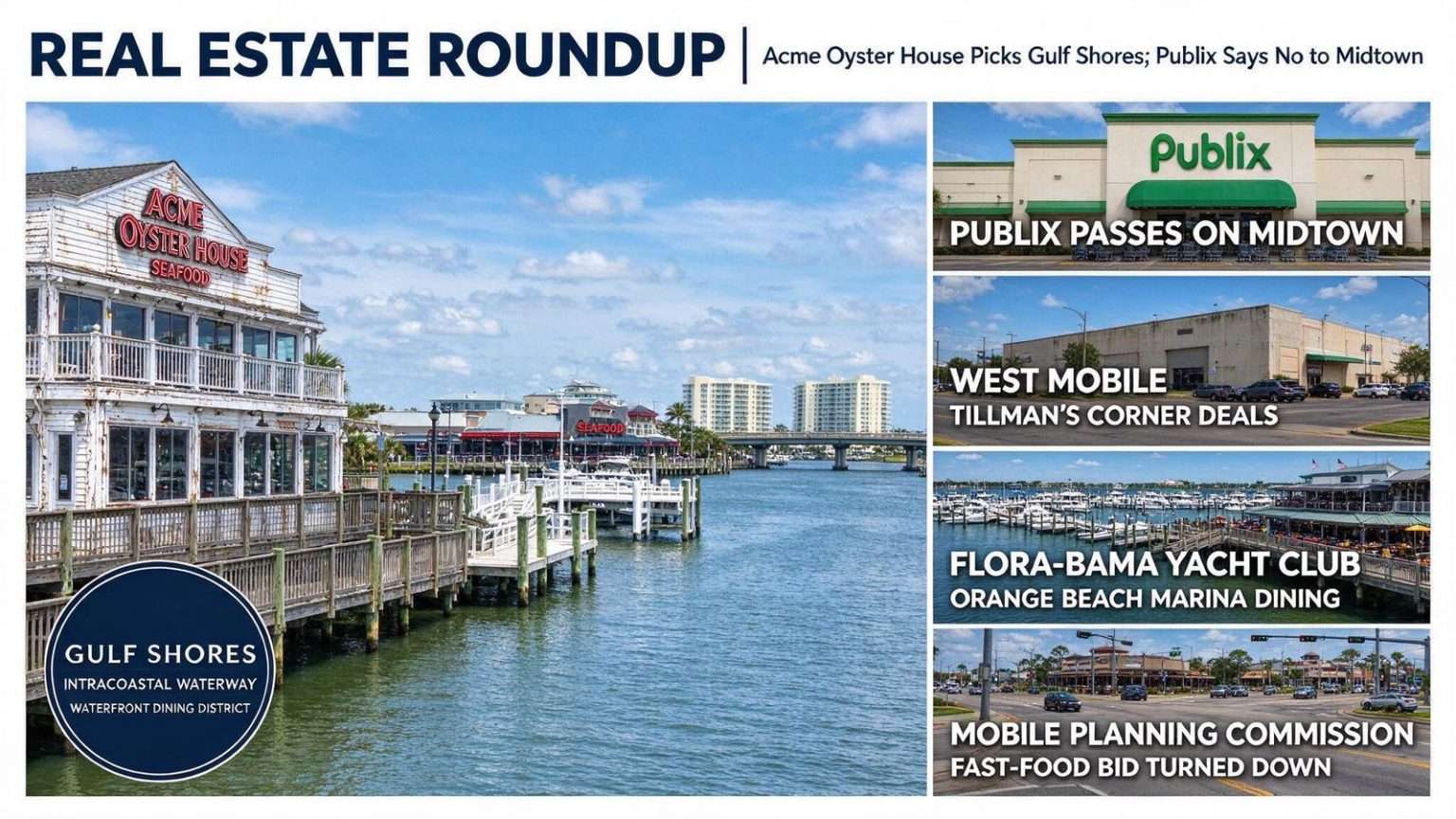
Acme Oyster House was expected to announce that it would build a new restaurant on the Intracoastal Waterway near the Dr. W.C. Holmes Bridge in Gulf Shores. The New Orleans-based restaurant had been eyeing the Gulf Coast for a number of years and most recently zeroed in on Gulf Shores.
The company’s arrival would mark another milestone in Gulf Shores’ transformation from a seasonal beach town into a year-round dining destination. Acme, a New Orleans institution with roots stretching back to the early 20th century, built its reputation on raw and charbroiled oysters and a menu of Creole classics, and its restaurants have long drawn lines of tourists and locals alike at locations across the Gulf South.
The site near the Holmes Bridge, which carries traffic across the Intracoastal Waterway at Gulf Shores’ northern edge, sits in the middle of the city’s most ambitious planning effort — the development of a waterfront entertainment and shopping district along the canal. The city had been working to establish a waterfront entertainment and shopping district in the area around LuLu’s at Homeport on the north side of the Intracoastal and near Tacky Jack’s on the south side.
That corridor has become the anchor of Gulf Shores’ “other” waterfront — the working-waterway side of the city, removed from the beach but carrying its own draw. LuLu’s, the waterfront restaurant and entertainment complex founded by a member of the Buffett family, and Tacky Jack’s, a longtime local favorite for seafood and sunset views, established the pattern: waterfront dining with boat access, boardwalks and room to grow.
A waterfront district along the Intracoastal gives the city a second leg to stand on economically. Beach traffic dominates Baldwin County’s tourism economy, but canal-side development captures boaters traveling the Intracoastal, anglers returning from Gulf passes and visitors seeking a change of pace — a market the city has been deliberately cultivating through zoning, infrastructure and public access improvements.
Deals in West Mobile and Tillman’s Corner
A local investor paid $375,000 for a 5,000-square-foot former BLP Paint Store at Schillinger and Cottage Hill roads in west Mobile and planned to use it for warehouse space, according to Marl Cummings IV of Cummings & Associates.
The sale illustrates the steady market for small commercial buildings in west Mobile, where Schillinger Road serves as a north-south commercial spine crossing the Cottage Hill corridor. Former retail buildings of that size trade in a niche market — too small for national chains, but prized by local operators needing warehouse or light commercial space close to residential rooftops.
Cummings & Associates, a Mobile commercial real estate firm, has handled much of the area’s small-property brokerage for years, and deals of this scale are the bread and butter of the local investment market: properties that change hands among local buyers, often financed locally, and put back to work serving neighborhood demand rather than regional chains.
Nearby in Tillman’s Corner, Quicken Loans leased 2,200 square feet at 5420 U.S. 90. The lease by the Detroit-based online mortgage lender put a national brand into one of south Mobile County’s busiest commercial districts, where the U.S. 90 corridor channels traffic between downtown Mobile and the communities along the bay.
Tillman’s Corner has long functioned as south Mobile County’s retail hub, drawing shoppers from Theodore, Grand Bay and the bayfront communities. Service-sector tenants like online lenders, insurers and wireless stores have increasingly filled the district’s strip centers, reflecting a national shift in how financial and consumer services occupy brick-and-mortar space.
Publix Passes on Midtown
Publix Supermarket said no to building a store at Spring Hill Avenue and Mobile Infirmary Boulevard in Midtown. The decision left one of central Mobile’s most persistent retail questions — when a full-service grocer would commit to the corridor — unanswered for the time being.
Aronov Realty of Montgomery continued to seek a grocery anchor for the area and had received city planning approval to rezone the three-acre former Ernest Construction property fronting Old Shell Road near Mobile Infirmary Boulevard for retail use, according to attorney Doug Anderson.
Plans called for a store fronting Old Shell next to the Dew Drop Inn Restaurant, with the retail center wrapping behind the eatery. The Dew Drop, a Mobile lunch institution that has operated near the site for generations, would have anchored the project’s street frontage under the site plan, giving the center a touch of Midtown continuity amid new construction.
Publix’s expansion across the Gulf Coast made its decision notable. The Lakeland, Florida-based chain had spent years pushing aggressively into Alabama, opening stores across the Mobile and Baldwin County markets and reshaping grocery competition wherever it landed. A Midtown store would have brought the chain’s format — prized by shoppers for its service and store-brand products — to a dense, established neighborhood close to downtown and the Medical Center district.
For Aronov, one of Alabama’s largest developers, the rezoning approval preserved the option of pursuing another grocer. Midtown’s fundamentals remained attractive to retailers: thousands of households within a short drive, major traffic counts on Old Shell Road and Spring Hill Avenue, and the daily gravity of Mobile Infirmary, one of the city’s largest employers, at the corridor’s center.
Along the Coast
The owners of the Flora-Bama Lounge, Package and Oyster Bar on the Alabama-Florida line at Perdido Key opened a new restaurant, the Flora-Bama Yacht Club, behind the Flora-Bama liquor store on Ole River.
The Flora-Bama is one of the Gulf Coast’s signature bars, a rambling roadhouse straddling the state line where Perdido Key meets the Alabama shore, famous for its annual mullet toss and for drawing beach crowds from Pensacola and Orange Beach alike. Adding a family-friendly restaurant on the Ole River waterfront extended the brand from late-night barroom to all-day destination.
The Yacht Club’s location behind the package store put it directly on the water, where boaters can tie up and beach crowds can arrive by land. Waterfront dining on Ole River had become one of the fastest-growing niches on the Alabama-Florida line, as the protected waters between Perdido Key and Ono Island host one of the region’s most active recreational boating fleets.
In Orange Beach, Fisher’s at Orange Beach Marina was set to open in late May, led by Johnny Fisher, former general manager of LuLu’s at Homeport, who had also helped develop The Gulf at the Perdido Pass Bridge the previous fall.
Fisher’s trajectory traced the rise of Orange Beach’s dining scene. The Gulf, built at the foot of the Perdido Pass Bridge, made its mark with a contemporary design and a beach-club atmosphere that drew regional attention, while LuLu’s established the template of waterfront entertainment dining on the Back Bay. Opening at Orange Beach Marina placed Fisher’s new venture in the heart of the city’s sportfishing and charter-boat district, where marina traffic feeds a steady stream of customers through the season.
Orange Beach’s marina district — home to one of the largest charter fishing fleets on the Gulf — has evolved into the city’s culinary center, as restaurant developers compete for waterfront sites that combine boat access, sunset views and proximity to the condominium towers that fill the island in summer.
Planning Commission Turns Down Fast-Food Bid
Meanwhile, the Mobile Planning Commission turned down a request to build a fast-food restaurant at the southeast corner of Airport and University boulevards.
The intersection is among the busiest in west Mobile, where Airport Boulevard’s commercial strip meets the University corridor that carries traffic between the city’s growing western suburbs and the Medical Center district. Corner lots at major west Mobile intersections are among the most contested properties in the city’s development review process, drawing bids from fuel stations, banks and chain restaurants seeking traffic counts measured in the tens of thousands of vehicles a day.
Fast-food proposals at such corners routinely draw scrutiny from commissioners and nearby residents alike, who weigh traffic turning movements, drive-through stacking and the character of adjoining neighborhoods against the commercial value of the site. Denials at major intersections are not uncommon, and applicants often return with revised site plans addressing access and buffering concerns.
The decision reflected the commission’s ongoing balancing act in west Mobile, where decades of growth have created both demand for commercial development and pressure to manage congestion along the Airport Boulevard corridor. As the city’s population has pushed west, each major intersection has become a small battleground between commercial potential and neighborhood stability.
A Regional Market in Motion
Taken together, the quarter’s deals traced the outlines of a Gulf Coast commercial market moving in several directions at once. National and regional restaurant chains pressed forward on the beaches and in Gulf Shores, where tourism dollars support ever-larger waterfront concepts. In Mobile, small investors absorbed vacant commercial buildings in the suburbs while developers regrouped after a high-profile grocer’s decision in Midtown.
For the region’s real estate professionals, the pattern was familiar: Baldwin County’s resort corridor and Mobile’s established neighborhoods follow different rhythms, but both depend on the same fundamentals — traffic, waterfront access and a growing population. The projects announced in these weeks, from an oyster house on the Intracoastal to a warehouse sale at Schillinger and Cottage Hill, were each bets on continued growth along the upper Gulf Coast.