Orange Beach Makos Bet on Experience as They Move Into a Loaded Class 4A Region
Two plays from the playoffs in each of the last two seasons, Orange Beach returns a dozen starters and two recruited underclassmen as it enters a Class 4A region stacked with Mobile County schools.
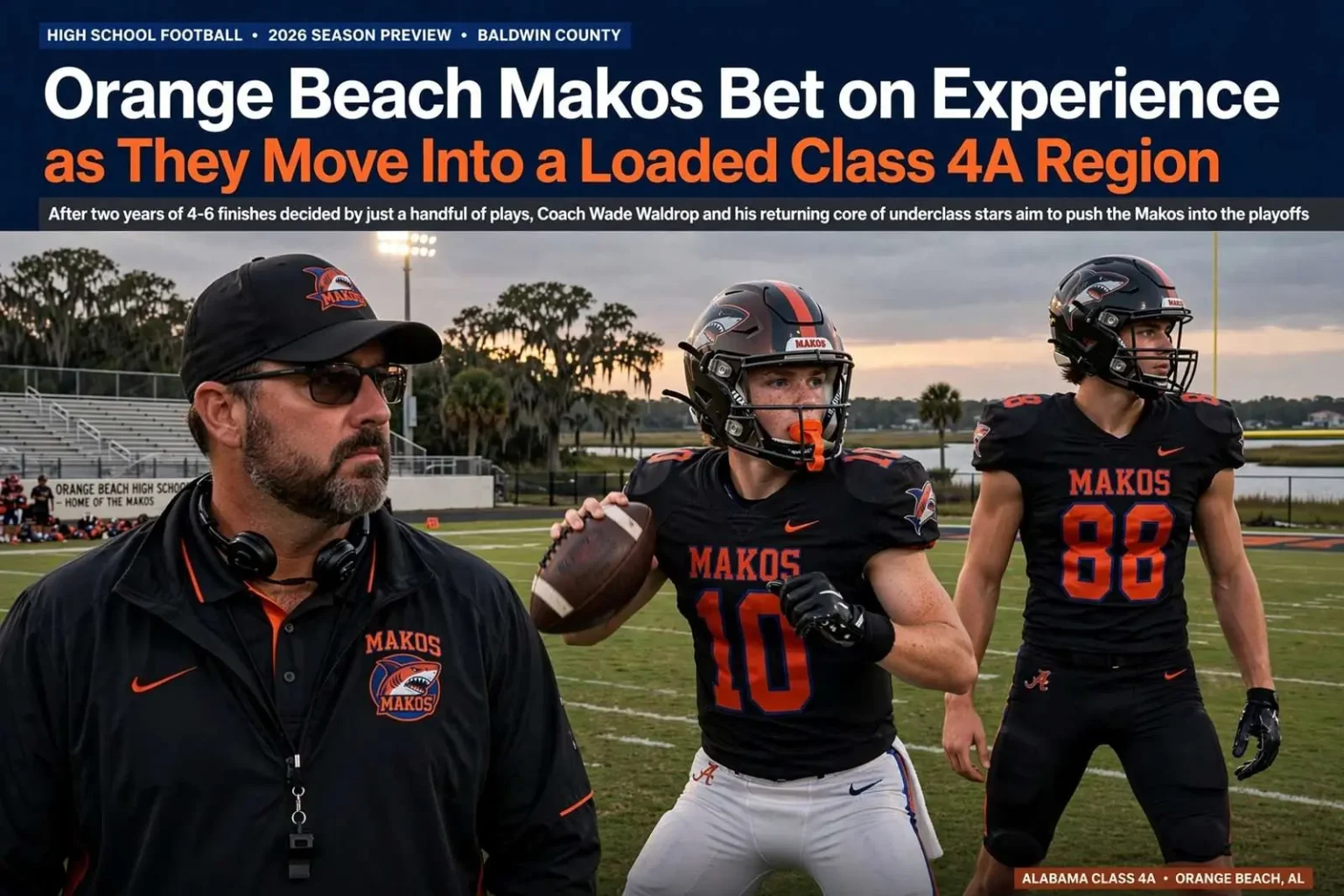
Wade Waldrop does not need a reminder of how close his Orange Beach Makos came in 2025. He offers the record himself: 4-6.
Then he offers the caveat. Two of those losses — to Robertsdale and Mobile Christian — came down to a handful of plays. Flip them, and Orange Beach is a playoff team.
“We were a couple of plays away from flipping that thing around and being on the other side and being in the playoffs,” Waldrop said. “Really two years in a row we’ve been a play or two away from being in the playoffs. It’s really time to take another step.”
The arithmetic of Alabama high school football makes his point plainly. Under the Alabama High School Athletic Association’s format, region standings — not overall records — determine who reaches the postseason, and a single region loss can decide an entire autumn. In a classification where four or five teams routinely cluster within a game of one another, the margin between a 4-6 season spent at home in November and a playoff berth can be one failed two-point conversion, one dropped interception, one clock-management decision in the fourth quarter. Waldrop’s Makos have lived on the wrong side of that margin two years running, and the head coach’s message heading into 2026 is that the program has stopped being an expansion afterthought and started being a contender whose breaks have to start falling its way.
Orange Beach High School is still one of the newest football programs on the Alabama Gulf Coast, a product of the explosive growth along the beaches and Ono Island that pushed the city to build its own school rather than continue sending students east toward Gulf Shores. Programs born that way do not inherit generations of tradition or a deep bench of veteran players; they inherit whoever lives in the city limits, which on the coast can mean rosters that shrink and swell with each graduating class. What the Makos have done instead is develop — slowly, and with growing success — the kind of individual talent that lets a young program punch above its numbers.
Two Recruited Underclassmen Lead the Way
The Makos return two players who are already drawing serious attention from college programs, and neither is close to graduating.
Tucker Wade, a left-handed sophomore quarterback, will not finish high school until 2029 — and already holds scholarship offers.
A growth spurt has taken him from 5-foot-10 as a freshman to pushing 6 feet entering 2026.
“Going from being a freshman your first year, varsity experience, to coming into your second year, he’s being asked to do a little bit more than he was a year ago,” Waldrop said. “He’s handled it well so far, he’s gotten stronger and matured a bit.”
Left-handed quarterbacks are rare enough at any level of football that recruiters notice them immediately, and a lefty who is still growing into his frame draws a second look. Quarterbacks who add height and strength between their freshman and junior years — the window Wade is entering — often transform from promising athletes into genuine college prospects, because the tools recruiters grade most heavily, arm strength and field vision, tend to arrive with physical maturity. Waldrop’s willingness to hand a varsity offense to a freshman and then expand his responsibilities as a sophomore is itself a signal: programs that protect young quarterbacks behind veteran lines can accelerate their development, and the Makos’ returning experience on both lines is exactly the environment in which that development pays off.
Lee Steele, a 6-foot-6 junior tight end and defensive end who graduates in 2028, has offers from five SEC schools including Alabama and Auburn, and is rated a three-star football prospect.
Both Alabama and Auburn have also expressed interest in his basketball ability.
A two-sport lineman of Steele’s size occupies rare territory in Alabama recruiting. The SEC’s Alabama and Auburn programs evaluate in-state talent with particular intensity, and a 6-foot-6 junior drawing five SEC offers before his senior season puts Steele among the most heavily pursued prospects on the Gulf Coast. Tight ends with defensive-end versatility are prized because modern college offenses ask the position to block like an extra tackle and run routes like a receiver, while the same length and athleticism translate directly to rushing the passer on defense. The basketball interest from the state’s two flagship programs underscores the athleticism underneath the measurements — footwork, hands and coordination that show up on a court as clearly as on a Friday night.
“Those are two players we are looking for leadership from,” Waldrop said.
That is a heavier demand than it sounds in a young program. In established schools, leadership passes down through senior classes that have waited their turn; at Orange Beach, the players with the most recruiting attention are also the ones being asked to set the standard in the weight room, in film study and in the way the team practices. Waldrop’s bet is that the underclassmen who have already earned college interest are the ones most capable of pulling a young roster across the line that has twice kept the Makos out of the playoffs.
Experience Across Both Lines
Star power aside, Waldrop keeps returning to the same theme: the Makos bring back roughly six starters on each side of the ball, and that experience is the real reason for optimism.
Linebackers: Seniors Turner Tillman and Luke Reed anchor the defense.
Secondary: Junior cornerback Michael Ashley returns after starting the past two seasons.
Sam Creel, a senior safety who transferred from Elberta and holds several collegiate offers, gives the back end of the defense another experienced piece.
Linebacker play is the fulcrum of defense in Class 4A, where spread offenses put athletic runners in space and force the second level to tackle in the open field. A senior pairing like Tillman and Reed — two players who have absorbed two years of varsity snaps together — is the kind of foundation young programs usually lack, and their communication responsibilities extend well beyond their own positions: linebackers call fronts, adjust to formations and settle the defensive line before the snap. Behind them, a cornerback with two seasons of starting experience and a safety with collegiate offers give the Makos coverage pieces that can hold up against the passing games they will meet in region play.
The experience extends to the trenches, where continuity matters more than anywhere else on a roster. Offensive lines are built on repetitions together — five players learning each other’s timing, calls and tendencies across hundreds of practice snaps — and returning starters on both lines are the most reliable predictor of whether a team’s quarterback has time to grow. For a sophomore signal-caller like Wade, protection is not a luxury; it is the difference between a second-year starter developing confidence and a young quarterback learning to hurry. Waldrop’s roster math, six starters per side, means the Makos will field a unit whose parts have played together before — something neither of the previous two Orange Beach teams could fully claim.
The Region Ahead
What makes 2026 unforgiving is the company Orange Beach keeps. Class 4A in south Alabama stacks some of the state’s most competitive programs into the same region, and the non-region slate adds opponents like Mobile Christian, whose own ambitions make every cross-classification meeting a measuring stick. Robertsdale, the Baldwin County school that edged the Makos in 2025, sits in the same crowded corner of the county where growth has lifted enrollment and rosters at nearly every school from Spanish Fort to Foley.
The region format punishes the middle of the pack. Teams that finish in the top four of their region advance to the AHSAA playoffs; those below do not, regardless of overall record. In a region where several programs hover around .500, the standings routinely come down to the final week — which is why Waldrop frames his team’s recent history not as rebuilding but as a series of near-misses. The Makos have not lacked effort or talent; they have lacked the two or three plays that separate the fourth qualifier from the fifth.
Coastal programs also carry challenges their inland neighbors do not. Orange Beach’s roster is drawn from a small municipal population that swells seasonally with tourism but produces a fixed number of student-athletes; injuries to a handful of starters can reshape a season in a way they might not at a larger Baldwin County school. Depth is the quiet constraint behind every optimistic preseason projection on the beaches, and it is the reason Waldrop emphasizes development in his underclassmen as much as production from his seniors.
The Step That Matters
Two years of near-misses have given the Makos a roster full of players who know precisely how thin the margin is. A quarterback growing into his body, a two-sport lineman with SEC offers, two senior linebackers, a tested cornerback and a collegiate-caliber safety transfer form the core of a team whose experience now matches its ambition. The task in front of them is not a transformation but an increment — the handful of plays Waldrop keeps describing, executed this time on the right side of the scoreboard. For a program built within the last decade on Alabama’s fast-growing coastline, that step would be the first real arrival: not almost a playoff team, but one.