University of South Alabama Mobile
Four Immigrant Entrepreneurs Who Built Lasting Businesses in Mobile
Ahead of the Fourth of July, four Mobile business owners born in Iran, Ethiopia, Taiwan and Peru share their American Dream stories.
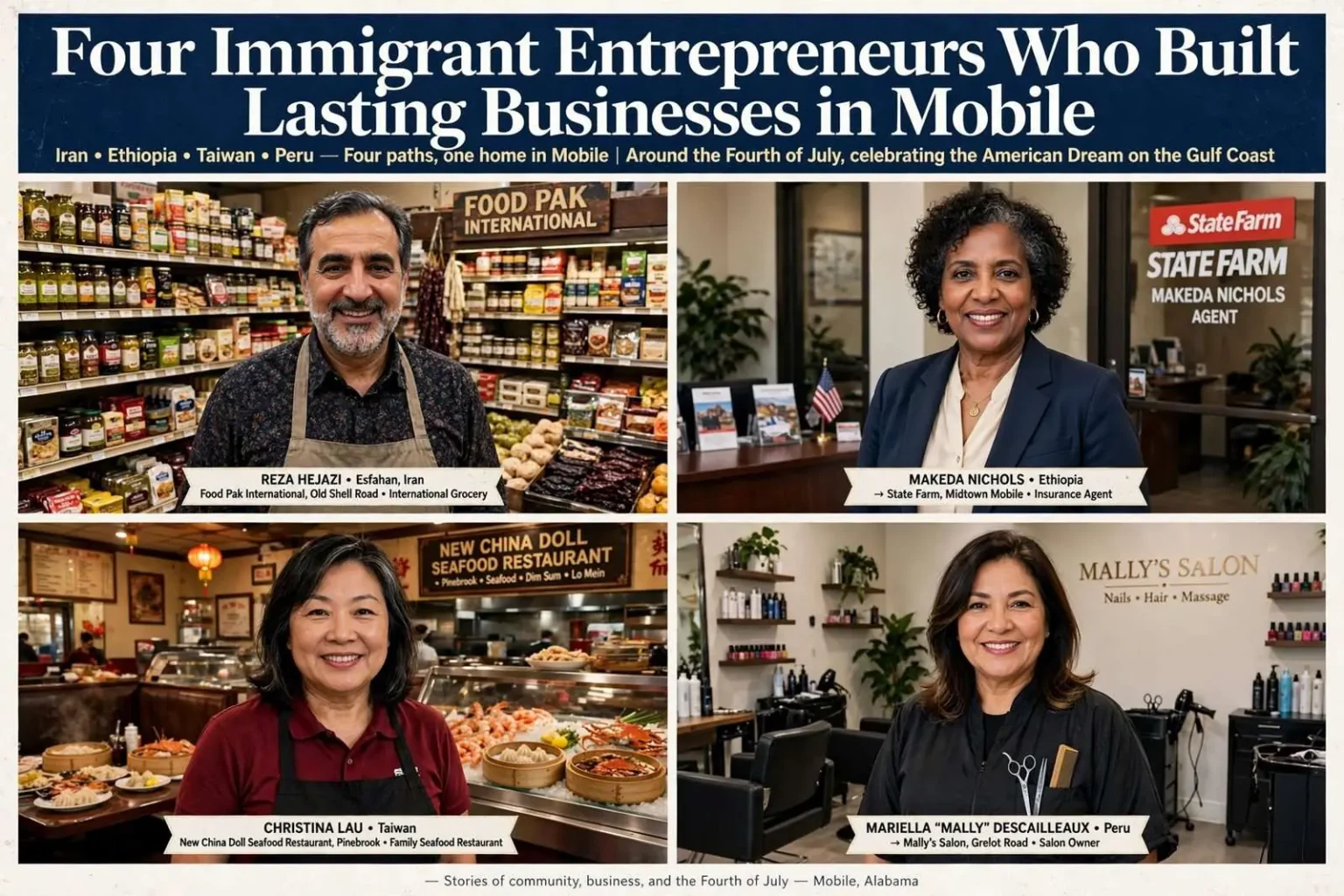
Around the Fourth of July, immigrants who became American citizens often feel the holiday especially deeply, celebrating not just fireworks and cookouts but the freedom and opportunity that drew them to this country. In Mobile, that story has played out again and again through business owners who built lasting enterprises far from their native homelands. Their storefronts — a grocery on Old Shell Road, an insurance office in Midtown, a family seafood restaurant and a salon in West Mobile — are as much a part of the city’s economy as any of its larger institutions, and their founders’ paths to Mobile stretch from Iran, Ethiopia, Taiwan and Peru.
From Iran to an International Grocery
Reza Hejazi grew up working in his father’s bakery and market in Esfahan, Iran, starting at age six, before leaving in 1974 to attend the University of Florida. After marrying his wife, Nahin, and transferring to the University of South Alabama to finish a civil engineering degree, the couple decided to make Mobile home. The plan, like those of many international students who land on the Gulf Coast, was education first — but the city had a way of turning temporary residents into permanent ones.
Unable to find engineering work, Reza worked in a hotel food and beverage department and ran a used car lot before opening Food Pak International in a long-vacant convenience store space on Old Shell Road in 1991, believed to be Mobile’s first international grocery store. The store arrived at a moment when the city’s international community — students, port workers, physicians recruited to USA’s hospitals and families relocated by industry — had grown large enough to support a market stocked with ingredients no supermarket aisle carried.
More than two decades later, the shop is known both for hard-to-find imported ingredients and for sandwiches ranging from Italian muffulettas to Greek gyros. Generations of Mobilians have walked past the same shelves for olive oils, spices, cheeses and staples from half a dozen cuisines, and the lunch counter has made the store a destination in its own right for workers and families along the Old Shell Road corridor.
Nahin built her own business too, opening a beauty salon on Airport Boulevard in the 1980s that eventually became a commercial rental company. Their sons have carried the business into a third generation, with one running the store full time today. “I truly believe in the American Dream,” Reza said. “If you’re committed and passionate about your work, you can make it.”
The Hejazi family’s trajectory mirrors the pattern sociologists of immigration have documented for generations: the first generation takes whatever work is available, the family invests in a small business, and the second and third generations build on that foundation. In the Hejazis’ case, the father’s bakery in Esfahan and the son’s grocery in Mobile bookend a story that has repeated itself across a century of American immigration.
From Ethiopia to a State Farm Office
Makeda Nichols grew up in Ethiopia, the daughter of a doctor and a farmer, before studying chemistry in Germany, where she met and married an American soldier. The couple eventually settled in Florida, where she arrived with only a few dollars to her name and worked as a seamstress and lab technician, and Makeda’s fluent German helped her land a job with a Mobile chemical company after the marriage brought her to the Gulf Coast. Like many immigrants, she arrived in Mobile by a route no map would predict — through a language learned in Europe, a chemistry degree and a military marriage.
Drawn to entrepreneurship, she became a State Farm agent and has run her own office in Midtown Mobile for three decades, work she says lets her make a real difference for families the way insurance never could for her own family after her father’s death in Ethiopia decades ago. The memory of what it means to lose a provider without a safety net shapes how she approaches a business that, at its best, keeps a family whole through its worst year.
Her brother, restaurateur Chakli Diggs of NoJa in downtown Mobile, later joined her in the city as well, drawn in part by the need to help care for their mother. The siblings’ parallel businesses — an insurance office in Midtown and one of the city’s best-known downtown restaurants — have made the family a fixture in two different corners of Mobile’s commercial landscape, and their story has become a familiar one in a city whose professional class increasingly includes first-generation Americans.
From Taiwan to a Family Seafood Restaurant
Christina Lau came to Mobile from Taiwan to visit her older sister, who had left for the United States first and encouraged her to follow, and never really left, eventually marrying Michael Lau, a Hong Kong native. It is the kind of origin story that unfolds in American cities every year — a planned visit that becomes a life — and in the Laus’ case it produced one of Mobile’s longest-running family restaurants.
The couple opened China Doll on Dauphin Street in 1989 before relocating to Pinebrook Shopping Center as New China Doll Seafood Restaurant. The move west tracked Mobile’s own movement, as dining and retail shifted toward the growing corridors of West Mobile in the 1990s. There the restaurant built its reputation on the combination that defines a good Gulf Coast Chinese kitchen: seafood — local shrimp, crab and fish — prepared alongside the fried rice, lo mein and dim sum standards that families have come to expect from a decades-old menu.
After Michael’s death from cancer in 2012, Christina kept the restaurant running herself, greeting customers seven days a week with the help of a cook of 20 years and a son studying finance at the University of South Alabama who plans to join the family business. The daily presence of the owner has become part of the restaurant’s identity — regulars expect to find her at the front of the house, and the continuity of a kitchen staffed by the same cook for two decades is the kind of stability few independent restaurants manage.
The restaurant’s endurance speaks to the economics of family dining in Mobile. A single-location, family-operated restaurant competes against national chains on convenience but wins on consistency and familiarity, and the Laus’ decision to keep the business in the family — with a finance-trained son positioned to take over — offers the rare prospect of a Mobile restaurant crossing into its fourth decade under the same family name.
From Peru to a Salon Built From Scratch
Mariella “Mally” Descailleaux left Lima, Peru on a student visa in 1987, married Mobile lawyer Robert Rone within months, and eventually opened Nails by Mally on Grelot Road in 1989 using furniture from her own home. The startup was as lean as they come — a new arrival with a trade, a borrowed set of furnishings and a location on one of West Mobile’s busiest retail corridors.
The business, now called Mally’s Salon, has grown through five locations and now employs stylists and a massage therapist. What began as a one-operator nail shop has expanded into a full-service salon whose growth has tracked the development of the Grelot Road and Hillcrest Road area, where subdivision after subdivision filled in during the 1990s and 2000s and turned West Mobile into one of the metro area’s busiest retail markets.
“There have been a lot of struggles, a lot of hard work,” she said, crediting her customers as her greatest reward. The salon business is built on exactly that: repeat customers who return every few weeks for years, sometimes decades, and who follow a trusted stylist across town when a location changes. A salon that survives multiple moves and keeps growing is one that has mastered the retention side of the trade.
Descailleaux’ path from a student visa to a multi-location salon also reflects the industry’s broader role as an entry point for immigrant entrepreneurs. Nail and beauty services require licensing but relatively little startup capital, letting new arrivals convert a skill into a business that can be expanded at the founder’s own pace — and, in Mally’s case, into an employer of other stylists and therapists building careers of their own.
The Common Thread
The four entrepreneurs came from four continents by four different routes — a student transfer, a military marriage, a family visit, a student visa — but their stories rhyme. Each arrived in Mobile without the local networks that make starting a business easier, and each built one anyway: a grocery that fed the city’s international kitchens, an insurance office that protects Midtown families, a seafood restaurant entering its third decade and a salon that grew from living-room furniture to five locations.
Their businesses also illustrate how immigrant-owned firms anchor neighborhoods. A grocery on Old Shell Road, a restaurant at Pinebrook, a salon on Grelot and an insurance office in Midtown are not downtown showpieces; they are the everyday commercial fabric of the corridors where Mobilians actually live. When such businesses close, the loss is measured in more than jobs — it is measured in the special-ingredient orders that no one else stocks and the lunch counter regulars who have nowhere else to gather. When they endure for decades, as all four of these have, they become landmarks in everything but name.
The timing of the stories around Independence Day is fitting. For citizens who naturalized as adults, the Fourth carries a weight that native-born Americans often do not feel — the memory of the process, the oath and the distance traveled. The entrepreneurs profiled here celebrated it the way many naturalized citizens do: as the anniversary of a choice rather than an accident of birth, and as the holiday that belongs most completely to those who chose the country deliberately.
Mobile’s own history gives the pattern deep roots. The city that grew up on cotton, timber and the shipping trade has always been a port of entry, with successive waves of newcomers — Lebanese merchants, Greek restaurateurs, Vietnamese shrimpers, Latin American families — opening businesses that became part of the local canon. The Hejazis, Nicholses, Laus and Descailleaux families are simply the latest chapters in a story the city has been writing since its founding.
What each of the four also shares is the insistence that the work itself was the point. Reza Hejazi speaks of commitment and passion; Makeda Nichols measures her success in families protected; Christina Lau opens her doors seven days a week; Mariella Descailleaux credits her customers as her greatest reward. None describe luck as the deciding factor — and that, more than any single business achievement, may be the most American thing about them.
For young entrepreneurs in Mobile’s growing international community, the four offer a practical template as much as an inspiration: learn the local market from the inside, as an employee before an owner; build on a skill or a cuisine the mainstream market is missing; keep the family in the business; and stay put long enough for the neighborhood to grow around you. The American Dream, as one of them put it, belongs to those who are committed — and in Mobile, that commitment has brick-and-mortar addresses on Old Shell Road, Dauphin Street, Grelot Road and Midtown’s streets.