A Familiar Name Returns: Constantine’s Brings Lebanese Cuisine Back to Old Shell Road
Constantine's, a name long familiar to Mobile diners, returned to the local restaurant scene on Old Shell Road, serving authentic Lebanese fare that won early praise from a lifelong connoisseur.
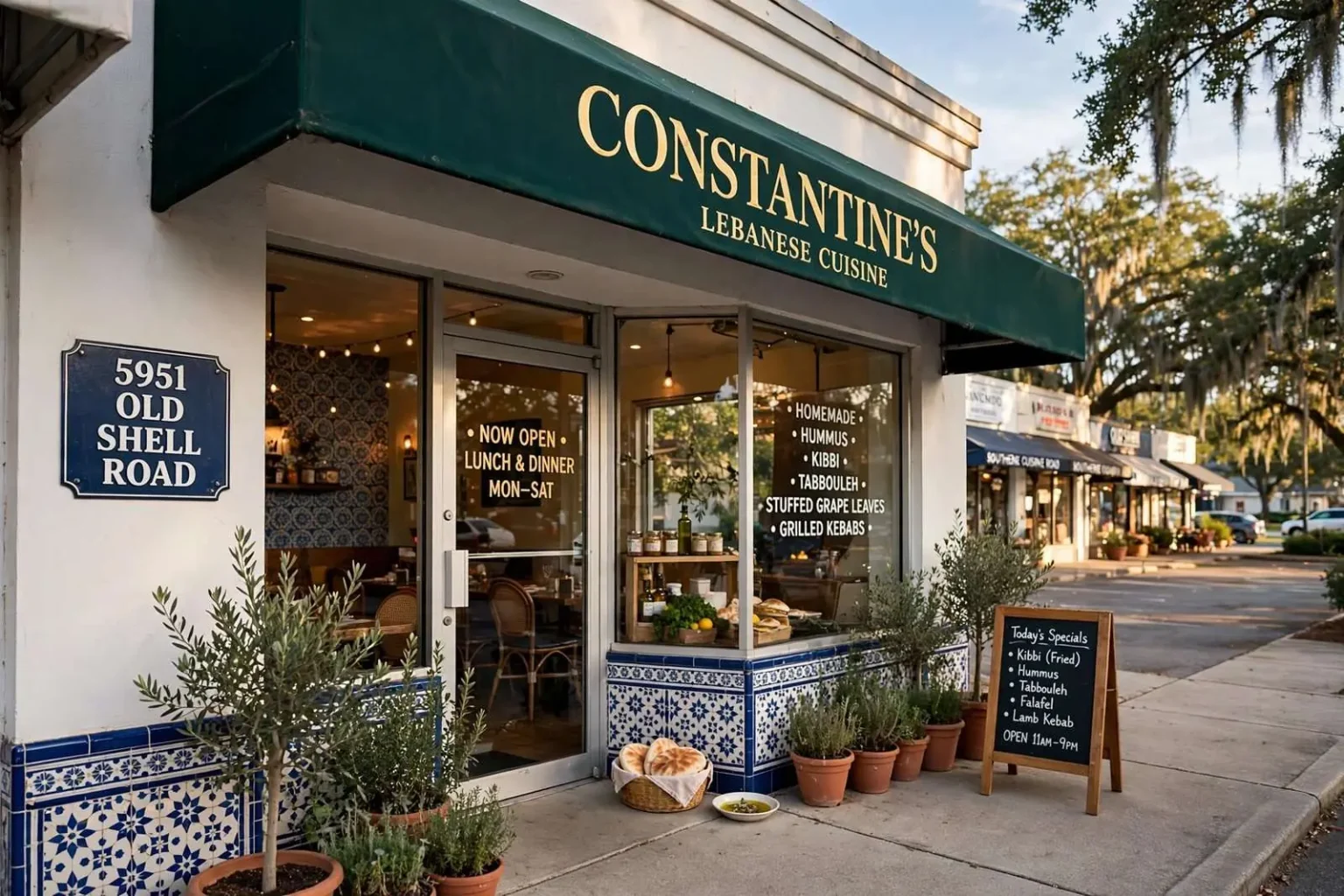
A name long familiar to Mobile gastronomes, Constantine’s, was again on the local restaurant scene, this time at 5951 Old Shell Road.
An old name, a new kitchen
Both the Constantine’s of yesteryear and the newer establishment, named after Kamal and Eginee Constantine and their family, specialized in authentic Lebanese cuisine. The restaurant opened for lunch and dinner Monday through Saturday, offering Mobile diners a return of a culinary tradition that had been part of the city’s dining memory for years.
The revival carried an echo of local restaurant history. Constantine Panayiotou, a Greek immigrant, had owned and operated the original Constantine’s, along with Gaslight Square, in Mobile years earlier. The reappearance of the name on a west Mobile storefront linked the new venture to that earlier chapter, even as the current family put its own stamp on the menu.
Lebanese cooking has deep roots in Mobile, carried here by immigrant families who settled in the port city in waves through the nineteenth and twentieth centuries. Alongside the city’s better-known Gulf seafood and Creole traditions, Middle Eastern kitchens have quietly held their place for generations — church festivals, family tables and a handful of restaurants keeping staples like kibbi and tabbouleh in circulation for diners who grew up on them and newcomers discovering them for the first time.
The Constantine family’s version of that tradition arrived in a stretch of Old Shell Road long known for its mix of local eateries, where independent restaurants have historically held their own against the chains that ring the city farther west. The address put the new kitchen within easy reach of the neighborhoods that fill Spring Hill, Skyland and the surrounding districts at lunchtime — the audience a family restaurant depends on for its daily rhythm.
Hours would matter as much as location. Six days of service, covering both the midday business crowd and the evening family trade, is the demanding schedule that defines independent restaurants, and the family’s decision to hold it signaled an intent to compete for both meals rather than specialize in one.
A seal of approval
Few local palates carried more authority on such fare than that of Ed Kahalley Sr., and at 85 he reported that the new Constantine’s passed muster.
“I have eaten Lebanese food all my life and I can attest to the fact that it is wonderful and the best Mediterranean style food you can find anywhere,” Kahalley said. He had a specific recommendation for newcomers. “Be sure and try the Kibbi,” he advised. “It’s better than steak, but costs a lot less. Take my word for it.”
The endorsement, from someone who had spent a lifetime tasting the cuisine, offered exactly the kind of word-of-mouth that can help a new restaurant find its footing. In a city the size of Mobile, where dining reputations are built one table at a time and a respected regular’s advice travels through churches, clubs and offices, an early verdict like Kahalley’s is worth more than advertising.
Kibbi, the dish he singled out, is the classic measure of a Lebanese kitchen. The national dish is built from bulgur wheat and finely ground meat, pounded together with onion and spices into a paste that can be served raw, fried into croquettes, or layered in a baking dish with pine nuts — each form demanding a light hand and fresh ingredients to succeed. A kitchen that gets kibbi right has, by the standards of anyone raised on the cuisine, demonstrated the fundamentals.
Kahalley’s comparison to steak was not idle praise. Lebanese cooking has always offered an economical alternative to the meat-centered American table: small portions of grilled meat stretched across a spread of grains, vegetables, olive oil and herbs. A table at a Lebanese restaurant is built for sharing and abundance at modest cost, which is exactly the pitch an 85-year-old connoisseur was making to diners who had never tried the cuisine at all.
What the menu holds
Lebanese menus traditionally build on dishes such as kibbi, tabbouleh, hummus, stuffed grape leaves and grilled kebabs, preparations that reward fresh ingredients and careful seasoning. It was against that standard that Kahalley measured the new kitchen, and his verdict that it ranked with the best Mediterranean food anywhere carried weight precisely because it came from a diner who had spent a lifetime comparing one plate to the next.
The staples reward patience in ways that fast-casual imitations rarely match. Tabbouleh is mostly parsley by tradition, not bulgur, chopped fine and dressed with lemon and olive oil. Hummus depends on the texture of properly worked chickpeas and the quality of the tahini. Stuffed grape leaves are labor-intensive by definition — each leaf rolled by hand — which is why they remain a marker of a kitchen willing to put in the work. These are dishes that family restaurants do well precisely because the recipes are inherited rather than engineered.
A neighborhood addition
For the Old Shell Road corridor, the arrival added another independent, family-run option to a stretch of west Mobile dining. Lebanese cooking, with its emphasis on fresh ingredients, grains, herbs and grilled and stuffed preparations, gave the restaurant a distinct identity among the area’s offerings, and the Constantine name gave it instant recognition among longtime residents who remembered the earlier establishments.
That recognition is the quiet asset every reopening trades on, and the trickiest one to manage. Diners who remember the original Constantine’s arrive with expectations formed decades ago; younger customers arrive knowing only that the name sounds familiar. A family kitchen has to honor the memory without being imprisoned by it — keeping the traditions that made the name matter while cooking for the palates and schedules of the present.
The Panayiotou connection gave the name its own layered history. A Greek immigrant building a restaurant career in Mobile, operating rooms like Gaslight Square that became part of the city’s social geography, wrote a chapter of local dining history that the new Constantine’s now inherits in name. Mobile’s restaurant lineage has always been threaded with immigrant enterprise — Greek, Lebanese, Italian and Vietnamese kitchens among them — and the revival of a name is one of the ways that lineage stays visible.
The reopening reflected a familiar pattern in Mobile’s dining culture, where cherished names and family recipes resurface across generations, often in new locations and under new stewardship. By reviving Constantine’s, the family reconnected diners with a tradition of Mediterranean hospitality that had roots in the city’s past while introducing it to a new generation of patrons.
With midday and evening service six days a week and an early endorsement from one of the city’s most seasoned admirers of Lebanese food, the new Constantine’s set out to earn its place on the Mobile restaurant map, one plate of kibbi at a time.
The economics of running such a kitchen are the story behind every family restaurant that lasts. Independent eateries live or die on repeat customers — the office lunch crowd that comes weekly, the families that make Friday night a habit — and a Lebanese menu is well suited to building that loyalty, with combination plates and mezze spreads that give regulars variety without straining the kitchen’s preparation schedule. The Monday-through-Saturday hours the Constantines committed to are the standard grind of the independent trade, where there is no corporate office to absorb a slow week.
Old Shell Road itself has long been one of the city’s proving grounds for exactly this kind of restaurant. The corridor runs west from the edge of Spring Hill through mile after mile of established neighborhoods, and the strip centers that dot it have housed delis, barbecue joints, sandwich shops and family dinner houses for generations. A restaurant that wins a following there tends to keep it, because the customers live minutes away rather than arriving on the strength of a single destination visit.
For diners new to Lebanese food, the entry points are gentle. Hummus with warm pita, tabbouleh and stuffed grape leaves make a starter course that suits almost any palate, and grilled kebabs offer the familiar comfort of meat over fire for anyone hesitant about the rest of the menu. From there, the kibbi Kahalley recommended — and the lentils, stews and vegetable dishes that round out a traditional table — provide the deeper exploration that turns first visits into habits.
The family’s naming choice did more than borrow goodwill. It staked the new kitchen to the proposition that the old name still meant something in Mobile — that the quality of the cooking could carry the reputation forward another generation, the way family restaurants in this city always have. Whether the second Constantine’s earns the same affection the first enjoyed is now in the hands of the daily diners of west Mobile, who, by one 85-year-old’s early testimony, have every reason to take his word for it.