Kids Will Hunt for Hidden Treasure Aboard the USS Alabama This Saturday as Mobile Parks and Rec Teaches Navigation Through Geocaching
Mobile Parks and Recreation's Junior Geocaching Hunt brings kids ages 5-13 to Battleship Memorial Park this Saturday for a free, map-and-clue treasure hunt built around basic navigation skills.
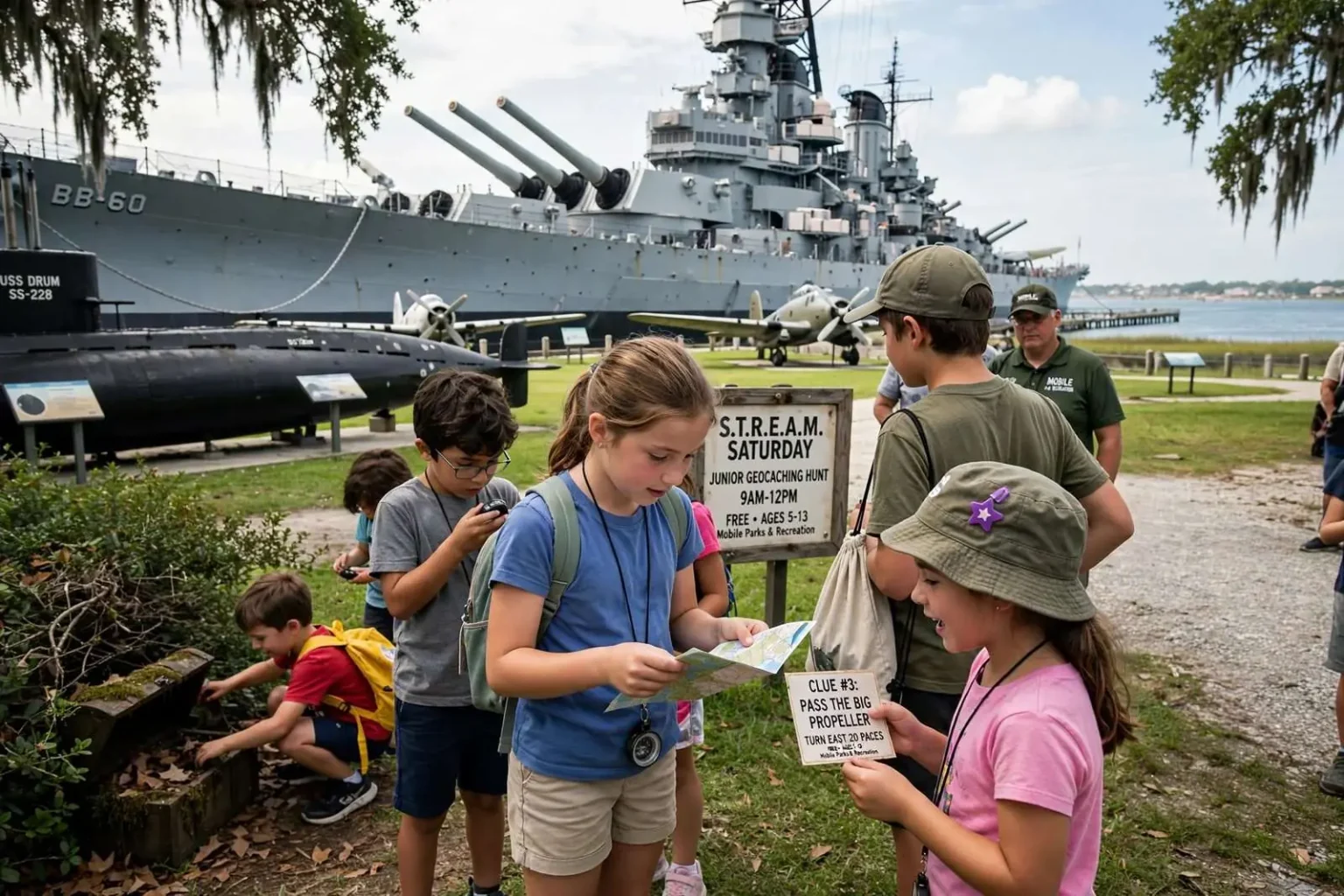
Mobile’s Parks and Recreation Department is sending kids on a treasure hunt around one of the city’s most recognizable landmarks this weekend, using hidden clues and maps to teach navigation skills at Battleship Memorial Park.
The Junior Geocaching Hunt, the latest installment of the department’s S.T.R.E.A.M. Saturday series, runs this Saturday from 9 a.m. to 12 p.m. at the U.S.S. Alabama Battleship Memorial Park. The event is free and open to children ages 5 to 13.
The setting gives the hunt a backdrop few classrooms can match. Battleship Memorial Park sits on the shore of Mobile Bay along the Causeway, where the USS Alabama — the South Dakota-class battleship that earned nine battle stars in the Pacific during World War II — has been moored since 1965 as the centerpiece of one of the country’s most visited military parks. Kids participating in the hunt will move across park grounds that also hold the submarine USS Drum, a collection of historic aircraft and military vehicles, all within sight of the bay’s waters.
Participants will search the grounds around the historic battleship using clues and maps rather than GPS coordinates alone, requiring problem-solving and teamwork as they track down hidden markers. Organizers say the format is designed to sneak basic navigation and orienteering lessons into what otherwise feels like a treasure hunt.
That deliberate blend of old-school and new-school navigation is the point of the exercise. Geocaching in its modern form sends hunters to precise coordinates using smartphones and GPS receivers, but the Parks and Recreation version starts one step earlier — teaching children to read a map, follow a compass bearing and interpret written clues before any screen gets involved. For a generation raised on turn-by-turn directions, working out a location from a paper map and a set of hints is a genuine skill-building exercise, and doing it in teams forces the kind of collaboration and communication that parents and educators prize.
Learning Disguised as Adventure
The S.T.R.E.A.M. Saturday series — an acronym for science, technology, reading, engineering, arts and math — has become a recurring feature of Mobile’s youth programming, rotating through different hands-on themes each month at parks and public spaces around the city. This installment leans on the battleship’s sprawling grounds as a built-in obstacle course for young explorers.
The S.T.R.E.A.M. framework extends the better-known STEM acronym by folding in reading and the arts, reflecting a philosophy that has spread through youth education in recent years: that creativity and communication belong alongside math and engineering in any well-rounded learning experience. Mobile’s Parks and Recreation Department has used the format to build a monthly rhythm of free programming that reaches families who might not have access to paid enrichment activities — one of the practical arguments for hosting events like Saturday’s hunt in public parks rather than private venues.
Past and future installments of the series rotate through themes as varied as simple engineering projects, nature science and creative arts, and the department has leaned on Mobile’s public spaces to give each event a distinct character. The battleship hunt may be the most visually striking setting in the rotation, but the underlying model is the same each month: show up, get hands-on, and learn something without it feeling like school on a Saturday morning.
Geocaching: A Worldwide Game With Local Roots
Geocaching itself began at the turn of the millennium, when the accurate civilian GPS signals made it possible to hide a container in the woods, publish its coordinates online, and challenge strangers to find it. The hobby grew into a worldwide network of millions of caches, but its simplest form — following clues to a hidden box — is essentially the classic scavenger hunt, which is exactly what makes it a natural fit for a children’s program. The junior version run by Mobile’s Parks and Recreation department strips the game down to its essentials and adds an educational layer: maps, spatial reasoning, teamwork and careful observation.
Educators have embraced the format for the same reasons. A cache hunt exercises math skills through distances and bearings, reading comprehension through written clues, engineering thinking through how and where to hide a container, and even the arts when children decorate or personalize their finds. Watching a five-year-old and a twelve-year-old negotiate over which direction to search first is the kind of soft-skill learning that is difficult to engineer in a classroom but happens naturally on a treasure hunt.
The battleship setting adds history to the mix without a formal lesson. Children who come for the hunt walk the grounds of a park that memorializes the service of Alabama’s World War II veterans, beneath the guns of a ship that carried thousands of sailors through the Pacific campaign. Parents often find that a morning built around a game turns into questions about the ship, the submarine Drum and the aircraft nearby — a spontaneous history lesson delivered on the child’s own curiosity.
The Details for Families
Families interested in attending do not need to register in advance; organizers say children can simply arrive at the park gates during the event window to join in. The event is free, though standard Battleship Memorial Park admission policies may apply for accompanying adults who want to tour the ship itself.
That drop-in format is deliberate. Free events with no registration requirement remove the barriers that keep working families away from enrichment programming — no sign-up deadline, no fee, no commitment if a Saturday morning fills up with errands. Parents can bring children within the five-to-thirteen age range, join the hunt, and decide on the spot whether to make a day of it at the park.
Organizers recommend comfortable shoes, sun protection and a water bottle, as the hunt sends kids walking across the park grounds for much of the three-hour window. Adults should plan to stay on site with their children, as with any Parks and Recreation youth event, and the morning timing keeps the activity ahead of the Gulf Coast summer heat that builds through midday along the bay.
For families looking for more, the department’s youth programming calendar continues through the year, with S.T.R.E.A.M. Saturday events scheduled monthly across the city’s parks and partner venues. Information about upcoming installments is available through Mobile’s Parks and Recreation Department, which encourages families to check back as each month’s theme is announced.
Why It Matters
Programs like the Junior Geocaching Hunt occupy a small but meaningful place in the city’s larger effort to keep children learning outside school hours. Municipal parks departments across Alabama have expanded their educational programming in recent years, recognizing that summer and weekend enrichment — particularly free programming — can narrow opportunity gaps for children who lack access to camps and paid activities.
A Saturday spent reading a map beneath the guns of the USS Alabama will not feel like a lesson to the children doing the hunting. That is exactly the point — and for Mobile’s Parks and Recreation Department, it is the whole strategy: hide the learning in the treasure, and let the hunt do the teaching.
Exploring the Park Beyond the Hunt
Because the hunt unfolds across the park’s grounds rather than inside the ship itself, families who want the full experience can plan for a longer visit. Battleship Memorial Park is among Alabama’s most-visited attractions, drawing school groups, veterans’ reunions and tourists from across the region, and a single admission covers the battleship’s decks, the submarine Drum and the aircraft pavilion where historic planes hang within arm’s reach of visitors.
The park’s location along the Mobile Bay Causeway also places it in the middle of one of the coast’s richest natural settings. The waters around the park hold fish, pelicans and the occasional dolphin, and the Causeway corridor is a well-known route for sightseers traveling between Mobile and the Eastern Shore. Families making a morning of the hunt often finish with lunch at one of the Causeway’s longstanding waterfront restaurants, extending a free morning of navigation games into a full day on the bay.
For children who catch the navigation bug on Saturday, the transition to real geocaching is easy. The worldwide game runs on free apps and simple coordinates, and Mobile’s parks, green spaces and waterfront trails hold dozens of public caches that families can hunt together year-round — a hobby that costs nothing and turns every errand into a potential detour for a hidden treasure.
The department’s approach also highlights the value of partnerships between city programming and the community institutions that host them. By rotating events through venues like Battleship Memorial Park, Mobile’s Parks and Recreation Department connects families with attractions they might not otherwise visit, while the venues gain a morning of young visitors discovering their grounds for the first time. It is a model other Gulf Coast municipalities have watched with interest as they build out their own youth programming calendars.