Battleship Memorial Park makes progress on USS Alabama renovations
Crews are replacing steel plate on the upper decks of the USS Alabama at Battleship Memorial Park in Mobile, with a steel donation from SSAB Steel.
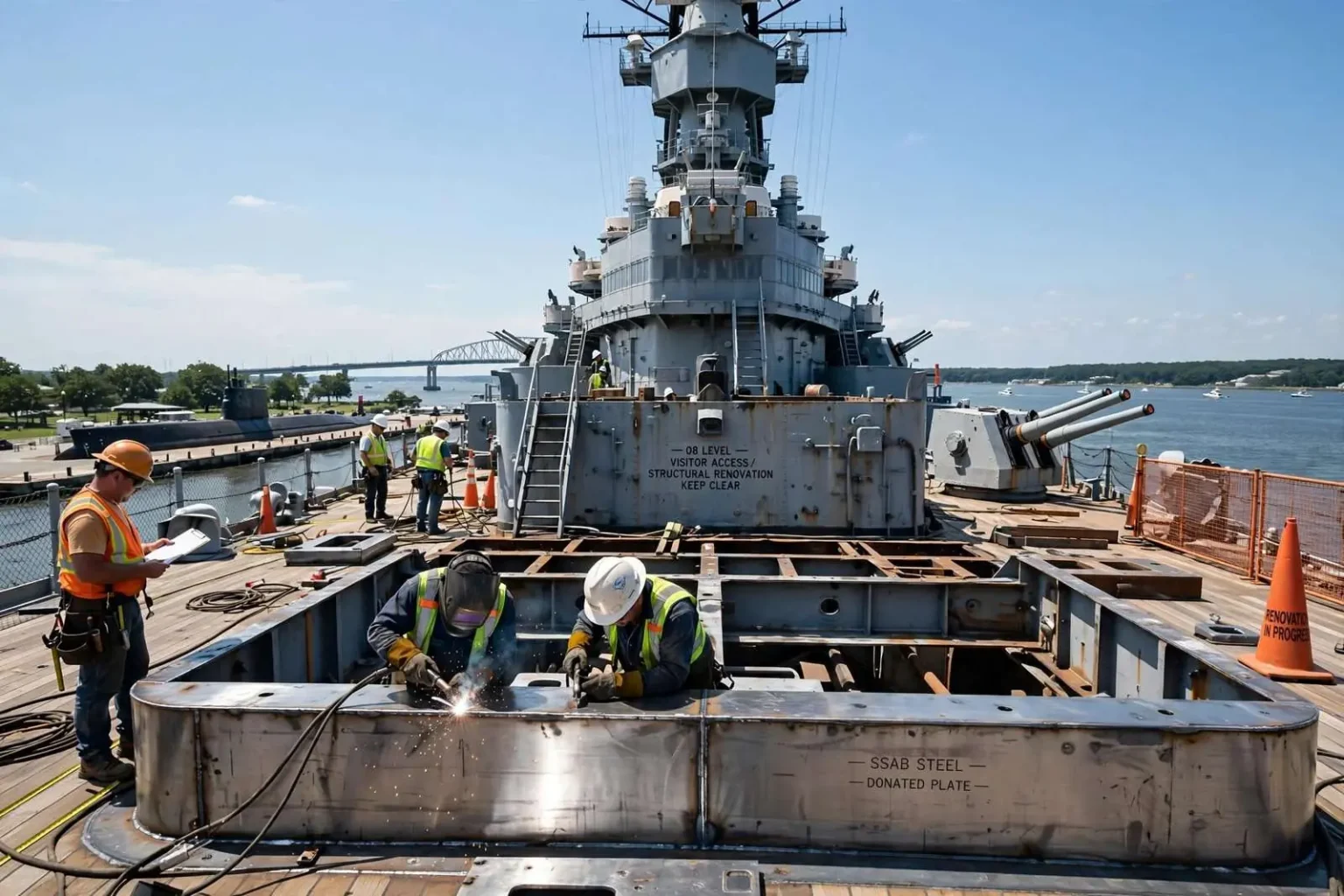
Battleship Memorial Park in Mobile is making steady progress this summer on a round of renovations to the USS Alabama, the World War II battleship that has anchored the park on the west side of Mobile Bay for decades. The work began in late spring on the upper levels of the ship, an area that ranks among the most popular stops for the many visitors who tour the vessel each year, and crews have continued the effort through the warm months when attendance at the park is at its highest.
The focus of the current project is the superstructure above the main deck, where guests can climb ladders to the 08 and 09 decks for sweeping views of the park, the causeway and Mobile Bay itself. Because those levels sit high above the water line and are exposed year-round to sun, salt air and heavy foot traffic, they require periodic inspection and repair to remain safe and open to the public.
Crews working on the project inspected the steel in those upper areas and found sections of plate that needed to be replaced, according to Janet Cobb, executive director of Battleship Memorial Park. Rather than simply covering over degraded metal, workers are cutting out the worn sections and laying new plate down across the upper decks, a labor-intensive process that addresses the underlying condition of the ship rather than its appearance.
A donation of steel plate from SSAB Steel made the repair work possible. Material costs are among the largest obstacles facing any battleship restoration effort, and the donation allowed the park’s maintenance teams to move forward with replacement work that might otherwise have been phased in slowly across multiple budget cycles. For a self-supporting historic attraction, in-kind contributions of this kind can be the difference between a stalled project and visible progress.
The new plate is being laid down on the upper decks as part of the ongoing upkeep of one of Mobile’s best-known landmarks. Park leadership has long described maintenance of the ship as a constant, year-round responsibility, with paint, steel, electrical systems, drainage and safety features all requiring attention as the vessel ages and tens of thousands of guests climb through its spaces every year.
A World War II veteran with deep roots in Mobile
The USS Alabama, hull number BB-60, is a South Dakota-class battleship that was commissioned in 1942 and went on to serve in both the Atlantic and Pacific theaters during World War II. The ship protected convoys, bombarded enemy positions ahead of amphibious landings and supported carrier operations, and it earned nine battle stars for its wartime service before the guns fell silent in 1945.
After the war, the Alabama was decommissioned in 1947 and spent years in the Navy’s reserve fleet before Alabama took steps to save it from the scrapyard. Schoolchildren across the state famously collected pennies and spare change to help fund the effort, and the ship was towed to Mobile Bay, where it opened in 1965 as the centerpiece of Battleship Memorial Park along the Mobile Bay Causeway.
Today the battleship shares the park with the World War II submarine USS Drum, a collection of historic aircraft, tanks and artillery pieces, and memorials honoring Alabamians who served in every branch of the military in conflicts from World War II to the present. The park operates as a nonprofit organization, which makes admissions, memberships and donated materials like the SSAB steel central to its ability to keep the ships maintained and open.
Why steel replacement matters on an aging warship
Steel on a decommissioned warship does not stop deteriorating simply because the ship is no longer at sea. The same salt-laden Gulf Coast air that draws tourists to the Mobile Bay shoreline works steadily on every exposed surface of the vessel, and moisture that collects inside compartments, behind plating and along deck edges accelerates corrosion in ways that are not always visible from the outside.
That is why the park treats the current work as inspection first and repair second. Crews examined the steel structure of the upper decks deck by deck, identified the sections where plate had thinned or corroded beyond safe service, and marked them for replacement. The approach is consistent with standard historic ship preservation practice, which favors cutting out compromised material and welding in new plate over cosmetic fixes that would only postpone the underlying problem.
The 08 and 09 decks are among the highest levels visitors can reach on the ship, and they are also among the most exposed. Guests who make the climb are rewarded with views across the park grounds, the USS Drum, the aircraft pavilion and the open water of Mobile Bay, but the price of that exposure is constant weathering of railings, ladders, decking and structural supports in those spaces.
Replacing deck plate on a battleship is not a quick job. Each section must be measured, cut, fitted and welded, and the work has to be sequenced so the ship can remain open to visitors as much as possible during the busy summer season. Keeping the 08 and 09 decks safe for guests is a priority because the view from those levels is one of the signature experiences of a visit to the park.
The donation of steel plate from SSAB Steel addresses one of the most persistent challenges in battleship preservation. Marine-grade and structural steel is expensive, and historic ships of this size require it in quantity. When a manufacturer supplies the material, more of the park’s operating budget can go toward skilled labor, tools and the dozens of other maintenance projects that compete for attention across the battleship, the submarine and the park grounds.
The work also reflects a broader truth about ships like the Alabama: preservation is never finished. A vessel that carried thousands of sailors through a world war and has now spent decades as a museum requires continuous care, and each repair cycle builds on the last. Officials have framed the upper deck project as one part of a long-term upkeep program intended to keep the ship sound for future generations of Alabamians and visitors.
Preservation as a year-round mission
Battleship Memorial Park functions simultaneously as a tourist attraction, a classroom and a memorial, and each of those roles places demands on the physical plant. School groups walk the decks on field trips, veterans return to reflect at the memorials, families climb through gun turrets and crew spaces, and community events use the park’s grounds throughout the year. Every one of those activities depends on the ships and facilities being safe, accessible and well maintained.
Summer is a particularly demanding stretch for the maintenance team. High visitation means more wear on ladders, handrails and deck surfaces, while Gulf Coast heat and afternoon thunderstorms accelerate the weathering that makes steel work necessary in the first place. Completing plate replacement during this season allows the park to stay ahead of deterioration rather than reacting to failures.
What the work means for visitors and for Mobile
For travelers crossing the Mobile Bay Causeway, the USS Alabama is often the first landmark that comes into view, its superstructure rising above the tree line on the west side of the bay. The park has drawn visitors to the area for decades, and it remains one of the region’s most recognizable destinations alongside the city’s historic districts, museums and waterfront attractions.
The upper decks play an outsized role in that experience. Many visitors consider the climb to the 08 and 09 levels the high point of a tour, both for the views and for the close-up look at the anti-aircraft mounts and ranging equipment that once defended the ship. Keeping those levels open, safe and structurally sound protects the most memorable part of the visit.
The renovations also carry weight beyond tourism. The Alabama serves as a memorial to the Alabamians who served aboard her and to the broader generation that fought in World War II, and the condition of the ship is a matter of respect as much as safety. Each plate laid down on the upper decks extends the life of a vessel that survived the war only to face a slower enemy in rust and time.
Community support has been central to the park’s survival from the beginning, from the schoolchildren’s coin drives that helped bring the ship to Mobile to the donors and volunteers who sustain it today. The SSAB Steel donation fits squarely in that tradition, pairing the region’s industrial base with one of its most treasured historic assets.
As the summer progresses, park staff will continue working through the repair list on the upper levels, with the goal of preserving full public access to the ship’s most scenic spaces. For the executive director and the maintenance crew, the measure of success is simple: a battleship that looks much as she always has to visitors, but beneath the paint is structurally stronger than she was in the spring, and ready to welcome the next generation of guests to Mobile Bay.