Mobile County Health Department Urges Flu Precautions as Cases Climb
Mobile County health officials reported hundreds of confirmed flu cases this winter and urged residents to take basic precautions to slow the spread.
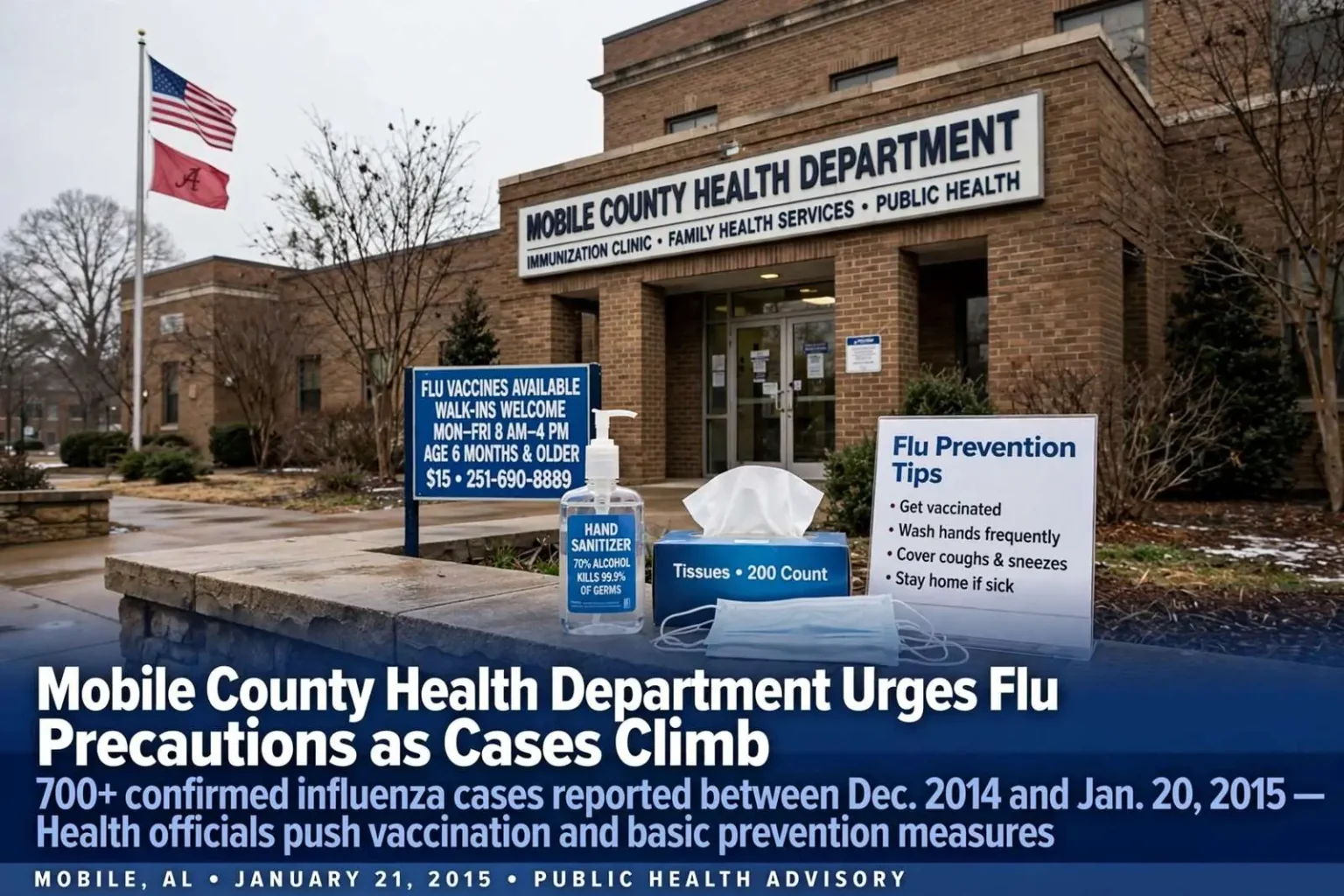
The Mobile County Health Department reported a sharp rise in confirmed influenza cases during the first weeks of 2015, prompting local health officials to renew their calls for residents to take basic precautions against the virus. The uptick arrived in the heart of a flu season that public health agencies had been warning about for months, and it pushed the department to remind the public that simple, everyday habits remain the first line of defense against an illness that spreads easily through homes, schools and workplaces.
Between the start of December 2014 and Jan. 20, 2015, the department logged more than 700 confirmed flu cases, a count based on positive test results reported from area hospitals and the department’s own family health clinics. Officials cautioned that the real number of infections in Mobile County is almost certainly higher, since influenza is not a disease that private doctors and urgent care clinics are required to report to public health authorities. The confirmed-case count therefore represents only a portion of the illness circulating in the community, capturing mainly the patients whose cases were lab-verified in settings that do report.
Dr. Bernard Eichold, the county’s health officer, said the flu remains a serious and sometimes deadly illness, and he encouraged residents who had not yet been vaccinated to do so. His message carried particular weight because of the position he holds: the health officer oversees public health operations for Alabama’s second-most-populous county, and his office serves as the community’s clearinghouse for information during disease outbreaks, hurricane seasons and other public health events.
Simple steps that slow the spread
Alongside the vaccination push, Eichold outlined a handful of simple steps residents can take to help prevent the virus from spreading. The guidance is familiar but officials stressed that it works only when practiced consistently: covering coughs and sneezes with a tissue or the crook of an arm, washing hands frequently with soap and water, using alcohol-based hand sanitizer when soap is not available, avoiding touching the eyes, nose and mouth, and staying home when sick. Each of those habits targets a specific way the influenza virus moves from person to person, whether through airborne droplets or through surfaces that infected hands have touched.
Health educators have long noted that the last recommendation is often the hardest to follow. Workers without paid sick leave and parents juggling school and child care schedules frequently go to work or send children to class while symptomatic, which is precisely when the virus is most contagious. Public health departments across the Gulf Coast repeat the stay-home message every winter in hopes of shortening the season’s peak, and the Mobile County department’s renewed appeal was aimed squarely at workplaces and classrooms where one sick individual can seed dozens of new infections.
The heightened precautions come as no surprise to anyone who follows the seasonal rhythm of influenza along the Gulf Coast. Health departments across South Alabama routinely see case counts climb in January, as colder weather pushes people indoors and into closer contact with one another. Holiday gatherings in late December add another accelerant, mixing households and generations before students return to school and workers return to shared offices, and the resulting wave of illness typically builds through the first weeks of the new year.
The 2014-15 season fit that pattern, and national health officials had been tracking an unusually active flu season that winter. Public health agencies across the country reported widespread influenza activity, and early-season surveillance suggested that the strains circulating were hitting harder than in recent years. Mobile County’s numbers reflected that broader trend, with the local case count climbing steadily through December and into January as the season gathered strength.
Vaccine still available without an appointment
To help meet demand, the Mobile County Health Department made the seasonal flu vaccine available without an appointment to anyone age 6 months and older. Walk-in shots were offered Monday through Friday from 8 a.m. to 4 p.m. at the department’s Immunization Clinic on North Bayou Street in downtown Mobile. For residents who preferred to schedule a visit rather than walk in, appointments were also available at the department’s outlying Family Health Centers, which extend preventive and primary care services into neighborhoods across the county beyond the downtown core.
Cost was kept deliberately low to remove barriers to protection. The vaccine was offered for $15 per dose, payable by cash, credit card, Medicaid, Medicare Part B or private insurance that covers immunizations. That pricing structure made the shot accessible to a broad swath of county residents regardless of ability to pay out of pocket, and it allowed the department to serve both insured patients whose plans could be billed and uninsured residents who might otherwise skip vaccination entirely.
The 6-months-and-older eligibility line reflects national immunization guidance, which recommends annual flu vaccination for nearly everyone who can receive it. Infants younger than 6 months cannot be vaccinated themselves, which is one reason health officials urge everyone around them – parents, grandparents, older siblings and child care workers – to be vaccinated, a strategy known as cocooning that protects the most vulnerable by surrounding them with immune contacts.
Public health officials stressed that vaccination remains the single most effective tool for reducing the severity and spread of the illness, even though the shot is not a guarantee against infection. Vaccine effectiveness varies from season to season because influenza viruses mutate continuously and manufacturers must forecast which strains will circulate months before the season begins. Even in seasons when the match is imperfect, however, studies consistently show that vaccination reduces the likelihood of severe outcomes, including hospitalization and death, among those who do get sick anyway.
Why the count keeps climbing
The confirmed-case tally reported by the department is best understood as an indicator of a trend rather than a full census of illness. Because reporting requirements capture hospitals and the department’s own clinics but not the full universe of private providers, the 700-plus figure signals how steeply the virus’s footprint has grown since early December rather than how many residents have been infected in total. Epidemiologists use such sentinel data the way meteorologists use rain gauges – a sample that reveals the intensity and direction of a storm without measuring every drop.
For residents weighing whether to get a late-season shot, health officials offer a straightforward answer: yes. Flu seasons along the Gulf Coast can extend well into spring, and vaccination later in the season still provides protection against the strains still to come. The department also reminded residents that its clinics offer guidance on which household members should be vaccinated and when, particularly for families with infants, older adults or members with chronic health conditions that raise the risk of flu complications.
Residents with questions about vaccine availability, clinic hours or the cost of a flu shot were encouraged to call the Mobile County Health Department’s Immunization Clinic directly at 251-690-8889 for the latest scheduling information. The department has long directed residents to that line during respiratory illness season, and staff can confirm walk-in availability, appointment slots at the Family Health Centers and insurance questions before a family makes a trip downtown.
The department’s seasonal push is part of a public health infrastructure that has served the county for generations. The Mobile County Health Department is one of the oldest county health organizations in the United States, tracing its roots to the early 19th century when yellow fever epidemics along the Gulf Coast forced cities to build organized public health responses. That legacy gives the agency deep experience with communicable disease control, from vector-borne illnesses in the summer to respiratory viruses in the winter, and its clinics form a safety net for residents who might otherwise go without preventive care.
Beyond vaccination, the department’s winter guidance doubles as common-sense advice for daily life during flu season. Keeping frequently touched surfaces clean, ventilating shared spaces when possible, and teaching children to wash their hands thoroughly all reduce transmission, and employers can help by accommodating workers who stay home sick rather than pressuring them to come in. Schools, which act as an early amplifier of every respiratory season, rely on the same toolkit – emphasizing hand hygiene, disinfecting classrooms and sending symptomatic students home quickly.
For now, health officials say the arithmetic of flu season is simple. Cases are climbing, the season is expected to continue for weeks, and the tools to slow it are already in the community’s hands: a low-cost vaccine available on a walk-in basis five days a week, and a set of habits that cost nothing at all. Residents who act on either front are not only protecting themselves, officials note, but also the neighbors, coworkers and classmates who are most vulnerable to what remains a serious and sometimes deadly illness.