Mobile County Flu Tests Surpassed Prior Season’s Total Early in 2018
Mobile County recorded 1,148 positive flu tests by Jan. 19, 2018, exceeding the total from the prior flu season as cases peaked unusually early.
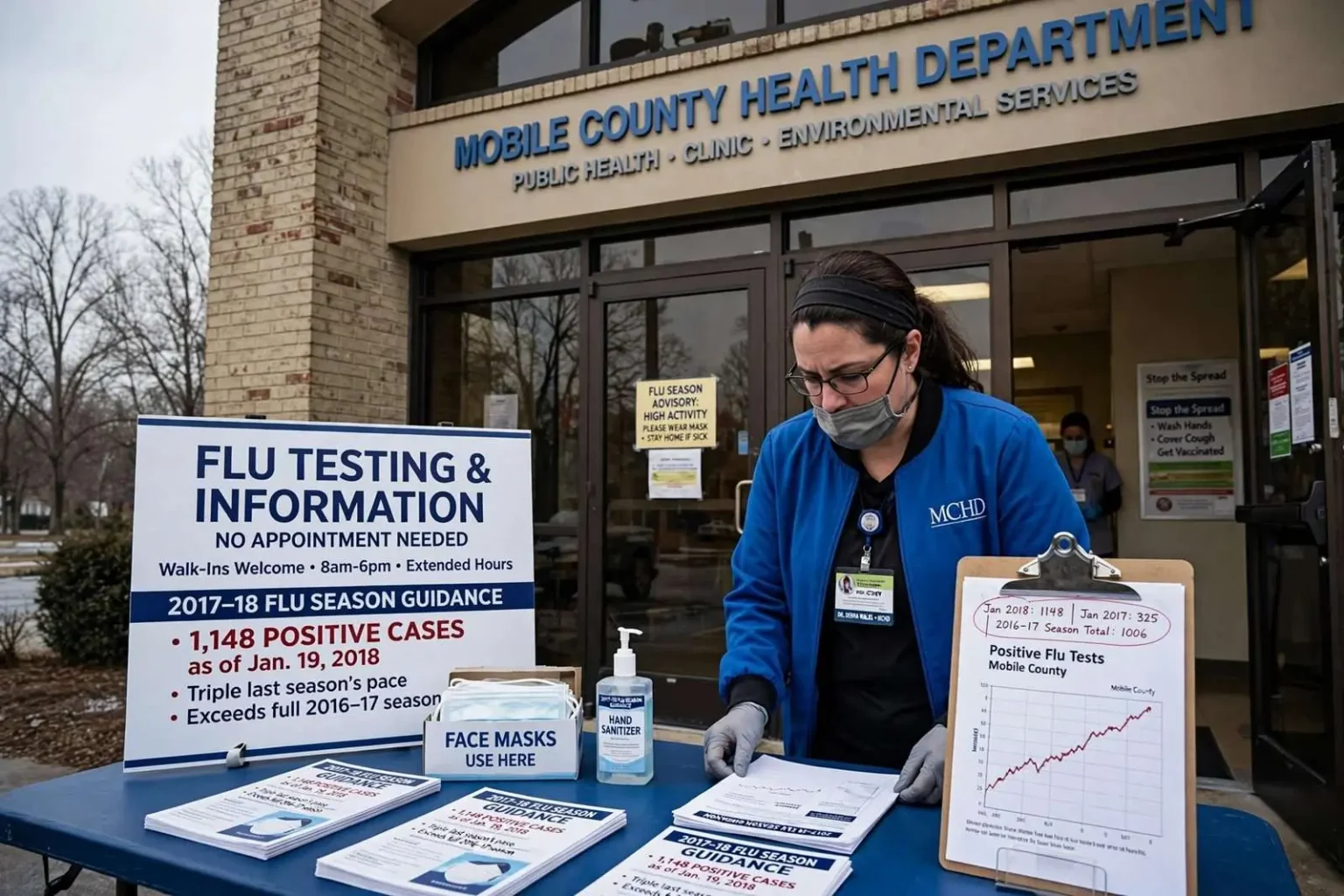
Mobile County health officials reported a sharp increase in positive flu tests during January 2018, with the local total already exceeding the number recorded during the entire previous flu season. The figures confirmed what clinics and emergency rooms across the county had been seeing for weeks: an influenza season that arrived early, hit hard, and showed no signs of slowing as mid-January passed.
By Jan. 19, the county had logged 1,148 positive tests. That was more than three times the 325 positive tests reported at the same point a year earlier, and it was higher than the roughly 1,006 positives recorded across the full 2016-17 season. In practical terms, with weeks of flu season still ahead, Mobile County had already tripled its prior-season pace and surpassed a full winter’s worth of laboratory-confirmed cases.
The numbers carried weight beyond the statistics themselves. Every positive test represented a household managing sick family members, a workplace missing employees, or a school juggling absent students. Pharmacies across Mobile and Prichard reported runs on fever reducers and tissues, and urgent care clinics extended hours to keep up with walk-in demand as the virus moved through neighborhoods.
An Unusually Early Peak
Dr. Debra Walks of the Mobile County Health Department described the surge as unusual because flu activity was cresting sooner than it typically did. Influenza cases often reached their high point in February, but the county was seeing an early peak that winter, meaning the worst of the season had arrived while many residents were still treating it as background risk rather than an active threat.
The early curve matters for how a community responds. Vaccination campaigns, workplace sick policies and school precautions are all built around the assumption that there is time to prepare before flu season intensifies. When the virus peaks in December and January instead, fewer people have been vaccinated by the time exposure risk is highest, and the season’s damage lands before habits adjust to it.
Health departments and hospitals across the Gulf Coast reported similar pressure during that stretch of winter, with the 2017-18 season earning a reputation as one of the more severe in recent years across much of the country. Emergency departments in Mobile County contended with waiting rooms full of febrile patients, and long-term care facilities tightened visitor policies in an effort to keep the virus away from their most fragile residents.
Local Data vs. the State Map
Local reporting also differed from the state’s public flu-activity map. While statewide data did not list Mobile County in the same widespread category as many other counties, local health officials said they were submitting their cases to the Alabama Department of Public Health. They noted that the state and county used different testing methods, which could affect how the county’s activity appeared in state reporting.
The discrepancy confused some residents who checked the state’s weekly map and saw a picture that did not match what they were experiencing at work or in their children’s schools. Health officials’ explanation was straightforward: surveillance systems are built from samples collected at different sentinel sites using different laboratory approaches, so two methods can legitimately classify the same outbreak differently. What the map showed and what the county’s own labs found were both accurate within their own systems; they were simply measuring the season through different lenses.
For families trying to make decisions, officials suggested treating the state map as one signal among several. Local school absence reports, clinic wait times, and direct guidance from the county health department offered a more granular picture of conditions in a specific community than a statewide summary could. The county’s message was that Mobile County’s outbreak was real and active regardless of how it was categorized on a color-coded chart.
Who Faced the Greatest Risk
Health officials continued to encourage vaccination despite concerns that season’s vaccine offered less protection than desired. They emphasized that partial protection could still matter, particularly for people more likely to develop serious complications. A vaccine that reduces the severity of illness, shortens its duration, or lowers the chance of hospitalization still delivers value, even in a year when the circulating strains drifted away from the vaccine’s composition.
Young children, older adults and people with chronic heart or lung conditions were identified as higher-risk groups. For those residents, influenza is not simply a bad week of fever and body aches; it is a condition that can escalate into pneumonia, worsen existing heart failure or asthma, and require hospital care. Officials urged families to think of vaccination less as personal convenience and more as a shield around the most vulnerable people in the household, including infants too young to be fully protected on their own.
Residents were also urged to take basic precautions, including frequent handwashing and staying home when ill to reduce the chance of spreading influenza to others. Those measures sound mundane, but in a season this active they carry measurable consequences. Influenza spreads through respiratory droplets passed in crowded rooms, shared workspaces and classrooms, and every sick person who stays home interrupts a chain of transmission that would otherwise continue through the community.
What the Season Taught the County
The January figures illustrated how quickly flu conditions could change during a season and why local testing data remained important for Mobile County families, schools and health-care providers. A county that tracks its own positives week by week can see a surge building before it shows up anywhere else, giving hospitals time to brace for patient volume and giving residents a nudge to take precautions while it still counts.
That season also reinforced habits that local health officials have carried forward: vaccinate early, treat flu season as a community event rather than an individual one, and pay attention to local signals rather than distant summaries. The 2017-18 experience showed that a season can outpace its averages, and that the difference between a manageable winter and an overwhelming one is measured in the small decisions residents make long before they feel the first symptom.
County officials closed their January update with the same guidance they had repeated all season: get vaccinated if you had not, wash your hands often, cover coughs, and keep sick family members home until fever-free for a full day. Simple instructions, they noted, but during a season that had already set records before February arrived, they were the community’s best available defense.
How Local Flu Surveillance Works
Behind the headline numbers sits a reporting apparatus that most residents never see. County health workers collect positive test results from hospitals, clinics and commercial laboratories, tally them weekly, and compare them against prior seasons to gauge whether activity is rising, plateauing or falling. Those counts feed state dashboards, and the state in turn reports to federal health agencies, creating the national picture that shapes each winter’s public messaging about influenza.
Testing volume itself is part of the story. In a heavy season, more sick patients seek care, more clinicians order tests, and more positives are recorded — so case counts reflect both the virus’s true spread and the community’s response to it. Health officials note that laboratory-confirmed totals are best read as a trend line rather than a precise census of everyone infected, since many people who catch influenza are never tested at all and recover at home without ever entering the counting system.
That is why the comparison to prior seasons matters more than any single week’s figure. When the same laboratories, using broadly the same methods, record more than three times the previous year’s positives at the same calendar point, the signal is difficult to dismiss. The county’s data showed a season operating well outside its usual range, which is precisely the situation surveillance exists to catch.
Guidance for Schools and Workplaces
The surge put practical pressure on institutions. Schools across Mobile County monitored attendance and sent home students who arrived with fever, while employers weighed sick-leave policies against production schedules. Health officials used the January update to remind administrators that sending symptomatic people home quickly protects everyone else in the building, and that a brief operational disruption is far cheaper than a workplace-wide outbreak.
Childcare settings faced a particular challenge, since influenza spreads efficiently among young children who are close talkers, frequent hand-sharers and often contagious before symptoms become obvious. Officials encouraged daycare operators to disinfect shared surfaces daily during peak weeks, to keep handwashing routines vigorous, and to enforce clear return-to-care rules so that children sent home with fever did not return the next morning still infectious.
For households caring for someone with the flu, the standard advice remained unchanged: rest, fluids and fever control for the patient, and separation, handwashing and vigilance for everyone else. Officials also urged residents to watch for warning signs that turn influenza into an emergency — difficulty breathing, persistent chest pain, confusion, or a fever that returns after easing — and to seek care promptly when those appear, especially in the very young, the very old and those with chronic conditions.
The county’s closing message blended urgency with reassurance. The season was severe and unusual, but it was also survivable with ordinary tools applied consistently: vaccination for anyone still unvaccinated, hygiene at home and school, and cooperation from employers and institutions. Those measures, officials said, were how Mobile County would get through a winter that had already made history before the calendar turned to February.