Dinner and a Movie: Pork Burgers With Sweet Potato Fries and the Story of Steve Jobs
A Mobile Bay kitchen paired hearty pork burgers, crispy sweet potato fries and a tangy kale slaw with a screening of the biographical drama Steve Jobs.
There are evenings when the best entertainment does not require leaving the house at all. On one such night around the Mobile Bay area, a home cook set out to pair a satisfying, from-scratch supper with a movie worth arguing about afterward. The menu was pork burgers with sweet potato fries and a bright kale slaw. The feature was Steve Jobs, the stylized portrait of the Apple co-founder. The result was a full and unhurried night at home on the Gulf Coast, the kind that costs a fraction of a dinner-and-a-show outing downtown and leaves leftovers for lunch the next day.
Nights like this have become a quiet staple of household routine across the coast. Between bridge traffic on the Causeway, school schedules and summer heat that makes a hot car ride unappealing, plenty of Baldwin County and Mobile families have concluded that the best seat in the house is the one already paid for. What separates a memorable evening in from an ordinary one is usually the effort put into the plate, and this menu asked for nothing more exotic than a hot skillet, a sheet pan and a short shopping list.
Pork itself deserves a word. Ground pork remains one of the most affordable proteins in the meat case along the Gulf Coast, and it takes on seasoning more willingly than beef, which makes it a natural fit for the Cajun and Creole blends that fill spice racks in south Louisiana and south Alabama alike. A burger built from it cooks quickly, stays juicy when an egg is folded into the mix, and pairs comfortably with the sweet-and-savory combination that defines so much of Gulf Coast home cooking.
In the kitchen
The plate came together with a short shopping list and a hot skillet. The cook gathered roughly ten ounces of lean ground pork, a sweet potato, Cajun or Creole seasoning, an egg, two potato buns, a bunch of kale, a wedge of cabbage, red wine vinegar, shredded cheddar, blue cheese dressing, mayonnaise and Dijon mustard. Nearly all of it is available at any neighborhood grocery, which is part of the appeal: nothing here required a specialty run to a farmers market or a butcher, and nothing would go to waste if a portion of the slaw outlasted the burgers.
The lineup also illustrates how a small pantry can stretch a meal. Red wine vinegar and Dijon mustard do double duty here, sharpening the slaw and then forming the base of the sauce that dresses the bun. Mayonnaise appears twice, once inside the slaw and once thinned with mustard for the sandwich. A cook who keeps those staples on hand can put this dinner together on a weeknight with a single stop for pork, produce and buns.
Fries first
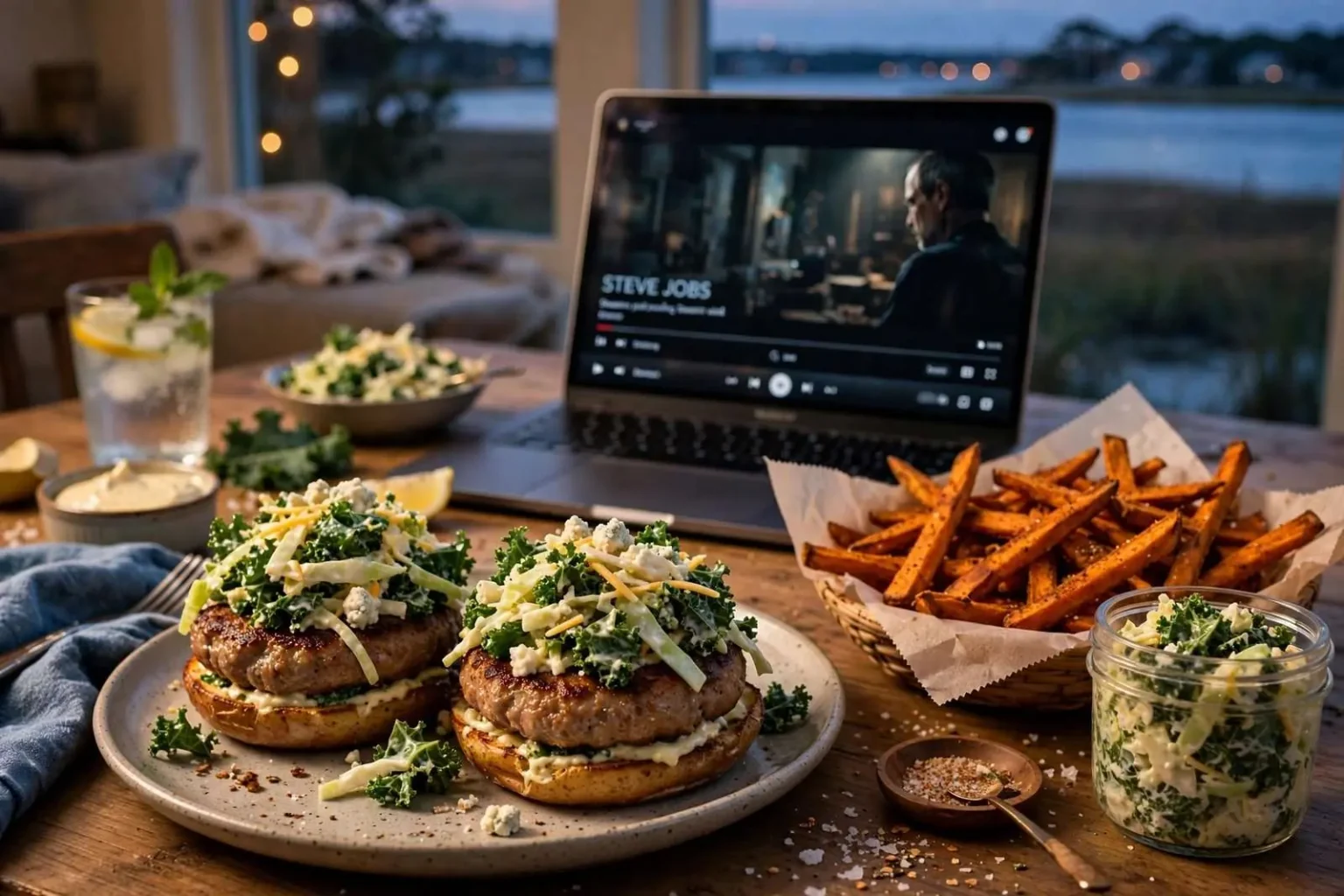
Fries first. The oven was set to 450 degrees. The sweet potato was sliced lengthwise, then cut crosswise into quarter-inch pieces, tossed with olive oil, salt and pepper, and spread on a baking pan for fifteen to twenty minutes. The high heat matters: sweet potatoes carry more natural sugar than white potatoes, and a 450-degree oven caramelizes the edges while the centers turn creamy, delivering the crisp-outside, soft-inside contrast that makes the fries worth the bother.
Getting the cut right is the difference between fries and sad wedges. Quarter-inch pieces expose enough surface area to brown without steaming, and spreading them in a single layer with a little breathing room keeps moisture from building up underneath. Crowding the pan is the classic mistake, and it is worth swapping to a second pan rather than piling the pieces on top of one another. A pinch of cayenne or a dusting of the same Cajun seasoning used on the pork ties the two parts of the plate together.
Sweet potatoes, it is worth noting, are no novelty along the northern Gulf Coast. The crop has deep roots in the region’s sandy soils, and the state’s farmers have long grown them for markets across the Southeast. Serving them as fries alongside a grilled or griddled sandwich is a natural local pairing, one that shows up on menus from Fairhope to Gulf Shores, and it translates to the home oven with almost no fuss.
The patties
The pork was folded together with seasoning and the egg, then shaped into patties a half-inch to an inch thick. They cooked in hot olive oil, four to six minutes on the first side and three to four on the second, until done to taste. The egg acts as a binder and keeps the lean meat from turning dry, an old trick that costs nothing and makes a noticeable difference on the second bite. Gentle handling matters too: compressing the meat too hard yields a dense patty, while a light touch leaves it tender.
Timing varies with thickness, which is why the range is broad. A half-inch patty in a properly heated skillet will finish in well under ten minutes total, while an inch-thick one may want a covered pan and a minute or two more. Because ground pork should be cooked through, a cook who doubts the timing can sacrifice the thickest patty to a quick check. The reward for patience is a burger with a deep brown crust that carries most of the flavor.
Using the same skillet for the entire menu is not just convenience. The fond left behind by the pork seasons the buns later, and the pan stays hot so nothing waits on anything else. It is the kind of efficient sequencing that home cooks along the Gulf Coast have practiced for generations, when kitchens ran hot before air conditioning and every extra minute over the stove was a minute too many.
The slaw
The slaw. Kale leaves were stripped from their stems and sliced thin along with the cabbage. Red wine vinegar, salt and pepper went in first, followed by mayonnaise, blue cheese dressing and shredded cheddar, tossed until it looked like a proper slaw. Dressing the greens in stages is the detail that makes it work: the vinegar softens and wilts the kale and cabbage first, mellowing their raw edge, before the creamy elements go in to coat everything evenly.
Kale has earned its place on Gulf Coast tables over the past decade, moving from a curiosity to a staple that thrives in the region’s long growing season and shows up in everything from summer salads to braised winter sides. Here it does the heavy lifting in a slaw that would traditionally be all cabbage, adding texture and a slightly bitter note that stands up to the richness of the pork and the blue cheese dressing. Cabbage keeps the crunch familiar.
The combination also solves a practical problem. A slaw this hearty holds up for hours without going soggy, which means it can be made while the fries roast and the patties sear, and any leftover keeps until the next day. A spoonful inside the burger, a second spoonful on the plate, and lunch is half assembled before the dishes are done.
Assembly and the verdict
After a five-minute rest for the meat, the buns were toasted face down in the same pan. A quick mayonnaise-and-Dijon sauce dressed the bottom bun, the patty went on top, and a spoonful of slaw finished it. The extra slaw and sauce were served on the side with the fries. Resting the patties for those five minutes lets the juices redistribute instead of running out at the first bite, and toasting the buns in the pork fat turns a grocery-store potato bun into something closer to what a good burger joint would serve.
The layering is deliberate. The sauce on the bottom bun guards against sogginess, the patty sits where the heat can be managed, and the slaw goes on last so its crunch survives until serving. It is a small piece of engineering, but it is what separates a burger that holds together from one that collapses halfway through.
The verdict from the table was two enthusiastic thumbs up. That kind of unanimous review is rare in any household, where opinions on slaw alone can divide a family, and it says something about the balance of the plate: rich pork, sweet fries, sharp slaw, nothing competing and nothing missing.
On the screen
The evening’s film was Steve Jobs, directed by Danny Boyle, with Michael Fassbender in the title role alongside Kate Winslet, Seth Rogen, Jeff Daniels, Michael Stuhlbarg and Katherine Waterston. Rather than a cradle-to-grave biography, the picture unfolds in three tense stretches set backstage before major product launches, using those moments to weigh Jobs’ relentless drive against the personal relationships he strained along the way. It is a structure that turns a business story into something closer to a stage play, with the countdown to each launch supplying the ticking clock.
Boyle, whose credits run from Trainspotting to Slumdog Millionaire, brought kinetic energy to material that could easily have been a dry corporate history, and the screenplay’s choice to dramatize only the minutes before the 1984 Macintosh introduction, the 1988 NeXT launch and the 1998 iMac debut compresses nearly two decades of Silicon Valley history into a single evening. The launches are chosen well: each one catches Jobs at a different moment of triumph, exile and comeback.
Fassbender’s performance anchors the film, playing Jobs as brilliant, ruthless and frequently unlikeable, while Winslet’s Joanna Hoffman serves as the conscience of the picture, the one person willing to tell him hard truths to his face. Rogen’s turn as Apple co-founder Steve Wozniak supplies the film’s central accusation, that Jobs took credit for the work of others and left people behind on the way up.
The reviewers found the acting and direction strong, and the movie’s real value in how it dramatizes the way the technology industry operates. For a Gulf Coast audience far from Cupertino, the film functions as a window into a culture most residents only touch through the devices in their pockets, and it raises questions about work, family and ambition that outlast the credits.
The structure is not a tidy timeline, and the dialogue turns dense and technical in places, which demands a viewer’s full attention. It is not a relaxing watch so much as a rewarding one for anyone curious about the culture behind the products. Viewers hoping for a gentle tribute should adjust expectations; the film is closer to an argument about its subject than a celebration of him.
By the household’s playful rating system, the film earned a couple of half thumbs, netting out to a single, respectable thumb up. Paired with the pork burgers, it made for a full and unhurried night at home on the Gulf Coast.
Why the pairing works
There is a small logic to matching a hands-on supper with a demanding film. Both ask for engagement rather than passive consumption, and both reward a little patience. A plate assembled in stages and a story told in three acts turn an ordinary evening into something with a shape to it, the kind of night people remember more clearly than a week of scrolling.
It is also a budget-friendly template worth repeating. Ten ounces of pork, one sweet potato and a head of greens fed the table for what a single ticket and popcorn would cost at a multiplex, with the movie streamed at home. For families watching expenses along the coast, the math is part of the appeal, and the format scales easily: swap the protein, swap the film, keep the structure.
The household’s dinner-and-a-movie series has already covered a range of menus and genres, from comfort food casseroles paired with family films to spicier suppers with crime dramas, and this installment landed in the middle of that spectrum: a supper that required real technique and a film that required real attention. Two thumbs up for the food, one for the movie, and a plan to do it again soon.