Mobile County Health Officials Report First Mosquito-Borne Virus Cases of the Season
Sentinel poultry near Theodore tested positive for Eastern Equine Encephalitis, marking Mobile County's first mosquito-virus detection of the year.
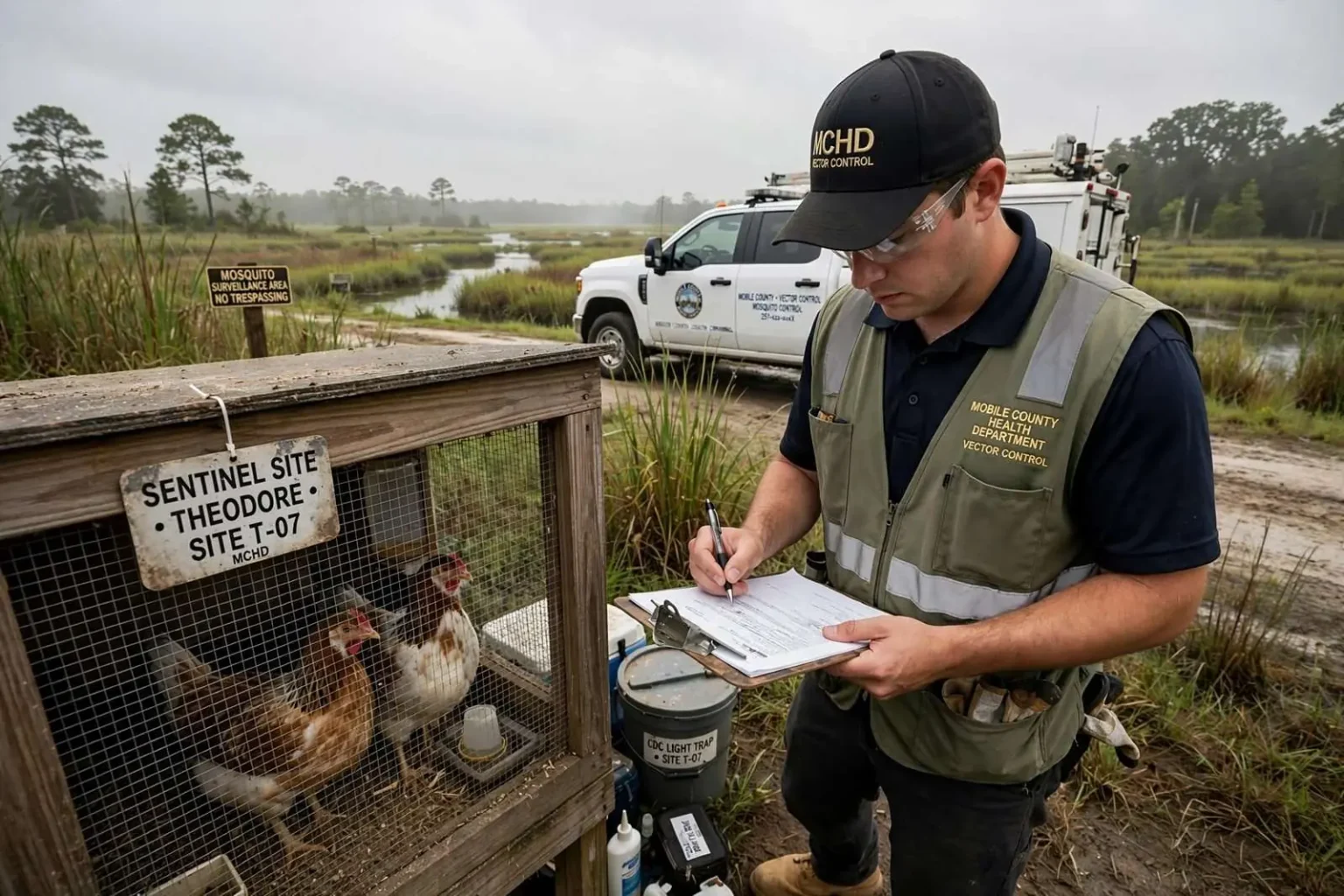
Health officials in Mobile County have confirmed the first mosquito-borne virus detections of the year after two sentinel chickens kept near Theodore tested positive for Eastern Equine Encephalitis, according to the Mobile County Health Department. The positive tests signal that the virus is circulating in the local mosquito population, weeks before the county’s mosquito season reaches its late-summer peak.
The department’s Vector Control division keeps small flocks of chickens at strategic points around the county specifically to catch early warning signs of dangerous viruses circulating in the local mosquito population. Because chickens are frequently bitten by mosquitoes but rarely show symptoms themselves, their blood can reveal exposure to viruses well before human or animal cases appear.
The sentinel program works because of that biology. A chicken bitten by an infected mosquito develops antibodies without becoming sick or serving as a source of infection for other mosquitoes, making the birds ideal early-warning instruments. Vector Control staff draw small blood samples from the flocks on a regular schedule throughout mosquito season and send them for testing; a positive result tells the department exactly where in the county active virus transmission is happening.
Traps placed throughout Mobile County are regularly tested for Eastern Equine Encephalitis, West Nile Virus, and St. Louis Encephalitis, giving officials a rolling picture of mosquito-borne disease risk through the warm months. The trapping network and the sentinel flocks together form one of the most established surveillance programs on the Gulf Coast, allowing the department to target spraying and public advisories to the areas where virus activity actually shows up rather than treating the entire county as a uniform risk.
How the virus moves
According to the health department, these mosquito-borne viruses circulate primarily between birds and mosquitoes. A mosquito that feeds on an infected bird can pick up the virus and later pass it to another animal or person during a subsequent bite. Humans, horses and other mammals sit at the end of that chain rather than in the middle of it — the virus is amplifying among wild birds and certain mosquito species, and people become infected only when the cycle spills over.
Horses and humans can both become seriously ill if infected, but neither species can pass the virus on to another host — meaning a sick person or horse poses no direct transmission risk to family members, coworkers, or other livestock. That dead-end status is worth emphasizing for residents worried about contagion: an EEE diagnosis in a neighbor, family member or barn animal does not spread from one to another, and ordinary contact carries no risk.
Wild birds, particularly in wetland areas, serve as the virus’s natural reservoir. South Mobile County’s mix of marsh, tidal creeks and standing water near communities like Theodore provides exactly the habitat where the bird-mosquito cycle thrives, which is why sentinel sites in that part of the county regularly produce the season’s earliest positives.
Of the viruses being monitored, Eastern Equine Encephalitis is considered one of the more serious threats to people and other mammals. Though human cases are rare compared with West Nile Virus, EEE carries a high fatality rate among those who develop severe illness, and survivors can be left with lasting neurological damage. The rarity of cases is no comfort to public health officials, who treat every detection in the mosquito population as reason to warn residents before a human case can occur.
Protecting horses
Vaccines exist to protect horses against both Eastern Equine Encephalitis and West Nile Virus, but no vaccine is currently available to protect humans from EEE, making mosquito avoidance the primary defense for residents. For horse owners across south Mobile County and into neighboring Baldwin County, the detection near Theodore is the annual signal to check vaccination records and schedule boosters where animals are not current.
Equine veterinarians recommend routine vaccination against the mosquito-borne encephalitides, and horses that lapse between boosters can be left exposed during the peak of mosquito season. Owners are also advised to reduce mosquito breeding around barns and paddocks — draining water troughs and buckets, eliminating standing puddles, and keeping animals stabled during dawn and dusk hours when the mosquitoes that carry the virus are most active.
The distinction between the animal and human situation is stark. Horse owners have an effective, inexpensive vaccine their animals can receive from any large-animal veterinarian. Residents have no such option for themselves, which places the burden of human protection squarely on behavior: repellent, clothing, screens and avoidance.
The county’s response
The detection comes as the health department has already stepped up mosquito spraying efforts across the county in recent weeks, a response to the wet-season conditions that tend to boost local mosquito populations. Gulf Coast summers deliver near-daily rain, and every storm leaves behind the containers, ditches and low spots where mosquitoes breed. Vector Control’s trucks work nighttime routes in the areas where trapping and sentinel results show activity, and the positive tests near Theodore will concentrate that effort in the surrounding communities.
Residents in the Theodore area and elsewhere in Mobile County should expect to see and hear spray trucks in their neighborhoods during evening and overnight hours. The department asks residents to help the program work — closing windows at night, bringing pets indoors during spraying, and reporting heavy mosquito activity so routes can be adjusted. Spraying reduces adult mosquito numbers temporarily, but the most durable control happens on private property, where most breeding sites are found.
That is the department’s standing message to every household: dump it. Flower pots, birdbaths, gutters, tires, buckets, kiddie pools and anything else that holds water for more than a few days will produce mosquitoes, and the species that breed in containers are among the most likely to live near people. A weekly walk around the yard to empty and scrub water-holding containers does more to cut neighborhood mosquito numbers than any amount of spraying.
What residents should do
Personal protection follows the same rules public health officials repeat every season. Use an EPA-registered insect repellent when outdoors, wear long sleeves and pants during peak mosquito hours around dawn and dusk, and make sure windows and doors have tight-fitting screens. The precautions matter most for the very young, the elderly and anyone with weakened immune systems, the groups most vulnerable should severe illness occur.
Residents who develop high fever, severe headache, stiff neck, disorientation or other symptoms of encephalitis after mosquito exposure should seek medical care promptly and mention the exposure. Physicians report suspected mosquito-borne illness to the health department, which investigates every potential human case to understand where transmission is occurring.
The health department will continue testing sentinel flocks and traps throughout the mosquito season and will report additional positives as they occur. A detection near Theodore does not confine the risk to that community — mosquitoes and the birds that carry the virus do not recognize municipal boundaries — so officials treat the finding as a countywide reminder: the season has started, the virus is here, and the habits that prevent bites are the only vaccine residents currently have.
A program built over decades
Mobile County’s sentinel chicken program is among the longest-running mosquito surveillance efforts on the northern Gulf Coast, and its design has changed little over the decades: place the flocks where mosquitoes and birds mix, test the blood on schedule, and map the results. The flocks are small, tended by Vector Control staff, and positioned to cover the county’s varied geography — the tidal south county, the urban core of Mobile, the suburbs and the agricultural fringes where horse properties cluster.
Surveillance of this kind is invisible to most residents until a positive result surfaces, but it is the reason advisories can be specific. Without the flocks and traps, the department would learn of virus activity only when a person or horse got sick — weeks after transmission began. With them, the warning arrives early enough for spraying schedules, veterinary reminders and public notices to get ahead of the peak.
The same infrastructure monitors for West Nile Virus and St. Louis Encephalitis alongside EEE, and the three viruses tend to follow overlapping but not identical seasonal patterns. West Nile typically builds through late summer into fall; EEE activity often appears earlier in the season in the wetland-heavy south county. Tracking all three from the same flocks and traps gives the department a single integrated picture of the county’s mosquito-borne disease risk.
Theodore and the south county wetlands
Theodore sits in the southern reach of Mobile County, where suburban development meets the marshy landscape that drains toward Mobile Bay. Tidal creeks, drainage canals and low ground hold water through the wet season, and the area’s mix of woods, water and backyards is prime territory for the mosquito species involved in the bird-to-mosquito cycle. It is no accident that sentinel sites in this part of the county repeatedly produce the year’s first positives.
Residents of the area have lived with the county’s mosquito control efforts for generations, and many remember seasons when multiple horses died of encephalitis before vaccination became routine in local barns. The modern combination of equine vaccines, sentinel surveillance and truck spraying has made serious illness rare, but the underlying ecology has not changed: the virus winters in the environment, reappears when rain and heat align, and finds its way to the first susceptible hosts available.
The department’s advice for the weeks ahead will sound familiar because it works. Empty the containers. Fix the screens. Wear the repellent. Keep the horses current on their boosters. And when the spray trucks come through the neighborhood in the evening hours, remember what they are responding to: two chickens near Theodore whose blood told the county something residents could not yet see — that Eastern Equine Encephalitis has joined them for another Gulf Coast summer.
Additional detections will be announced as testing continues, and the health department encourages residents with questions about mosquito control, spraying schedules or reporting standing water to contact the Vector Control division directly. The program runs through the end of mosquito season and beyond, wherever the flocks and the traps say the risk has gone next.