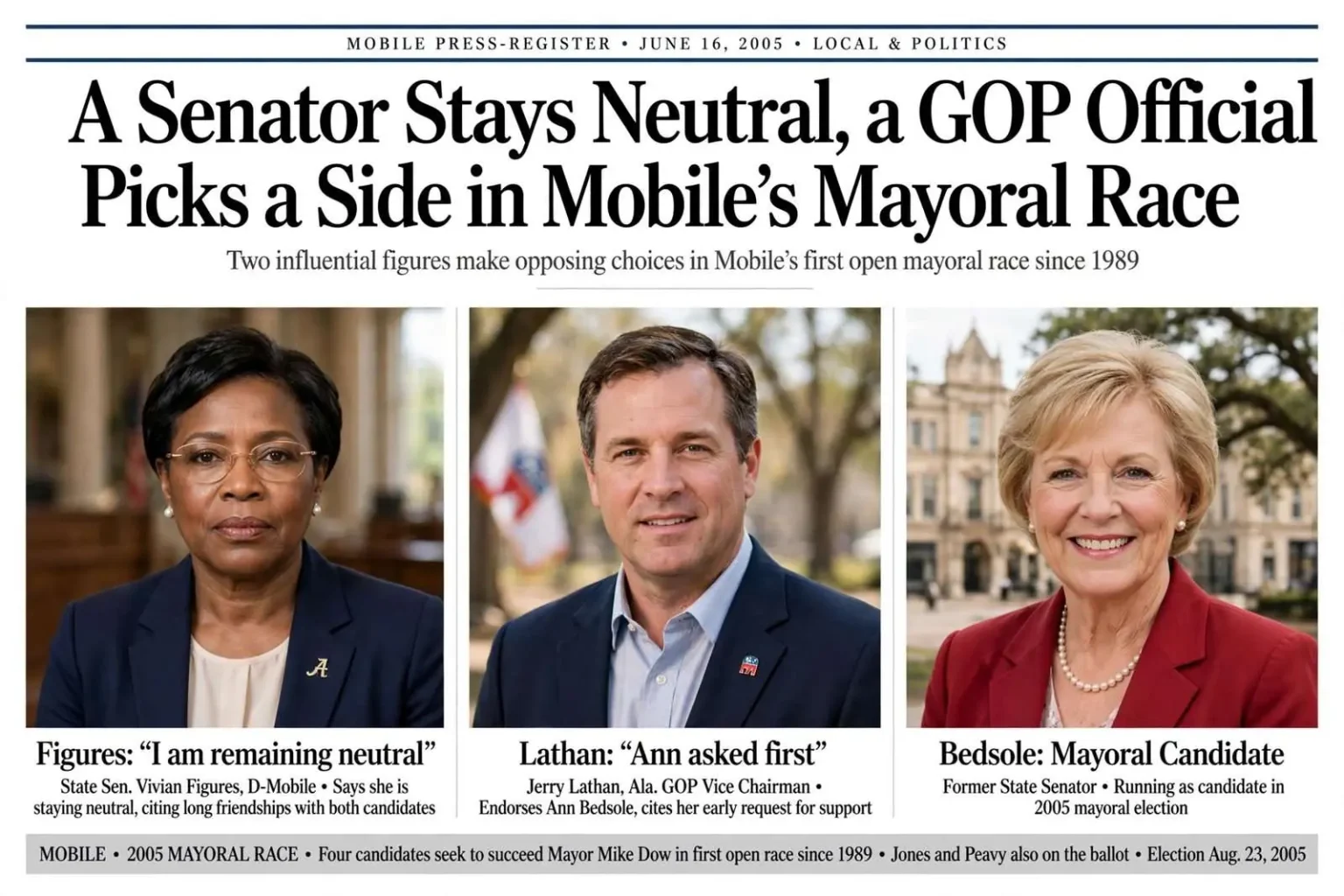
MOBILE — Two of the more closely watched endorsement decisions in Mobile’s 2005 mayoral race were resolved in mid-June, and they went in opposite directions: one prominent figure declined to choose at all, and another chose, with an unusually candid explanation of why. The decisions carried weight because the race itself was unlike anything Mobile had seen in sixteen years. Mayor Mike Dow had decided against seeking another term, and the contest to replace him was the city’s first genuinely open mayoral race since 1989. Four candidates were competing to succeed him, and how the city’s most influential political figures positioned themselves — or declined to position themselves — was read across Mobile as a signal about how the election’s principal voting blocs might ultimately come together.
Figures: ‘I am remaining neutral’
State Sen. Vivian Figures, D-Mobile, who represented as many Black Mobilians as any other locally elected official, faced a genuinely difficult choice. The field included Ann Bedsole, a white Republican and former state senator, and Sam Jones, a Black Democrat and a longtime Mobile County commissioner. The conventional expectation pointed one way. Figures’s personal history pointed another. She chose neither.
“I am remaining neutral in the mayor’s race,” Figures said. “Ann is a very, very dear friend. Sam Jones is a good friend as well.” She explained the arithmetic of loyalty that produced the decision. “Ann Bedsole supported me and raised money for me. I always try to treat people the way I would want to be treated. I encouraged Sam to run. I thought it was a great idea. But when Ann Bedsole got in, I could not favor someone over her.”
The neutrality was less a dodge than a settled account between old friends. Figures’s ties to Bedsole ran through years of campaigns in which Bedsole, one of the most prominent women in Alabama Republican politics, had backed Figures financially and publicly. Her ties to Jones ran through the local Democratic establishment and through a debt of a different kind, one that went back a decade.
Figures had represented District 2 on the Mobile City Council until 1995, when her husband died and she won the special election to succeed him in the state Senate. That race had divided Mobile’s Black political community: Figures defeated state Rep. James Buskey for the Senate seat her husband had held, and the contest between two of the city’s best-known Black Democrats left marks that took years to fade. Jones had stayed neutral in that race, declining to take sides when others pressed him to. A decade later, in the mayoral contest of 2005, Figures returned the courtesy to both sides — refusing, in effect, to repay one old friend by costing another.
A career rooted in District 2
Figures’s standing in the community made her neutrality itself a kind of news. Her Senate district stretched across much of central Mobile, and her former Council district had included some of the city’s most historic Black neighborhoods. When she encouraged Jones to run, as she confirmed, she was giving his candidacy an early stamp of legitimacy from one of the district’s most durable officeholders. When she then declined to endorse him, she was preserving a friendship that had produced campaign support in harder races. Both halves of the equation were understood by everyone who followed Mobile politics, which is precisely why her announcement was considered worth reporting at all.
Her decision also reflected the unusual makeup of the 2005 field. Bedsole was not an ordinary Republican opponent for a Democratic legislator to weigh; she had spent years in Mobile politics crossing the lines that usually separated the city’s white and Black political establishments, and her friendships across those lines were part of why her candidacy drew attention from both parties. For Figures, the question was not whether to back a Republican over a Democrat in the abstract, but whether to rank two personal friends, one drawn from each tradition. She declined to do either.
Lathan: ‘Ann asked first’
Jerry Lathan, vice chairman of the Alabama Republican Party representing the southern third of the state, faced a different puzzle. Three of the four mayoral candidates had either held or sought office as Republicans, and Lathan’s impatience with what he called RINOs — Republicans In Name Only — was well known in party circles. Bedsole’s standing with party regulars had been debated ever since her loss in the 1994 GOP gubernatorial primary, a contest in which Fob James ultimately took the nomination. Some party loyalists had never fully let the episode go. Lathan endorsed her anyway.
“Yes, I’m supporting Ann Bedsole,” he said. “I think it’s important that someone who is identified as a Republican and a fiscal conservative be the next mayor of Mobile.”
What made the endorsement unusual was how thoroughly he declined to weaponize it. Both Bedsole and City Councilman John Peavy, he said, had called him, espoused conservative principles and pledged to govern by them. He told each that they were welcome to claim him as a supporter if it helped. There was no ultimatum, no list of policy demands and no threat to campaign against whoever lost his favor.
“Ann asked first,” Lathan said. “She has been a Republican her whole career. That gives her a slight lead in Republican credentials with no slight to John. That’s just the way it is.” He went further, pre-emptively defusing any suggestion that backing one candidate’s rival meant rebuking the other. “I don’t want any of them to think I’ve chosen one side as a sign that I do not think well of the other,” he said. “I have good friends supporting both of them that are good Republicans and have been with me in many fights.”
Lathan also volunteered a disclaimer that few endorsers offer: “I don’t even live in the city. To the degree that a non-resident’s opinion counts, so be it.” He said he had not spoken with the fourth candidate, Bess Rich, a city council member whose campaign emphasized her record on budgets and spending. Lathan, then 48, was an industrial roofing contractor based in Theodore and a longtime Republican loyalist whose organizing work across southwest Alabama had made him a familiar figure to candidates up and down the ballot.
Nonpartisan ballots, partisan undercurrents
Mobile’s municipal elections are formally nonpartisan, which in practice means party identity operates as an undercurrent rather than a ballot line. No candidate’s party affiliation appears on the ballot, and no party primary filters the field. But the city’s electorate is anything but indifferent to party: Black voters in Mobile have for decades formed the core of the local Democratic coalition, while much of the city’s white electorate, particularly in the western and southern neighborhoods, has leaned Republican in federal and state races. In a four-way race with no runoff guarantee, the question of how those blocs would sort themselves was the central strategic puzzle, and the June endorsements were read as early answers to it.
The sequencing also mattered. Endorsements in a crowded local race function partly as signals to other donors and activists, and an early, unambiguous blessing tends to travel further than one delivered late in the campaign. Bedsole had asked before Peavy did, and Lathan was frank that the order of the calls — not a difference in the pitch he heard — settled the matter. It was an unusually honest account of how local endorsements actually get made.
What each decision meant
Figures’s neutrality withheld a significant asset from Jones. In a city where Black turnout and community leadership had decided many a local election, the public support of the area’s most prominent Black state senator would have been worth real organization and real money to any campaign. By staying out, Figures neither consolidated the Black vote behind Jones nor handed Bedsole a way to divide it. Her explanation made clear that the decision was personal rather than strategic: loyalty ran in both directions in her account, and she was not willing to spend one in order to pay the other.
Lathan’s endorsement gave Bedsole a claim on party regulars she might otherwise have had to fight for. Bedsole carried long-established name recognition from her years in the state Senate, but her credentials with the party’s base had been questioned since the 1994 primary. An explicit blessing from the GOP’s vice chairman for south Alabama — delivered, no less, with a public disclaimer that the councilman who had also sought his support was not thereby insulted — let her campaign present itself as the Republican-leaning choice in the field without having to litigate her history with the party’s grassroots.
The result
The race was decided on Aug. 23, 2005. Sam Jones won, becoming Mobile’s first Black mayor and serving two terms in office. His victory placed a Black chief executive over a city whose population had been nearly half Black for decades, and it capped a campaign in which the endorsements and non-endorsements of June had quietly shaped the ground each candidate stood on. Bedsole, Peavy and Rich divided the rest of the vote across the city’s neighborhoods.
But the endorsements of that June are a reminder that in local politics, friendship and sequence — who asked first — can matter as much as ideology. Figures’s refusal to choose was as consequential a choice as Lathan’s decision to answer the first call. In Mobile’s nonpartisan arena, where the ballot offers no party label and the campaign calendar offers no primary to win, the debts and courtesies accumulated over decades of local races are among the few reliable currencies candidates can spend. In the summer of 2005, two of the city’s most experienced political operators showed exactly how those currencies get spent — and how deliberately they can be declined.
For readers tracing Mobile’s political history, the episode also marks a hinge. The 2005 election opened a decade in which the city’s leadership and its demographic balance shifted together, and the careful neutrality of a figure like Figures — alongside the careful friendliness of a figure like Lathan — offers a window into how both parties’ local establishments tried to navigate that change without breaking the personal relationships that make municipal politics work.