Rich Pledges to Move Downtown if Elected Mayor of Mobile
Mobile mayoral candidate Bess Rich said in April 2005 that she and her husband would sell their west Mobile home of 25 years and move downtown if she won the August election.
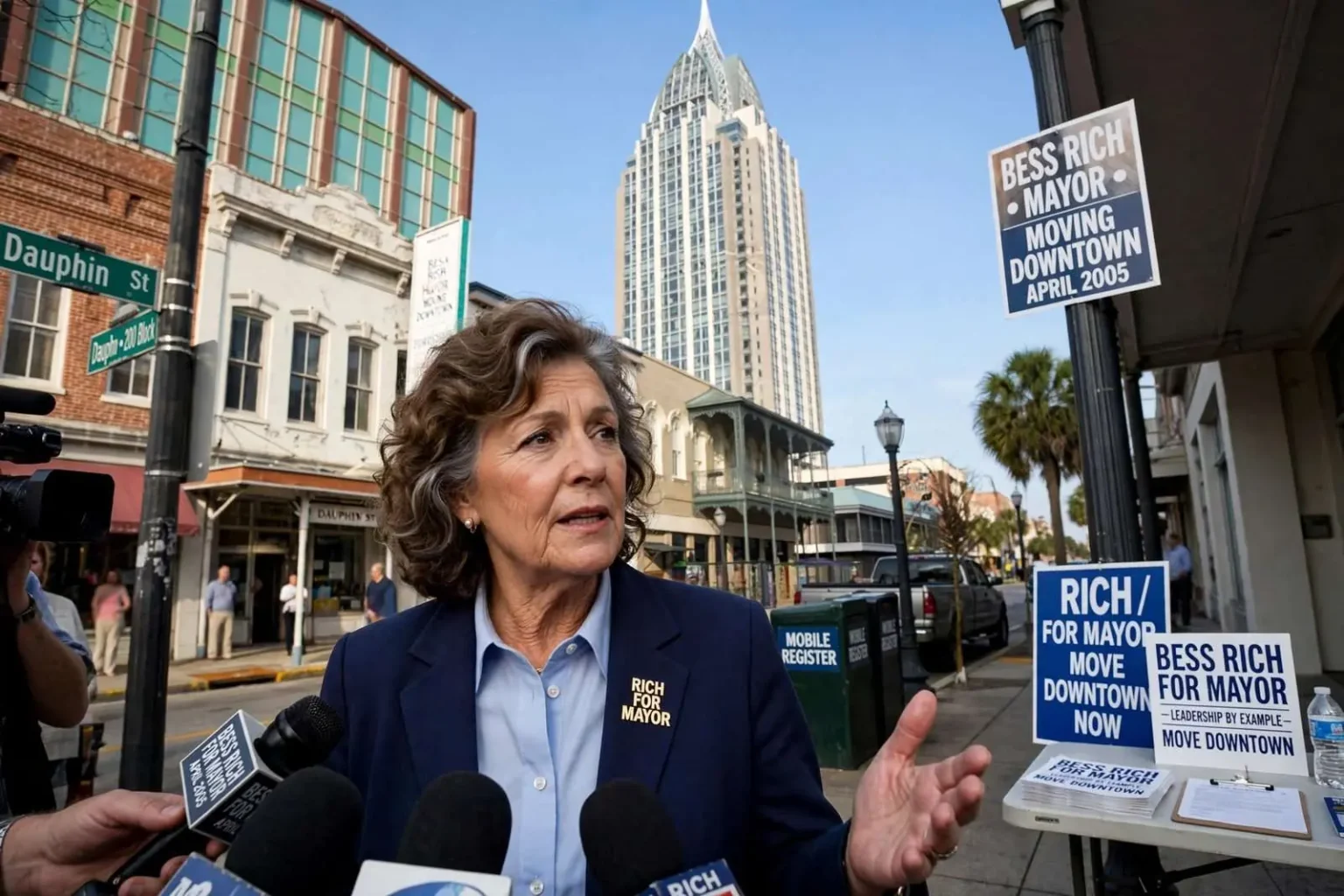
MOBILE — Mayoral candidate Bess Rich made an unusual campaign promise in April 2005: if elected, she would move. Rich pledged that she and her husband, Dr. Leonard Rich, would sell the west Mobile house where they had lived for 25 years and raised their family, and take up residence in downtown Mobile.
“I can’t just talk about having a vibrant downtown,” she said. “I want to set an example for others to show them how wonderful downtown Mobile can truly be.”
Candidates promise downtowns all kinds of things — tax incentives, new stadiums, parking garages. A promise to change one’s own address is rarer, and Rich offered it deliberately as a test of her own sincerity. If downtown living was good enough to campaign on, the pledge implied, it should be good enough to live in. The promise made her the only candidate in the race whose downtown policy could be verified by looking up where she slept.
A promise with a cost attached
The pledge carried real inconvenience. The Riches lived off Airport Boulevard in west Mobile, and Dr. Rich’s office was in west Mobile as well — a short commute that a downtown move would lengthen considerably.
“My husband’s office is in west Mobile, so convenience is a factor for us,” she said. “But he is more than happy to make a work-related move for me.”
Upon election, she said, the couple would list the west Mobile house and acquire living quarters downtown. “I’d love walking to work,” she said. “It will make my life so much easier.”
The walking-to-work image carried its own argument. City hall sits in the heart of downtown, steps from the buildings and blocks a mayor’s policies most directly affect. A mayor who lived downtown would see the sidewalks she was pledging to fix, walk past the storefronts she hoped to fill, and answer to her neighbors in person when a promise lagged. Political observers in Mobile had watched downtown mayors in other cities make the same calculation; the pledge put Rich in their company and dared her rivals to match it.
It also came with the honesty of a household budget. Selling a family home of 25 years — a house that held the family’s history as well as its furniture — is not a symbolic gesture; it is a relocation with costs, timing and the housing market attached. Rich’s willingness to itemize that price in public, and her husband’s willingness to pay part of it in commute time, gave the pledge a credibility that policy position papers rarely achieve.
Why downtown was the argument
To understand the pledge, it helps to remember what downtown Mobile was in 2005. After decades in which retail, offices and households drained westward toward Airport Boulevard and beyond, the city center was in the early stages of a revival that was real but far from settled. Dauphin Street had begun to fill with restaurants and bars. The convention center and the RSA tower had gone up. But downtown residential living — the thing that turns a district from a destination into a neighborhood — remained thin.
That thinness was the strategic problem. A downtown that empties at 5 p.m. generates traffic for its bars but not its grocery stores, its dry cleaners or its elementary schools. Every urban planner advising Gulf Coast cities in those years made the same point: entertainment districts are fragile, residential neighborhoods are durable, and the cities that rebuilt their cores did it by getting people to live there. Mobile’s revival had produced the restaurants and the offices; it had not yet produced the residents.
Every candidate for mayor that year talked about downtown. Rich’s answer to the credibility problem was to offer her own address as collateral. When she promised a vibrant downtown, opponents could recite the same pledge from a subdivision off Airport Boulevard; when she promised it, she had already begun packing. The distinction was the message, and it sharpened the entire field’s debate over what downtown renewal would actually require.
The candidate
Rich was not a newcomer. She had represented her west Mobile area as the District 6 city councilwoman for two terms, from 1993 to 2001, when she gave up the seat to challenge incumbent Mayor Mike Dow — unsuccessfully. Redistricting had since redrawn the boundaries of the district she once represented, altering the political map she had left four years earlier.
Her record on the council gave the downtown pledge a history to stand on. Eight years as a west Mobile councilwoman meant Rich had voted on the budgets, zoning cases and capital projects of the era — the years, notably, when the convention center rose and the city committed to its first serious downtown investments. A critic could argue that revival had begun on her watch; a supporter could argue she had voted for it and meant to finish it. Either way, the pledge was not the postcard of a political newcomer but the closing argument of a candidate who had already served at the seat of city government.
Her earlier run against Dow also framed the 2005 race. Having challenged an incumbent mayor once before, Rich entered the field with name recognition across the city, a donor and volunteer network, and a well-practiced argument about the city’s direction. The downtown pledge extended that argument into its most personal register: the problem was not merely that the city had grown westward while its center languished — the problem was that its leaders kept commuting past it.
The 2005 race and the west Mobile base
The pledge also involved political risk at home. Rich’s base was the west Mobile electorate she had represented for eight years — voters who had chosen her repeatedly to look after the interests of the growing suburbs. Asking those voters to send her downtown, literally, required them to accept that the city’s next chapter would be written in its oldest neighborhood. Her campaign’s bet was that west Mobile voters cared about the whole city’s health, and that a mayor anchored downtown would still answer to the districts that elected her.
The field she entered was crowded with that question. Incumbency, council experience and civic identity all competed in 2005, and downtown’s future was the shared platform on which every candidate stood. What differentiated the contenders was the theory of how revival happens: incentives, policing, infrastructure, marketing. Rich’s theory was distinctively personal — leadership by residence, the mayor as downtown’s most conspicuous resident and customer.
It was also, as she described it, a quality-of-life conviction rather than a development scheme. The quotations she offered in April — about setting an example, about walking to work, about showing people how wonderful downtown Mobile could truly be — describe a mayor’s daily life as a form of advocacy. No ribbon-cutting conveys that argument; a lit window over Dauphin Street does.
What downtown had become by 2005
The downtown of April 2005 was a place of visible progress and unfinished blocks. The convention center had given the city a meetings economy on the waterfront. The RSA tower had put state investment and office workers at the foot of Government Street. Dauphin Street’s nightlife had become a regional draw, pulling young adults into the historic core on weekends and giving the city a version of urban life it had not offered in decades. Historic districts such as Oakleigh, De Tonti Square and Church Street East held intact neighborhoods of restored homes whose owners had proven the housing market existed.
What remained missing was scale. Few apartments, fewer condominiums, and a stock of upper floors — the classic raw material of downtown housing — still waiting on developers willing to rehabilitate them. The city had begun talking about upper-floor housing programs, loft conversions and the adaptive reuse of its older commercial blocks, the standard tools of the era’s downtown housing revival. The candidates’ arguments were, in that sense, riding a national wave: cities across the country were discovering that young professionals and empty-nesters wanted to live where they worked and played. Mobile’s question was whether its government would lead that market or wait for it.
What the pledge asked of voters
The downtown pledge asked Mobile’s voters to evaluate a candidate by a new standard: not where a politician stood on downtown, but where she stood. That framing favored Rich in the campaign’s imagery war — a candidate photographed in a downtown loft reads differently from one photographed at a suburban ribbon-cutting — and it placed pressure on every rival to explain why their downtown commitments should be believed without the same collateral.
It also asked west Mobile to share the city’s attention. The suburbs had absorbed Mobile’s growth, its retail tax base and its political energy for a generation, and suburban voters were accustomed to seeing their interests as the city’s center of gravity. A mayor who moved downtown was promising to rebalance that attention — not to abandon the suburbs, Rich’s campaign argued, but to rebuild the core that made the whole municipality valuable. Whether voters accepted that argument would be measured in August, when the election arrived.
The promise’s testability was its greatest strength and its exposure. If Rich won and moved, the pledge became a standing exhibit of campaign promises kept. If she won and did not, or lost, the pledge would fade as campaign rhetoric does. She treated that exposure as the point: a promise that could be checked was, in her argument, the only kind worth making about downtown.
The larger story: leadership by example
Whatever the election’s outcome, the April 2005 pledge earned its place in Mobile’s civic conversation for a reason that transcended the campaign. Downtown revival is a subject on which governments speak in incentives and studies, and residents can be forgiven for tuning out both. A candidate putting her own house on the market translates the abstractions into something anyone can understand: the belief that a city’s center is worth living in, stated in the most binding personal terms available.
The years since have made the wager look prescient. The residential revival that was “real but far from settled” in 2005 — the lofts, the condominiums, the restored storefronts along Dauphin and Government streets — became one of the defining developments of Mobile’s subsequent decades, exactly the transformation Rich said she wanted to live inside of. Her pledge captured the moment when that outcome was still a hope rather than a market, and when the difference between talking about a vibrant downtown and moving into one still meant something.
For the 2005 race, the pledge became the lens through which Rich’s candidacy was read: a west Mobile councilwoman of eight years, a former challenger of an incumbent mayor, asking the city to judge her by the address she intended to keep. It was a small promise in financial terms and a large one in political terms — and it made the question of downtown Mobile’s future, for one campaign season, impossible to discuss in the abstract.